|
|
|
|
|
| |
Sinusoidal PWM (SPWM)
Sinusoidal pulse width modulation (SPWM) is a technique for producing an alternating output that approximates a sine wave from a direct-current source. It is a central method in power electronics, used in inverters that convert DC into AC and in variable-speed motor drives. Rather than switching at a fixed duty cycle, SPWM continuously varies the width of the switching pulses so that their averaged value traces out a sinusoid.
The basic principle compares two signals: a low-frequency sinusoidal reference, which represents the desired output waveform, and a much higher-frequency triangular or sawtooth carrier. Wherever the reference is greater than the carrier, the switching device is turned on; elsewhere it is turned off. This produces a train of pulses whose widths grow and shrink in step with the sine reference. When this pulse train is passed through the load and a filter, the high-frequency switching components are attenuated and the underlying sinusoidal component remains.
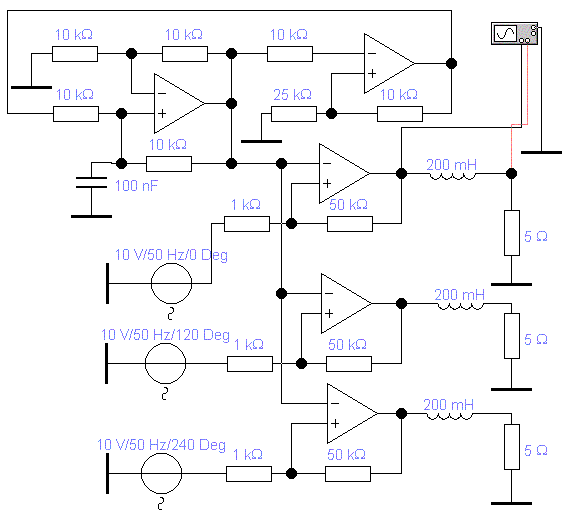
SPWM is commonly applied to switching topologies such as the H-bridge, which can drive the load in both polarities and so generate a full AC cycle. Adjusting the amplitude and frequency of the reference sine sets the magnitude and frequency of the synthesised output, which is how inverters and motor drives control speed and voltage. A simulation circuit lets these waveforms be observed: the sine reference, the carrier, the resulting modulated pulses and the filtered output, making the modulation process easier to understand than from equations alone.
Frequently asked questions
- How does sinusoidal PWM generate an AC waveform?
- It compares a sine reference with a high-frequency triangular carrier to make pulses whose widths vary sinusoidally; filtering leaves the underlying sine wave.
- What is the role of the carrier signal?
- The high-frequency triangular carrier sets the switching rate; its intersections with the sine reference determine when the switch turns on and off.
- Why is an H-bridge used with SPWM?
- An H-bridge can apply both positive and negative voltage to the load, allowing a full alternating output cycle to be synthesised from a DC supply.
|
|
|
|
|
|
| |
|