| |
PID Control
Proportional-integral-derivative (PID) control is the most widely used feedback control strategy in industrial automation. A PID controller continuously computes the difference between a desired setpoint and the measured process variable, then produces a correcting output by summing three contributions derived from that error. Because it requires no detailed mathematical model of the process, the PID controller can be applied to a vast range of tasks, including temperature regulation, flow and pressure control, motor speed and position control.
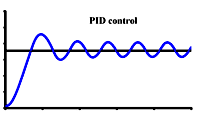
Each term shapes the response differently. The proportional term produces an output proportional to the present error, giving a fast reaction whose strength is set by the proportional gain; used alone it usually leaves a residual offset. The integral term sums the error over time, driving that steady-state offset to zero but tending to slow the loop and add overshoot if too strong. The derivative term responds to the rate of change of the error, anticipating future behaviour and damping oscillations, though it can amplify measurement noise. Many practical loops use only proportional and integral action.
Choosing the three settings is called tuning, and it determines whether the loop is fast, stable and accurate or sluggish and oscillatory. The Ziegler–Nichols method is a classic empirical approach: one technique increases the proportional gain until the loop oscillates steadily, records that critical gain and oscillation period, and applies tabulated rules to derive the settings. Modern controllers often add features such as anti-windup to limit integral accumulation and setpoint weighting to soften the response to abrupt command changes.
Frequently asked questions
- Why is the integral term needed?
- Proportional action alone usually leaves a small constant error. The integral term accumulates that error over time and adjusts the output until the steady-state offset is eliminated.
- What is the drawback of derivative action?
- Because it reacts to the rate of change of the error, the derivative term can greatly amplify high-frequency measurement noise, so it is often filtered or omitted.
- What is the Ziegler-Nichols method?
- It is an empirical tuning procedure that finds the gain at which the loop just oscillates, then uses standard formulas based on that critical gain and period to set the PID parameters.
|
|
|
PID Contol Systems
related subjects: Bus systems,
Hydraulics,
Motor speed
control, Pneumatics,
Power control,
Sensors |
|
Basic control theory
2 n introduction to automatic controls, The control of Heating, Ventilating
and Air Conditioning systems, Process control, control loops and dynamics. An
explanation of each component of a control system, including valves, actuators,
sensors and controllers; together with an introduction to methods of control and
system dynamics, including simple control loops and feedback systems |
|
Basic
structure of closed-loop systems Basic structure of closed-loop systems |
|
Control System Circuits with Opamps Difference Amplifier, Opamp Integrator,
Opamp Differentiator, Opamp Summer, Opamp Differentiator Circuit, pdf file |
|
Course on
Dynamics of multidisplicinary and controlled Systems |
|
Control systems
A control system is a dynamical system that affects the behaviour of another
system, feedback control device, control design algorithms, Block Diagrams and
PID Controllers, animated |
|
Design of PID Controllers using Ziegler Nichols Tuning PID controllers are
probably the most commonly used controller structures in industry. They do,
however, present some challenges to control and instrumentation engineers in the
aspect of tuning of the gains required for stability and good transient
performance, pdf file |
|
Empirical tuning rules according to Ziegler and Nichols |
| Feedback and
temperature control proportional, derivative, integral, on - off, third order
systems, simulation, introduction to the effects of feedback on systems using a PID temperature controller as a case study. An interactive simulation illustrating the case study is also provided,
Interactive Simulator |
|
Feedback
and Temperature Control |
|
Introduction to Closed-Loop Control In Open-Loop control, no feedback loop
is employed and system variations which cause the output to deviate from the
desired value are not detected or corrected. A Closed-Loop system utilizes
feedback to measure the actual system operating parameter being controlled such
as temperature, pressure, flow, level, or speed, pdf file |
|
Op Amp PID
Controller The Op Amp PID Controller, The PID controller takes this error
and determines the drive voltage applied to the process in an attempt to bring
Vset = Vsensor or Verr = 0 |
|
Op Amp PID
Controller The Op Amp PID Controller, Opamp based PID Controller Circuit,
Multipurpose Analog PID Controller, PID may be operated using a single opamp, or
a multiple opamp setup, pdf file |
| Open loop tuning rules Ziegler-Nichols, Cohen-Coon, Open Loop Tuning Rules,
Minimum ITAE, Closed Loop Tuning Rules, Ziegler-Nichols Stability Margin, Dale’s
Closed Loop PI Tuning Technique, pdf file |
|
Open loop
vs closed loop |
|
Optimizing Thermoelectric Temperature Control Systems pdf file |
|
PID control PID Control Features, Proportional Control, The integral
feedback loop, The differential feedback loop,
Educypedia |
| PID control explained very easy to
understand, controller tuning, loop tuning, PID, feed , forward control, feedback control, cascade control, digital control, ISA,
multivariable control, predictive control, dynamic modeling, process identification, process simulation,
PID Algorithm Code |
|
PID controller P -Proportional, I - Integral, D - Derivative |
|
PID Control of Continuous Processes PID (proportional-integral-derivative)
is an effective control system for continuous processes that performs two
control tasks, ... |
|
PID
control technical notes PID (Proportional-Integral-Derivative) control action allow the process control to accurately maintain setpoint by adjusting
the control outputs. This technical note will explain what PID is in practical terms |
|
PID Control Without Math If you need to design an optimized control loop for
a hardware control problem, consider trying a proportional integral derivative
(PID) controller, pdf file |
|
PID Controller
Tuning Tuning Kp, Tuning Ki, Tuning Kd |
|
PID
Motor Speed Control tachometer, PID controller, motor drive circuit, pdf file |
| PID tuning
PID controller, process control, tuning, chemical process |
| PID
tutorial for matlab open loop step response, proportional control, proportional derivative control,
proportional integral control, proportional integral derivative control |
| PI-regelaar pdf file, in Dutch |
|
Process control
virtual lab PID controller, controller tuning, Ziegler-Nichols, Cohen-Coon, pdf file |
|
Régulation
proportionnelle intégrale et dérivée en Français |
|
Ziegler-Nichols closed Loop tuning Ziegler-Nichols closed loop tuning, Ziegler Nichols methods |
| Ziegler Nichols PID tuning the open loop method allows to calculate PID parameters from the process parameters, Ziegler Nichols PID tuning |
|
|
Home
|
Site Map
|
Email: support[at]karadimov.info
Last updated on:
2026-06-24
|
Copyright © 2011-2021 Educypedia.
https://educypedia.org
|
| |
|
|