| |
Spectrum Analysis
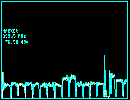
Spectrum analysis examines a signal in the frequency domain, showing how its power is distributed across frequency rather than how its amplitude varies over time. While an oscilloscope plots voltage against time, a spectrum analyzer plots amplitude against frequency, so a pure sine wave appears as a single spike and a complex signal as a collection of lines and bands. This view exposes features that are hard to see in the time domain, such as harmonics, spurious tones, noise and the sidebands produced by modulation.
The traditional swept-tuned spectrum analyzer works much like a tunable radio receiver. It mixes the incoming signal with a local oscillator whose frequency is swept across the band of interest, so that each part of the input spectrum in turn is translated to a fixed intermediate frequency where it passes through a narrow filter and is measured. The result is traced across the screen as the sweep proceeds. The width of that filter, called the resolution bandwidth, sets how closely spaced two signals can be and still be seen as separate; a narrower setting resolves finer detail but takes longer to sweep.
Spectrum analyzers are essential in radio-frequency and communications work. They are used to check that a transmitter occupies only its assigned channel, to measure harmonic and intermodulation distortion, to characterise noise, and to verify modulation. Many modern analyzers compute the spectrum digitally using the fast Fourier transform on sampled data, which suits lower-frequency and transient signals, while swept designs remain common at high frequencies. Either way the frequency-domain view complements time-domain measurement.
Frequently asked questions
- How does a spectrum analyzer differ from an oscilloscope?
- An oscilloscope shows amplitude against time, while a spectrum analyzer shows amplitude against frequency, revealing harmonics, noise and modulation sidebands not obvious in the time domain.
- What is resolution bandwidth?
- It is the width of the analyzer's measurement filter, which determines how close two signals can be and still be distinguished. A narrower setting resolves finer detail but sweeps more slowly.
- What are spectrum analyzers used for?
- They check transmitter occupied bandwidth, measure harmonic and intermodulation distortion, characterise noise and verify modulation, making them central to radio-frequency testing.
|
|
Spectrum analysis, Spectrum Analyzer  |
|
BASICS OF
THE SPECTRUM ANALYZER This document contains some general information about
spectrum analyzers, and some specific information about the spectrum analyzers you have available in the lab, pdf file |
|
Bluetooth RF Measurement Fundamentals Bluetooth RF Measurement Fundamentals,
Bluetooth radio unit, Bluetooth link control unit and link management, Bluetooth
RF test suite structure, Receiver Measurements, Test conditions and setup,
Sensitivity - single-slot packets, Sensitivity - multi-slot packets, EDR
sensitivity, ..., pdf file |
|
Cable Television System Measurements Handbook, NTSC Systems This handbook
refreshes the measurement concepts and updates the use of the modern spectrum
analyzer for making proof-of-performance measurements such as signal frequency,
signal level, noise, interference, ingress, co-channel interference, low
frequency and coherent disturbances, distortion, channel frequency response,
depth of modulation, system frequency response and interference outside the
system, pdf file |
|
Cable
Television System Measurements Handbook, PAL and SECAM Systems Cable
Television System Measurements Handbook, PAL and SECAM Systems, pdf file |
|
Cable TV
Analyzer pdf file |
|
Digital modulation:
application notes |
|
EMI Measurements, Test
Receiver vs. Spectrum Analyzer Spectrum Analyzer |
|
Exploring the Architectures of Network Analyzers Network Analyzers |
|
FCC Regulations for ISM Band Devices: 902 - 928 MHz |
|
Frequency spectrum QAM signal The spectrum analyzer, like an oscilloscope,
is a basic tool used for observing signals. Where the oscilloscope provides a
window into the time domain, the spectrum analyzer provides a window into the
frequency domain |
|
IEEE 802.11
Wireless LAN PHY Layer (RF) Operation and Measurement pdf file |
|
Measurements on
Transmission Lines Power and Attenuation Measurements, Power Measurement
with a Power Meter and Power Sensor, Power Measurement with a Spectrum Analyzer,
Measurement of Cable Loss with Power Meter, Measurement of Cable Loss with
Spectrum Analyzer and Signal Generator, Measurement of Cable Loss with Spectrum
Analyzer and Tracking Generator, Use of the Directional Coupler for the
measurement of Direct Power, Reflected Power and SWR, Measurement of Direct
Power, Reflected Power and SWR with Signal Generator, Power Meter and
Directional Coupler, Use of the SWR meter for the measurement of SWR, Measures
of Impedance of a Coaxial Cable, Measurement of the characteristic impedance of
a coaxial cable with a TDR, Location of a disturbance along a coaxial cable with
a TDR, pdf file |
|
Measuring Return Loss
This application note contains the basic operating procedures needed to help
engineers measure return loss using the spectrum analyzer |
|
MEASURING THE PEAK-TO-AVERAGE
POWER OF DIGITALLY MODULATED SIGNALS Digital Vector Modulation, pdf file |
|
Phase Noise Concepts pdf file |
|
Power
Measurements on DOCSIS Downstream QAM Signals |
|
Real-Time Spectrum Analysis for WLAN
Real-Time Spectrum Analysis for WLAN, pdf file |
|
Spectrum Analyzer
Tutorials This site is intended to explain the fundamentals of swept-tuned,
superheterodyne spectrum analyzers and discuss the latest advances in spectrum
analyzer capabilities, Spectrum Analyzer Fundamentals, Digital IF Overview,
Amplitude and Frequency Accuracy, Sensitivity and Noise, Dynamic Range,
Extending the Frequency Range, Modern Spectrum Analyzers |
|
Spectrum
analysis modulation
is the act of translating some low-frequency or base-band signal (voice,
music, data) to a higher frequency, amplitude modulation, frequency
modulation, phase modulation, pdf file |
|
Spectrum Analysis Basics This paper is intended to be a beginning tutorial
on spectrum analysis. It is written for those who are unfamiliar
with spectrum analyzers, and would like a basic understanding of how they work,
what you need to know, ..., pdf file |
|
Spectrum Analysis Basics What is a Spectrum? Why measure spectra? The
Superheterodyne Spectrum Analyzer, Tuning Equation, Resolution, Analog Filters,
Digital Filters, Residual FM, Phase Noise, Sweep Time, Analog Resolution
Filters, Digital Resolution Filters, Envelope Detector, Display Smoothing, Video
Filtering, Video Averaging, Amplitude Measurements, CRT Displays, Digital
Displays, Absolute Accuracy, Improving Overall Uncertainty, Sensitivity, Noise
Figure, Preamplifiers, Noise as a Signal, Preamplifier for Noise Measurements,
Dynamic Range, Definition, Dynamic Range versus Internal Distortion, Attenuator
Test, Noise, Dynamic Range versus Measurement Uncertainty, Mixer Compression,
Superheterodyne Spectrum Analyzer |
|
Spectrum Analysis Basics |
|
Spectrum Analysis Basics
Spectrum Analysis Basics application note, pdf file |
|
Spectrum Analyzer Measurements and Noise Spectrum Analyzer Measurements and
Noise, Simple noise, Baseband, Real, Gaussian, Bandpassed noise, I and Q,
Measuring the power of noise with an envelope detector, Logarithmic processing,
Measuring the power of noise with a log-envelope scale, Equivalent noise
bandwidth, The noise marker, pdf file |
|
Using a
Spectrum Analyzer Obtain Power Measurements of a DOCSIS Downstream Signal
Using a Spectrum Analyzer |
|
WLAN SPECTRUM ANALYZERS |
|
|
Home
|
Site Map
|
Email: support[at]karadimov.info
Last updated on:
2026-06-24
|
Copyright © 2011-2021 Educypedia.
https://educypedia.org
|
| |
|
|