|
| |
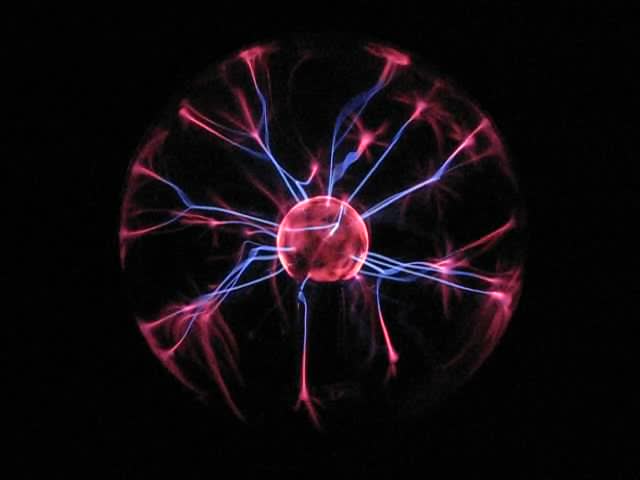
The plasma globe
A plasma globe is a clear glass sphere containing a mixture of low-pressure inert gases, with a small electrode at its centre. When the device is powered, a high-voltage, high-frequency signal applied to the central electrode ionises the gas, producing thin, branching filaments of coloured light that reach from the centre toward the glass. These tendrils shift and dance, and the effect is both a popular novelty object and a simple demonstration of how electric fields and ionised gases behave.
The filaments form because the strong, rapidly alternating electric field around the electrode strips electrons from the gas atoms, creating a conductive plasma. Current flows along the paths where ionisation is easiest, and the excited gas atoms emit light as they return to lower energy states; the colours depend on the particular gases used. The high frequency of the drive allows the energy to couple through the glass without a return wire, which is why touching the outside of the globe concentrates the filaments toward the finger: the hand provides a more favourable path for the field.
Because a plasma globe operates at high voltage, it should be treated with care, and it can interfere with nearby sensitive electronics through the electromagnetic field it radiates. As a teaching tool it neatly illustrates ionisation, electric fields and gas discharge, the same physics that underlies neon signs, fluorescent lamps and other gas-discharge devices.
Frequently asked questions
- What creates the moving filaments in a plasma globe?
- A high-voltage, high-frequency signal on the central electrode ionises the gas into a plasma. Current flows along the easiest paths, and the excited gas emits light, forming shifting filaments.
- Why do the filaments follow a finger touching the glass?
- A hand on the outside provides a more favourable path for the electric field, so the ionised filaments concentrate toward the point of contact.
- What physics does a plasma globe demonstrate?
- It illustrates ionisation of gases, electric fields and gas discharge, the same principles that operate in neon signs and fluorescent lamps.
|
|
Plasma globes  |
|
Creation of Plasma
Background on Lightning and Plasma, pdf file |
|
Flyback Drivers
solid state flyback driver based on a micro solid-state Tesla coil circuit |
|
Home built plasma globe |
|
How to build your glow
discharge plasma panel |
|
How
to make a plasma globe? How to make a plasma globe with flyback transformer
and a light bulb at home? |
|
Lightbulb plasma globe
Lightbulb Plasma globe |
|
Lightbulb plasma globes |
|
Lightbulb plasma globes |
|
Make your own plasma globes
the plasma globe, or inert gas discharge tube, as Nikola Tesla (it's inventor) first called it, is perhaps one of the
most beautiful manifestations of plasma. Also known as "Plasma Spheres",
"Lightning Globes", "Thunder Domes",
Educypedia |
|
Make your
own plasma globe |
|
Plasma
The fourth state of matter |
|
Plasma Ball
Just how do those plasma things work? |
|
Plasma Display
Documentation Can I make a plasma display from a normal light bulb? |
|
Plasma
generator Plasma generator, flyback transformer, pdf file |
|
Plasma globe
DIY Plasma Globe |
|
Plasma Globe Colors |
|
Plasma Globe
Power Supplies Plasma Globe Power
Supplies |
|
Plasmoid ( Ball
Lightning ) generation with Microwaves |
|
Plasma display
documentation Plasma Displays & Inert Gas Discharge Tubes (IGDT), pdf file |
|
Teralab
Glass Blowing for Vacuum Devices This section describes methods for working
glass for scientific vacuum devices such as glow tubes, filament lamps and
thermionic devices. It is a record of the approaches which I have taken and the
problems which I faced. The articles below apply to soda-lime glass |
|
|
 |
|
|
Home
|
Site Map
|
Email: support[at]karadimov.info
Last updated on:
2026-06-24
|
Copyright © 2011-2021 Educypedia.
https://educypedia.org
|
| |
|
|
| |