| |
Audio Amplifier Classes
Amplifier classes describe how the active devices in a power amplifier conduct over each cycle of the input signal. The classification turns on the conduction angle — the fraction of the input cycle during which an output device passes current — and on whether the device acts as a continuously variable element or as a switch. These choices set the fundamental trade-off between linearity, which keeps distortion low, and efficiency, which determines how much supply power is wasted as heat.
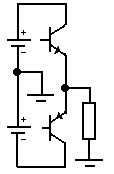
In a Class A amplifier the output device conducts for the entire cycle. This gives very low distortion but poor efficiency, because the device dissipates power even with no signal. A Class B stage uses two devices, each conducting for half the cycle, which improves efficiency but introduces crossover distortion at the handover point. Class AB is the common compromise: each device conducts for slightly more than half the cycle, nearly eliminating crossover distortion while remaining far more efficient than Class A. Class C conducts for less than half the cycle and is highly efficient but very non-linear, so it is used for radio-frequency rather than audio amplification.
Switching designs take a different approach. A Class D amplifier rapidly switches its output devices fully on or off and uses pulse-width modulation followed by a low-pass filter to reconstruct the audio, achieving high efficiency and little heat, which suits compact and battery-powered equipment. Class E is a specialised high-efficiency switching topology used mainly in radio-frequency power applications rather than for general audio.
Frequently asked questions
- Why is Class A amplification so inefficient?
- The output device conducts current throughout the whole signal cycle, even with no input, so it constantly dissipates power as heat regardless of the signal level.
- What is crossover distortion?
- It is the distortion that occurs in Class B amplifiers at the moment one output device hands over to the other near the zero-crossing of the waveform. Class AB biasing largely removes it.
- Why are Class D amplifiers so efficient?
- Their output devices act as switches that are either fully on or fully off, so they dissipate little power. The audio is recovered by filtering the switched waveform.
|
|
Amplifiers classes:  |
|
Amplifiers classes ppt file |
|
Amplifier classes simulation of class D amplifier included |
|
Amplifier classes
Amplifiers are classified according to their circuit configurations and methods
of operation into different classes such as A, B, C, and F. These classes range
from entirely linear with low efficiency to entirely non-linear with high
efficiency, pdf file |
|
Amplifier
design ppt file |
|
Amplifier
output stage Class A, class B, class C, pdf file |
| Class E RF power
amplifiers |
|
Class-I amplifier pdf file |
| Class T
digital audio
amplifiers class T digital audio
amplifiers application notes |
|
MOSFET "switched
mode" amplifiers Class D,E,F, MOSFET "switched mode" amplifiers,
pdf file |
|
MOSFET "switched
mode" amplifiers 2 Class D,E,F, MOSFET "switched mode" amplifiers,
pdf file |
|
Power switched mode amplifiers: introduction |
|
|
|
Amplifiers classes: A and AB |
|
Class A amplifiers ppt file |
|
Class A amplifiers |
|
Class A amplifiers
class A amplifiers,
class A power amplifiers |
|
Class A amplifiers explained
Class A amplifiers explained |
|
Class AB amplifiers
rubber diodes, class AB amplifiers, the basic ‘rubber zener’ arrangement, Quiescent Current |
|
Push-Pull
Transistor Amplifier Class A Amplifier
Class A, AB transistor amplifier design class A transistor
amplifier design, pdf file |
| |
|
Amplifiers classes: B |
|
Amplificateur classe B
en Français |
|
Class B
amplifier Push-pull amplifier biased using two diodes |
|
Class B Amplifier and Driver Class B Amplifier and Driver, pdf file |
|
Class
B Amplifier Efficiency Push-pull Class B ampli¯ers are used in linear
high-powered stages because of their greater efficiency, pdf file |
|
Class B
BJT amplifiers pdf file |
|
Class
B Switch-Mode Assisted Linear Amplifier pdf file |
|
Push-Pull Amplifier Transformers |
|
Push-pull type class-B amplifier |
| |
|
Amplifiers classes: C |
| |
|
Amplifiers classes: D |
|
Class
D
amplifiers |
| Class D
amplifier pdf file |
| Class
D
amplifiers a class-d amplifier uses Pulse Wide Modulation PWM (sometimes referred to as pulse duration modulation) |
|
Class
D
amplifiers pdf file |
|
Class D Audio
Amplifier Basics
What is a Class D Audio Amplifier? – Theory of Operation,
Topology Comparison – Linear vs. Class D, Analogy to a Synchronous Buck
Converter, Power Losses in the MOSFETs, Half Bridge vs. Full Bridge, Major Cause
of Imperfection, THD and Dead Time, Audio Performance Measurement, Shoot Through
and Dead Time, Power Supply Pumping, EMI Consideration: Qrr in Body Diode, pdf file |
|
Class D Audio
Amplifier Performance Relationship to MOSFET Parameters Key MOSFET
Electrical Parameters in Class D Audio Amplifiers, International Rectifier
Digital Audio MOSFET, This application note discusses key parameters to be
considered in the selection of MOSFETs for class D amplifier and their relationship with amplifier performance
such as efficiency, EMI, and THD. In addition, benefits and advantages of IR
Digital Audio MOSFETs in class D audio amplifier are presented, pdf file |
|
Class D Amp Principles Class D Amp
Principles, pdf file |
|
Class-D audio
amplifier The TDA8929T is the controller of a
two-chip set for a high efficiency class-D audio power amplifier system,
pdf file |
|
Class D Audio
Amplifier Design Class D Audio Amplifier Design, Class D Amplifier
Introduction, Gate Driver, MOSFET Package, Design Example, Theory of Class D
operation, topology comparison, How to drive the gate, key parameters in gate
drive stage, How to choose, tradeoff relationships, loss calculation, pdf file |
|
Class D audio amplifiers save battery life
examines the operation and benefits of a Class D (switch-mode) audio amplifier.
Switch-mode amplifiers such as the mono MAX4295 and stereo MAX4297 offer high
quality audio with improved efficiency when compared to traditional linear audio
amplifiers (Class A, Class B, and Class AB). This application note covers
efficiency calculations and output filter design for Class D amplifiers, Educypedia |
| Class D audio
amplifier output filter optimization
class D audio
amplifier output filter optimization |
|
Class D Audio Design Tips pdf file |
|
Class-D Audio Power Amplifier |
|
Class D SwitchFilter Class D
SwitchFilter design,
pdf file |
|
Delta Sigma Audio Power Amplifier (class D amplifier),
pdf file |
|
Design and analysis of a
basic class D amplifier The operating principle is based
on switching transistors that are either fully turned on or fully turned off for
a very short period of time. Both transistors are never turned on at the same
time and hence very little heat is generated. This type of amplifier is highly
efficient (around 95 percent). In the ideal case, it would be 100 percent
efficient, whereas class AB amplifiers can only achieve 78.5 percent. On the
other hand, the switching operation adds distortion to the output, ... |
|
Designing
Practical High Performance Class D Audio Amplifier The latest Digital Audio
MOSFET, DirectFET® MOSFET, Designing Dead-time and Overload, Protection with
Digital Audio Gate, Driver IC, pdf file |
| Klasse D
versterker in een klasse D
versterker wordt vermogen gegenereerd door het moduleren van de duty-cycle
verhouding van een rechthoek-signaal van een schakelende converter,
in Dutch |
|
Spread-Spectrum-Modulation Mode Minimizes Electromagnetic Interference in Class
D Amplifiers |
| Switching audio
amplifiers using TMOS power MOSFET's pdf file |
|
Switch mode multilevel (Class D) power amplifier pdf
file |
|
Some amplifier integrated circuits
related topic: Amplifier circuits |
|
EB-TA2024 2x15W class T digital audio amplifier evaluation board
pdf file |
|
MAX4295, MAX4297 mono/stereo, 2W, switch-mode (Class-D) audio power amplifiers |
|
TAS5110 - 50W amplifier, 4 Ohm class D amplifier |
|
TA2041A FOUR CHANNEL CLASS-T DIGITAL AUDIO AMPLIFIER TDA2041, pdf file |
|
|
Home
|
Site Map
|
Email: support[at]karadimov.info
Last updated on:
2026-06-24
|
Copyright © 2011-2021 Educypedia.
https://educypedia.org
|
|
|