|
| |
Bipolar Junction Transistors
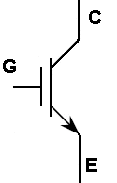
A bipolar junction transistor (BJT) is a three-terminal semiconductor device that can amplify signals or act as an electronic switch. It is formed from three regions of doped semiconductor arranged as either NPN or PNP, giving it two junctions. The three terminals are the base, the collector and the emitter. A small current flowing into the base controls a much larger current flowing between the collector and the emitter, and this current-controlling action is what makes the transistor so useful.
In an NPN transistor a small base current allows a larger collector current to flow, and the ratio between them is the device’s current gain. Used as an amplifier, the transistor turns a small varying input current into a larger copy at the output, the basis of audio and radio-frequency amplification. Used as a switch, it is driven either fully on or fully off, so that a small control signal can turn a much larger load on and off, as in logic circuits and relay drivers.
The behaviour of a bipolar transistor depends on the small forward voltage needed to turn on its base-emitter junction and on its current gain, both of which vary with the device and with temperature. Bipolar transistors are valued for their ability to handle current and for good high-frequency performance. They contrast with field-effect transistors, which are controlled by a voltage rather than a current; both types are fundamental building blocks of modern electronic circuits.
Frequently asked questions
- What are the three terminals of a bipolar transistor?
- They are the base, the collector and the emitter. A small current into the base controls the much larger current that flows between the collector and the emitter.
- What is the difference between NPN and PNP?
- They are the two arrangements of the transistor’s semiconductor regions. They operate with opposite polarities of voltage and current, but both control a large current with a small base current.
- How does a transistor work as a switch?
- The transistor is driven either fully off, blocking current, or fully on, conducting freely. This lets a small control signal turn a much larger load on and off.
|
|
Bipolar junction transistors  related topic: Transistor circuits
 |
| Bipolar junction transistors
Structure and principle of operation of a npn bipolar junction transistor, BJT, NPN bipolar transistor and PNP bipolar
transistor, Transistor Operation (NPN), Basic Circuit Configurations,
Small-Signal Models, Ideal and Perfect Bipolar Transistor Models,
Transconductance Model |
|
Bipolar junction transistors
ppt file |
| Bipolar junction transistors
a bipolar transistor uses a small current to control a larger current, a little like a relay. Bipolar transistors generally have 3 terminals. The control
terminal is called the base. The other 2 terminals are known as the emitter and the collector and they carry virtually all of the current flowing through the
transistor |
| Bipolar
junction transistors how transistors work, pdf file |
|
Darlington Transistors how Darlington Transistors work |
|
BJT Basics how transistors work, pdf file |
|
Komplementär darlington transistor schaltung in German |
| Courbes
caractéristiques d'un transistor 1 en Français |
| Courbes
caractéristiques d'un transistor 2 en Français |
| Courbes
caractéristiques d'un transistor 3 en Français |
|
Gate drive
characteristics and requirements for HEXFET power MOSFETs pdf file |
|
Inside RF Power
Transistors Inside RF Power Transistors, The purpose of this application
note is to show some of the chip level design considerations and technical
details for Ericssons bipolar RF Power transistors, pdf file |
| Power MOSFETs
and high voltage bipolar transistors pdf file |
|
Power Transistor Safe
Operating Area Special Considerations for Switching Power Supplies, The
power transistor, in today’s switching power supply, exists in an environment
which is quite hostile to semiconductors. Large currents, large voltages, high
temperature, high frequency, and low impedance sources add up to something close
to the worst of all possible worlds for the transistor, ..., pdf file |
|
Transistor
bipolaire en Français |
| Transistor
bipolaire en Français, pdf file |
| Transistor
en Français |
|
Transistor
en Français |
| Transistor
in Dutch, pdf file |
| Transistors
three-terminal, solid-state electronic device used for amplification and
switching |
| Transistors
transistor tutorials |
| |
|
Phototransistor technology
related topics: Optics, Transistor circuits |
|
Design Fundamentals for
Phototransistor Circuits Design Fundamentals for Phototransistor Circuits,
pdf file |
|
Optocoupler Input Drive
Circuits pdf file |
|
Photodiode/Phototransistor Application Circuit Photocurrent Amplifier
Circuit using Transistor, pdf file |
|
Using Surface Mount
Phototransistor Optical Interrupter Switch
pdf file |
|
vbpw77 Application
Note |
|
|
Home
|
Site Map
|
Email: support[at]karadimov.info
Last updated on:
2026-06-24
|
Copyright © 2011-2021 Educypedia.
https://educypedia.org
|
| |
|
|
| |