| |
Laser Technology
A laser is a device that produces a narrow, intense beam of light that is coherent, meaning its waves are in step in both phase and direction. The word is an acronym for light amplification by stimulated emission of radiation, which names the physical process at its heart. When an excited atom is struck by a photon of the right energy, it can be stimulated to emit a second, identical photon. This cascade amplifies the light, producing the characteristic coherent, nearly single-colour output.
Three ingredients are needed for laser action. A gain medium, which may be a gas, a crystal, a dye or a semiconductor, provides the atoms that emit light. An energy source, called the pump, raises those atoms to an excited state until more are excited than not, a condition known as population inversion that is essential for net amplification. Finally an optical cavity, usually formed by two mirrors, reflects the light back and forth through the gain medium to build up the beam, with one partially transparent mirror letting some light out.
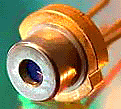
In electronics the most common type is the semiconductor laser diode, a tiny chip in which population inversion is created by passing current through a specially structured junction. Laser diodes are compact, efficient and easily modulated, which makes them the light sources in fibre-optic communication links, optical disc drives, laser printers and barcode scanners. Their pairing with photodiode optical receivers forms the basis of modern high-speed data transmission over glass fibre.
Frequently asked questions
- What does stimulated emission mean?
- It is the process where an incoming photon prompts an excited atom to emit a second, identical photon. Repeated many times this amplifies light into a coherent beam.
- What is population inversion?
- It is the state where more atoms in the gain medium are excited than are in their lower energy state. Without it the medium would absorb rather than amplify light.
- Where are laser diodes used?
- Semiconductor laser diodes serve as light sources in fibre-optic links, optical disc drives, laser printers and barcode scanners, owing to their small size and easy modulation.
|
|
Laser
technology  related subject: Physics: the theoretical
aspects of lasers
related subject: Physics: the theoretical
aspects of lasers |
| Amateur laser
construction |
|
How laser shows work a brief and basic explanation of how laser display systems produce the exciting
effects we all love |
|
ILDA standards |
|
ILDA standards |
|
ILDA Image
Data Transfer Format
The International Laser Display Association has
developed an “image data transfer” format, used to exchange frames between
systems. You can obtain frames from any program with an ILDA conversion program,
and transparently load them directly into any system that supports ILDA standard
frames,
pdf file |
|
Laser Introduction to lasers and laser electronics, Stimulated emission
devices LASERS,
pdf file |
| Laser
communications communication using lasers, a tip |
|
Laser Diode Characteristics Measuring Diode Laser Characteristics |
|
Laser
diode emission control Precision method for laser diode emission control |
| Laser diode optics
laser diode optics |
|
LASER DIODE TO FIBER
COUPLERS
pdf file |
|
Laser microphone to detect sound within a room (having an outside window) at a distance. The principle being that sound vibrations will cause the window
glass to move sufficient to deflect the LASER beam across the receiving photo detector |
| Laser modulation and other stuff
Light Amplification by Stimulated Emission of Radiation |
|
Laser Printer
Laser Printer |
|
Laser projector |
| Lasers
a practical guide to lasers for experimenters and hobbyists, basic laser principles, laser safety, general laser information, laser instruments and
applications, laser and parts sources, laser experiments and projects, a tip
a tip a tip
|
|
Lasers
Nature of Light, the processes of Absorption and Emission of Light, the
processes of Amplification of Light and The Laser, common Types of Laser,
Intrinsic Semiconductors, Extrinsic Semiconductors |
|
Laser technology
photonics experiments, optics experiments |
| Laser
instruments and applications |
|
Light-Emitting
Diodes (LED)
Emission of Light by Semiconductor Diodes, LED's & lasers,
Basic Semiconductor Laser Design, Structures of Laser Diodes, Temperature
Dependence of Laser Output, Mounting and Cooling of Laser Diodes, Spectral
Characteristics, Spatial Characteristics, Quantum Wells Laser, laser pointer |
|
Optoelectronic devices |
| Sam's
laser FAQ |
|
Semiconductor laser diodes semiconductor laser diodes |
|
Semiconductor lasers
Principles of the Semiconductor LASER, LASER
conditions, Interaction of Light and Electrons and Inversion, Light
Amplification in Semiconductors, From Amplification to Oscillation: Second Laser
Condition, Specific Topics, Turning on a Laser Diode, Laser Modes |
|
Semiconductor lasers
pdf file |
|
Semiconductor lasers
the semiconductor laser is a laser in which semiconductor serves as photon source. Semiconductors (typically direct band-gap semiconductors) can be used as small,
highly efficient photon sources. Such semiconductor photon sources find
application in displays, optical storage, communications, printing, surveying,
and as small efficient optical pumps for other optical processes |
|
Types
of Lasers Gas, Liquid and Solid Lasers, Excimer Lasers |
|
|
Home
|
Site Map
|
Email: support[at]karadimov.info
Last updated on:
2026-06-24
|
Copyright © 2011-2021 Educypedia.
https://educypedia.org
|
| |
|
|