| |
Polymer light-emitting diodes (PLEDs)
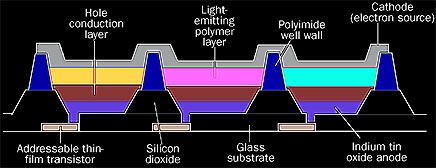
A polymer light-emitting diode (PLED) is a type of light-emitting device in which the active material that produces light is a conductive polymer rather than the small organic molecules used in many other organic LEDs. The light-emitting polymer, sometimes abbreviated LEP, is sandwiched between two electrodes; when current is driven through it, the material emits light by electroluminescence. PLEDs are therefore a subclass of organic light-emitting diode technology, distinguished by their polymer-based emissive layer.
The appeal of polymers lies in how they can be processed. Because suitable polymers can be dissolved and deposited from solution, PLED layers can in principle be applied using printing or coating techniques over large areas, which could make manufacturing cheaper and more scalable than methods that evaporate small molecules in a vacuum. Like other organic emissive displays, PLEDs generate their own light, so they need no backlight and can be made thin and potentially flexible, with wide viewing angles and good contrast.
PLED technology sits alongside small-molecule OLEDs and the active-matrix variants such as AMOLED used in many screens. It is also distinct from the liquid-crystal display, which does not emit light itself but modulates a backlight. Research and development have focused on improving the efficiency, colour range and operating lifetime of the emissive polymers, factors that determine how well the technology competes for use in displays and lighting.
Frequently asked questions
- What makes a PLED different from a standard OLED?
- A PLED uses a light-emitting polymer as its emissive layer, whereas many OLEDs use small organic molecules. Both produce light by electroluminescence and emit their own light without a backlight.
- Why are polymers attractive for displays?
- Suitable polymers can be deposited from solution, opening the door to printing or coating over large areas, which can make manufacturing cheaper and more scalable than vacuum-based methods.
- Do PLEDs need a backlight?
- No. Like other organic light-emitting devices, PLEDs emit their own light, so they require no backlight and can be made thin and potentially flexible.
|
|
PLEDS technology  |
|
Active-matrix polymer light-emitting displays (AMPLED) Active-matrix polymer
light-emitting displays (AMPLED),
pdf file |
|
Capacitance–voltage characterization of polymer light-emitting diodes
pdf file |
|
pFED -
A Viable Route to Large Field Emission Displays Field Emission Displays |
|
Photonic devices
of conjugated polymers Photonic devices of conjugated polymers |
|
PLED
pled manufacturing process,
polymer light emitting diodes display,
pdf file |
|
PLED How works OLED Display Technology, How works Pled Display Technology |
|
PLEDS
polymer light emitting diodes display, How PLEDS work - Device Structure, Active
and Passive Matrix, How PLEDS work - Chemistry, How PLEDS work - Device
Structure |
|
PLEDS
pdf file |
|
PLED Technology |
|
Polymeric Integrated Circuits and Light-Emitting Diodes
Polymeric Integrated Circuits and Light-Emitting Diodes,
pdf file |
|
Polymer Light Emitting Diodes Interface formation between metal and polymer
in Polymer Light Emitting Diodes |
|
Polymer Liquid Crystal Tutorial
discovery and development of polymer light emitting diodes (PLEDs), PLED
display consists of polymer material manufactured on a substrate of glass or
plastic, and does not require additional elements such as backlights, filters
and polarizers, ... |
|
Polymer Semiconductor
Development for Thin Film Transistors
pdf file |
|
Rheology and Processing of Light Emitting Polymer (LEP) Solutions LEPs
belong to a special class of polymers called conjugated polymers, ... |
|
What's PLED ? PLEDs is Polymer Light Emitting Diodes which include a Light
Emitting Polymer instead of a ceramic semiconductor (LED), ... |
|
LEP technology |
|
Light-Emitting Polymer (LEP)
pdf file |
|
Light-Emitting Polymer (LEP) Basics
Light-Emitting Polymer LEP,
LEP technology promises thin, lightweight emissive displays with low drive
voltage, low power consumption, high contrast, wide viewing angle, and fast
switching times, ... |
|
Light-emitting polymer technology Light-emitting polymer technology, LEP
technology promises thin, lightweight emissive displays with low drive voltage, low power consumption, high contrast, wide
viewing angle, and fast switching times |
|
Semiconducting Polymers on Display |
|
|
|
SED Display technology |
|
A closer look at SED, FED technologies field emission display (FED),
SED display, Surface-conduction Electron-emitter Display, pdf file |
|
SED display
SED display, Surface-conduction Electron-emitter Display |
|
SED Tv Technology
The core of the SED is the electron emission element (an SCE), made from an
ultra-thin electron emission film a few nanometers thick provided between two
electrodes, Surface-conduction Electron-emitter DisplayPhosphor, pdf file |
|
Surface conduction Electron emitter Display The flat panel display
technology that employs surface conduction electron emitters for every
individual display pixel can be referred to as the Surface-conduction
Electron-emitter Display (SED). Though the technology differs, the basic theory
that the emitted electrons can excite a phosphor coating on the display panel
seems to be the bottom line for both the SED display technology and the
traditional cathode ray tube (CRT), ..., pdf file |
|
|
 |
|
|
Home
|
Site Map
|
Email: support[at]karadimov.info
Last updated on:
2026-06-24
|
Copyright © 2011-2021 Educypedia.
https://educypedia.org
|
| |
|
|