|
|
|
|
|
| |
ADSL and VDSL
ADSL, short for Asymmetric Digital Subscriber Line, is a technology that carries high-speed digital data over the ordinary copper telephone wires already installed in homes and businesses. It works by using frequencies above those needed for voice calls, so a single line can carry both a telephone conversation and a data connection at the same time. A small filter, or splitter, separates the voice and data signals so they do not interfere with each other.
The “asymmetric” part of the name refers to the fact that the downstream rate, data flowing toward the user, is faster than the upstream rate flowing back to the network. This suits common activities such as web browsing and downloading, where most data travels toward the user. Achievable speeds fall off as the distance from the telephone exchange increases, because the signal weakens over long copper runs, so subscribers closer to the exchange generally get higher rates.
VDSL, or Very-high-bit-rate Digital Subscriber Line, is a faster member of the same DSL family, and its later version VDSL2 raises speeds further. It achieves higher rates by using a wider range of frequencies, but it is more sensitive to distance, so it is typically deployed where fibre reaches a nearby street cabinet and only a short copper run remains. The term cable modem is sometimes used loosely for the box that terminates a broadband line, though true cable modems run over coaxial cable television networks rather than telephone wiring.
Frequently asked questions
- Why is ADSL called asymmetric?
- Because the download speed is higher than the upload speed, matching typical home use where more data is received than sent.
- Can I use the phone and ADSL at the same time?
- Yes. ADSL uses frequencies above the voice band, and a splitter separates the two so calls and data work simultaneously.
- How does VDSL differ from ADSL?
- VDSL uses a wider frequency range for higher speeds but works only over shorter distances, so it is usually paired with fibre reaching a nearby cabinet.
|
|
ADSL-VDSL Technology  related subjects:
Digital modulation techniques,
Networking,
RF-electronics, TCP/IP
related subjects:
Digital modulation techniques,
Networking,
RF-electronics, TCP/IP |
|
ADSL Basics (DMT) pdf file |
|
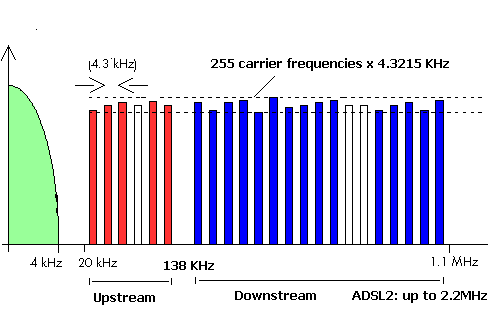
ADSL frequency spectrum Frequency allocation |
|
ADSL
modem - internet configuration the 4 variants or options that one has when
connecting a home or small office network to the Internet via an ADSL or Cable
modem |
|
ADSL technology |
|
ADSL transmission applet
Java applets simulate here ADSL-like transmissions ... Basically ADSL uses
multiple carrier modulation : multiple QAM (Quadrature Amplitude modulation) |
|
ADSL
tutorial asymmetric digital subscriber line (ADSL) is a new modem technology that converts existing twisted-pair telephone lines into access
paths for high-speed communications of various sorts |
|
ADSL2
tutorial Asymmetric Digital Subscriber Line (ADSL), a modem technology, converts existing twisted-pair telephone lines into access paths for
multimedia and high-speed data communications |
|
ADSL tutorial
ADSL transmits more than 6 Mbps to a subscriber, and as much as 640 kbps more in both directions |
| ADSL:
tutorial the essential concepts involved in making an ADSL connection to the internet,
pdf file |
|
Asymmetric Digital Subscriber Line (ADSL) Asymmetric digital subscriber line (ADSL) is a new modem technology that converts existing twisted-pair telephone
lines into access paths for high-speed communications of various sorts |
|
Cable Technologies |
|
Digital Subscriber Line (DSL)
Asymmetric Digital Subscriber Line, ADSL Capabilities, ADSL Technology,
Signaling and Modulation, CAP and DMT Modulated ADSL, ADSL Standards and
Associations, Additional DSL Technologies, SDSL, HDSL, HDSL-2, G.SHDSL, ISDN
Digital Subscriber Line, VDSL |
|
Digital Subscriber Line (DSL) VDSL is the highest-rate DSL technology available. Running at speeds of up to 52 Mbps, VDSL is the next
generation of DSL, with higher throughput and simpler implementation
requirements than ADSL, pdf file |
|
Digital Subscriber
Lines and Cable Modems residential broadband networking, including ADSL,
HDSL, VDSL, RADSL, cable modems, pdf file |
|
Setting up a wireless network
4 steps to set up your home wireless network, Choose your wireless equipment,
Connect your wireless router, Configure your wireless router, Connect your
computers |
|
The Splitter in
DSL Applications The Splitter in DSL Applications, pdf file |
|
VDSL Technology
related subjects:
Digital modulation techniques,
Networking,
RF-electronics, TCP/IP |
|
DSL Technology
Evolution ADSL2/ADSL2plus/ADSL-RE/VDSL2, pdf file |
|
ICT Regulation
Toolkit |
|
Standard VDSL Technology Overview of European (ETSI), North American
(T1E1.4) and International (ITU-T) VDSL standard development, pdf file |
|
Telecommunications Networks with VDSL2 VDSL2 (Very-High-Bit-Rate Digital
Subscriber Line 2), G.993.2, is the newest and most advanced standard of xDSL
broadband wireline communications. Designed to support the wide deployment of
Triple Play services such as voice, video, data, high definition television
(HDTV) and interactive gaming, VDSL2 enables operators and carriers to
gradually, flexibly, and cost efficiently upgrade existing xDSL-infrastructure,
... |
|
VDSL:
Introduction to VDSL System VDSL System allows fastest data transmission
among DSL technologies, pdf file |
|
VDSL2: taking the wire to the limit |
|
VDSL2 technology ADSL2plus is currently being deployed worldwide as the new
mainstream broadband technology for residential and business customers. But at
the same time, the industry is gearing up for the next step of the DSL
evolution: VDSL2. This second version of the very high-speed digital subscriber
line (VDSL) standard from ITU-T promises to deliver 100Mbps symmetrical traffic
on short copper loops, VDSL: Very High Speed Digital Subscriber Line, pdf file |
|
VDSL2
white paper |
|
|
ADSL frequency spectrum: |
|
 |
|
|
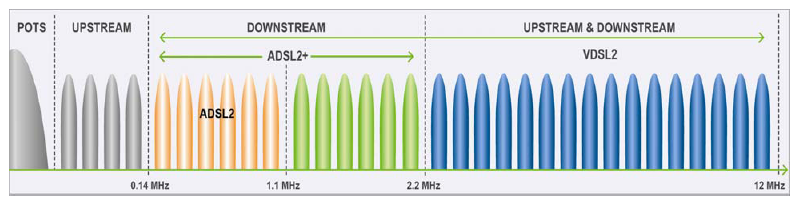
VDSL frequency spectrum (up to 30MHz): |
|
 |
|
|
|
|
xDSL Comparison table: |
|
Technology |
Upstream capacity |
Downstream capacity |
Maximum distance |
BW |
Tone spacing |
Type |
Standard |
|
ADSL |
640 Kb/s |
8 Mb/s |
6 km |
1.104 MHz |
4.3125 KHz |
asymmetric |
G.992.1 |
|
ADSL2 |
1 Mb/s |
12 Mb/s |
3 km |
1.104 MHz |
4.3125 KHz |
asymmetric |
G.992.3 |
|
ADSL 2+ |
1 Mb/s |
24 Mb/s |
4.3 km |
2.208 MHz |
4.3125 KHz |
asymmetric |
G.992.5 |
|
VDSL |
15 Mb/s |
55 Mb/s |
1.3 km |
12 MHz |
4.3125 KHz |
asymmetric
or symmetric |
G.993.1 |
|
VDSL 2 |
100 Mb/s |
100 Mb/s |
0.6 km |
30 MHz |
8.625 KHz |
asymmetric
or symmetric |
G.993.2 |
Remarks:
- xDSL means all type of DSL
- symmetric: downstream and upstream rates are the same.
- asymmetric: downstream rate is higher than the upstream rate
- VDSL2 BW bandplan configuration options: 8.5, 12, 17.7 and 30 MHz
- VDSL2 30 MHz bandplan: Upload: 25-138 KHz, 3.75-5.2 MHz, 8.5-21.567 MHz;
Download: 138 KHz-3.75 MHz, 5.2-8.5 MHz, 21.567-30 MHz
|
|
|
Home
|
Site Map
|
Email: support[at]karadimov.info
Last updated on:
2026-06-24
|
Copyright © 2011-2021 Educypedia.
https://educypedia.org
|
| |
|
|
| |
|
