|
|
|
|
|
|
| |
Runestones and the Futhark
Runes are the letters of the alphabets used by Germanic peoples, including the Norse of Scandinavia, before and alongside the adoption of the Latin script. The runic alphabet is called the futhark, a name taken from the sounds of its first several letters, just as the word alphabet comes from the first Greek letters. Runes are made largely of straight lines, a shape well suited to carving into wood, bone, metal and stone.
The futhark changed over time. The earlier Elder Futhark contained around two dozen characters and was used across the Germanic world in the first centuries of the common era. In Scandinavia it was later simplified into the shorter Younger Futhark, which had fewer letters and was used during the Viking Age. Because runes were often carved rather than written with ink, their angular forms reflect the tools and materials used to make them.
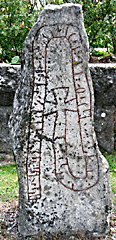
Runestones are raised stones bearing runic inscriptions, most numerous in Scandinavia and especially in what is now Sweden. Many were erected during the Viking and early medieval periods as memorials, commemorating dead relatives, recording journeys and conquests, or proclaiming the deeds and property of those who raised them. Some are decorated with carved animals, crosses and interlaced patterns. As written records from a largely oral society, runestones are valuable evidence for language, society and belief in the early medieval north.
Frequently asked questions
- What is the futhark?
- The futhark is the runic alphabet used by Germanic and Norse peoples. Its name comes from the sounds of its first letters, much as alphabet derives from the first Greek letters.
- Why are runes made of straight lines?
- Runes were commonly carved into hard materials such as wood, bone and stone. Straight, angular strokes are easier to cut than curves, which shaped their distinctive forms.
- What were runestones used for?
- Many runestones were memorials raised to honour the dead, but they also recorded journeys, conquests, property and family ties, serving as public inscriptions in stone.
|
|
Rune
stones  |
|
Ancient Hungarian
runic writing |
| Anglo
Saxon runes Anglo-Saxon runes |
| Futhark alphabet
Futhark alphabet |
| Futhark alphabet |
|
Futhark the Runic alphabet is also known as Futhark, a name composed from the first six
letters of the alphabet, namely f, u, th, a, r, and k. In this way, "Futhark" is analogous to the word
"alphabet", which is from alpha and beta, the first two
letters of the Greek alphabet, part of
Ancient scripts |
|
Kensington
rune stone photo |
|
Kensington
rune stone |
|
Kensington
rune stone |
|
Kensington runestone
new research suggests the stone is an artifact from a visit
to Minnesota in the 1300s by a group of Norwegians and Swedes who sailed up
the Great Lakes |
| Nordic runes, Elder Futhark, Norse runes |
| North American rune stones several rune stones have been found
in the United States, most notably the Kensington Runestone in Minnesota
and the Heavener Stone in Oklahoma |
|
Oklahoma runestones |
|
Rök
Rök-stone in Östergötland |
|
Rune stones
Rune stones are stones with runic inscriptions dating from the early Middle
Ages but are found to have been used most prominently during the Viking Age,
... |
| Rune stones in Sweden |
| Rune stones in Sweden |
| Rune poems |
| Runes
runes are
an alphabetic script used by the peoples of Northern Europe from the first
century c.e. until well into the Middle Ages. In addition to their use as a
written alphabet, the runes also served as a system of symbols used for
magic and divination |
| Runes |
| Runes and
pronunciation |
| Runes and Vikingpage |
|
Runes: alphabet of
mystery the runes of the Elder Futhark, their uses in writing,
divination, magic. History and mythology of the Norse |
| Runes of the Elder
Futhark |
|
Runes:
the meanings |
|
Runes:
the meanings |
|
Runic alphabet |
|
Runic alphabet |
| Runic
fonts old Futhark rune system |
|
Ruthwell cross The Ruthwell Cross is a sculptured monumental stone cross
of the late seventh or early eightth century, ... |
|
Sigurd runestone
illustrate the story of Sigurd the dragon slayer |
|
Sparlosa
stone |
|
Sparlosa
stone |
|
Your name in runes
Write Your Name in Runes, The Vikings are often portrayed as illiterate,
uncultured barbarians who evinced more interest in plunder than in poetry.
In fact, the Vikings left behind a great number of documents in stone, wood
and metal, all written in the enigmatic symbols known as runes |
|
|
Home
|
Site Map
|
Email: support[at]karadimov.info
Last updated on:
2026-06-24
|
Copyright © 2011-2021 Educypedia.
https://educypedia.org
|
| |
|
|
| |
|