|
|
|
|
|
|
| |
World War I
World War I, also called the Great War, was a global conflict that lasted from 1914 to 1918. It drew in the major powers of Europe, divided into two opposing alliances, along with their colonies and allies around the world. The immediate trigger was the assassination of the heir to the Austro-Hungarian throne in 1914, but the war grew out of deeper tensions including rival alliances, military build-ups and competition between the great powers. Within weeks much of Europe was at war.
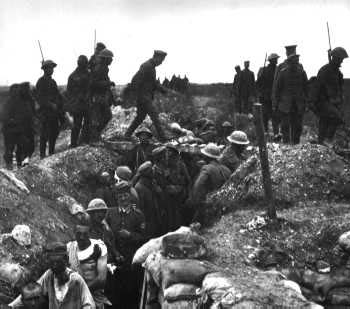
On the Western Front, running through Belgium and France, the fighting settled into a long stalemate of trench warfare. Soldiers on both sides dug networks of trenches facing each other across a devastated no man's land, and repeated offensives gained little ground at enormous human cost. Battles such as those around Verdun and in the region of Flanders became symbols of the war's scale and futility. The conflict introduced or expanded fearsome weapons, including the machine gun, heavy artillery, the airplane and the Zeppelin airship, and the use of poison gas as a chemical weapon.
The war spread far beyond the Western Front, with major fighting in Eastern Europe, the Middle East and at sea. After four years of attrition the alliance opposing Germany and its partners prevailed, and an armistice ended the fighting on 11 November 1918. The cost was staggering, with millions killed and wounded. The war reshaped the map of Europe, brought down several empires, and its unsettled aftermath contributed to the tensions that led to a second world war two decades later.
Frequently asked questions
- When did World War I take place?
- From 1914 to 1918. The fighting ended with an armistice on 11 November 1918.
- What was trench warfare?
- A form of fighting in which opposing armies dug long lines of trenches facing each other. It dominated the Western Front and produced a costly stalemate with little movement.
- Why is it called the Great War?
- It was given that name because of its unprecedented scale and destruction. The term “World War I” came into wider use after a second world war followed.
|
|
| World war I,
the great war:
general overview |
|
'Around the War in 80 Postcards' - Brave Little Belgium |
| BBC
news the war to end all wars |
|
Biographical
dictionary brief biographical sketches and photographs of prominent people
of the Great war era |
|
Blindganger
educatieve site over de eerste wereldoorlog aan de Ieperboog ( en de IJzer ),
in Dutch |
|
Charles Fiel's battlefield guide |
| Chronology
of events |
| Das
Archiv zum 1. Weltkrieg Darstellungen des Kampfes 1914-1918 aus der Sicht
der damaligen Zeit |
| Diggers.be
in Dutch |
| EyeWitness
to world war I gas attack, battle at Gallipoli, 1915, U-boat attack, 1916 |
| First world war.com:
a multimedia history of world war one origins of world war I, machine
guns, chemical warfare, Iraq in world war I, photographs of world war one, ..., a
tip |
|
Geography of the Great War |
| Hellfire
corner Verdun, Ypres, latest news about WW I, a
tip |
| Heritage of
the great war 1914 1918 the official war photographers were not supposed
to photograph the vast numbers of dead. The resason was simple. Their pictures
had but one purpose: keeping up morale. Their pictures were checked and
destroyed if they set the wrong tone |
| The
great war The great war |
| The
great war series War Times journal resources relating to the first world
war, the fighting in France and Belgium between 1914 and 1918, the major
offensives on the Eastern front during World War one, Germany's Naval airship
division, the naval war and its policies, Manfred von Richthofen, the Royal
Navy's home fleet from 1914 to 1918 |
| The
great war: interactive timeline |
|
The
First World War Arras, Amiens, Passchendaele, the Somme, Vimy and Ypres -
where thousands of Canadians fought and died more 90 years ago |
|
The Western
Front during the First World War |
|
The Western Front the western front, late during the summer of 1914, train stations
all over Europe echoed with the sound of leather boots and the clattering of
weapons as millions of enthusiastic young soldiers mobilized for the most
glorious conflict since the Napoleonic Wars, ... |
| Time
line of world war I |
| Timeline 1839 - 1914 the long fuse
click here for Artillery,
the Somme, Vimy Ridge,
Tank warfare, Delousing,
Canadian red
cross |
| War and
Peace: The First World War |
|
World
war I |
|
World
war I a tip |
|
World
war I la grande guerre 1914 1918, 14-18,
en Français |
|
World
war I la grande guerre 1914 1918, 14-18,
en Français |
|
World
war I World War I (The Great War) from its beginning to the Armistice
including the Marne, Somme, Verdun, gas, trench war, poems and music |
|
World
War I National Rivalries, Alliance System, Militarism, Economic Rivalries,
Colonial Rivalries, Pre-war Crises, Immediate Cause of the War 1914, Course of
the War 1914-18, Results of the First World War |
|
World
War I explore in detail the causes, course and consequences
of the war which shaped the nature of 20th century history |
| World
war I the causes of world war one, Archduke Ferdinand's assassination, the July crisis, events of July 1914
leading to war, how the war was planned, Schlieffen plan, Balkan causes of world war one, Austria's ultimatum to Serbia |
| World
war I internet history of world war I: trenches of the web |
| World war I
document archive |
|
World War I
Links |
|
World War I, World War I |
| World War
one - BBC |
| World War
one - BBC the war lasted from 1914-18, claimed 10 million lives and forever changed the political map of
Europe |
Armies and navies  |
| 13th battalion black watch Royal Highlanders of Canada
History of the 13th battalion Black Watch |
| Austro-Hungarian land
forces 1848-1918 the organisational history of the land forces of the
Austro-Hungarian monarchy from just prior to the outbreak of the Great War until
the collapse of the monarchy in 1918 |
| Canada in the
first world war |
| Frontflieger |
| German armed forces
in WWII German armed forces in WWII |
| German armee: Prussian machine |
| Newfoundland and the
great war |
| NORTH
RUSSIAN EXPEDITIONARY FORCE 1918-1919 |
| Were
the British generals of World War I "butchers and bunglers"? |
| WWI uniforms |
|
WWI uniforms: Artifact Galleries |
|
|
|
|
Home
|
Site Map
|
Email: support[at]karadimov.info
Last updated on:
2026-06-24
|
Copyright © 2011-2021 Educypedia.
https://educypedia.org
|
| |
|
|
| |
|