|
|
|
|
|
|
| |
World War I, the Great War
The First World War, known at the time as the Great War, was a global conflict fought from 1914 to 1918. It was triggered in the Balkans, where the assassination of the Austro-Hungarian heir set off a chain of alliances that drew the major European powers into war. The two main coalitions were the Allied Powers, including France, Britain, Russia and later the United States, and the Central Powers, led by Germany and Austria-Hungary alongside the Ottoman Empire.
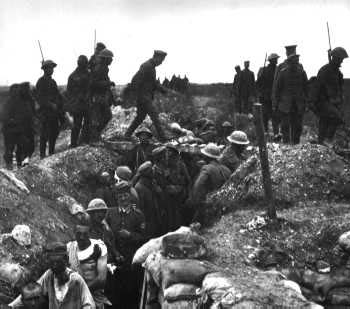
The war was fought on several fronts. The Western Front, running through France and Belgium, became notorious for prolonged trench warfare, with battles such as Verdun and the fighting in Flanders producing enormous casualties for little territorial change. The Eastern Front, between Germany, Austria-Hungary and Russia, covered a much larger and more fluid area. Fighting also extended to the Middle East, Africa, Italy and the seas. New weapons, including machine guns, massed artillery and chemical warfare in the form of poison gas, made the conflict exceptionally deadly.
The war ended in 1918 with the defeat of the Central Powers, after Russia had withdrawn following its revolution and the United States had reinforced the Allies. Its consequences were profound: empires collapsed, the map of Europe and the Middle East was redrawn, and the peace settlements, particularly the Treaty of Versailles, left tensions that contributed to the Second World War two decades later.
Frequently asked questions
- What caused World War I?
- The immediate trigger was the assassination of the Austro-Hungarian heir in the Balkans, which set off a network of alliances and drew the major European powers into war.
- Who fought in the war?
- The Allied Powers, including France, Britain, Russia and later the United States, fought the Central Powers, led by Germany and Austria-Hungary with the Ottoman Empire.
- What were the long-term consequences?
- Empires collapsed, borders were redrawn, and the postwar settlements left unresolved tensions that contributed to the outbreak of the Second World War.
|
|
World war I:
topics  |
| 23 July,
1914: the Austro-Hungarian ultimatum to Serbia , 25 July,
1914: the Serbian response to the Austro-Hungarian ultimatum |
| Alliance systems
before and during World War I |
|
Battlefield
Colloquialisms of the Great War (WW1) by Paul Hinckley |
|
Belgian War Graves |
|
Blindganger in Dutch |
|
Britain and World War One- 1914 - 1918 |
|
British Posters of
World War I |
| Canadian
Great War |
|
Canadian posters from the first World War |
|
Canadian
war posters |
| Death tolls for the man-made megadeaths of the twentieth century |
| English
songs popular during the first world war |
| Germany during world war one
the great war, world war one, consisted of two stages: conventional warfare
that lasted from 1914 to 1916, and a war of desperate expedients, when both
sides struggled for their own existences, lasting until the end |
| HILL 60 |
| Imperial war museum |
| In
Flanders fields worldwar I: Dutch and English |
|
La
situation de l'Europe en 1914, les alliances |
|
Le front Ouest en 1914 |
|
Le front Ouest entre 1915 et 1916 |
|
Le front Ouest en 1917 |
|
Les offensives allemandes sur le front Ouest en 1918 |
| Market Harborough in the
great war an East Midlands town in the first world war |
|
MASSACRES OF THE TURKS AND MASS GRAVES pdf file |
|
Medals of the Great War nearly all of the nations involved in the Great War
had medals and awards which they bestowed upon their citizens and allies for
meritorious service or specific acts of bravery. Many of these awards existed
long before the war. Some had long and complex histories. Some were newly
instituted during the war |
| Medical
front, WWI concerned with all medical aspects, military and civilian, of the
great war |
| Medical front |
| Medical:
lnseedlancers.com |
| Médecins de la grande guerre
en Français |
| Passchendaele
Remembered |
| USSR war
atlas |
| Sint-Juliaan
gedurende de eerste wereldoorlog in Dutch |
| Soldiers died in world war 1 |
|
SPANBROEKMOLEN MINE-CRATER |
| The diggers
voor geïnteresseerden in de geschiedenis van Wereldoorlog I in de streek van
Ieper, en meer bepaald in prospectie en opgravingen van oorlogsrelicten te
velde, in Dutch |
|
Trench Warfare |
|
World War I:
Technology vs. Tactics |
|
Zimmermann telegram |
|
World war I: Biographies |
|
Baron Manfred Von
Richthofen |
|
Cahier de guerre 1914-1918 de Constant Vincent |
| General Friedrich von
Bernhardi: the next war Friedrich von Bernhardi (1849-1930) |
|
Guldenboek der vuurkaart Het bevat namen en foto's van oorlogsveteranen die
in het bezit waren van een Vuurkaart |
|
Historische
Portraits bedeutender Persönlichkeiten |
| Jack
Turner's war |
|
Jozef Klemens
Pilsudski 1867-1935 |
| Kyles world war I a tip |
| Lawrence of Arabia, 1918 |
|
Lothar Freiherr von Richthofen |
|
Manfred von
Richthofen |
| The Lawrence of Arabia factfile
contains biographical information about T. E. Lawrence |
|
Who killed the Red Baron? |
|
World war I: Causes of world war I |
| Armenian genocide
Armenian genocide |
| Armenian
genocide exhibit in 1915, during the First World War, the Turkish
government resolved the "Armenian Question" by eliminating this
population from the Ottoman Empire. In February of 1915 the government ordered
Armenian men serving in the army disarmed. They were organized into labor
groups and eventually were killed |
| Assassination in Sarajevo
28-Jun-1914 Sarajevo |
| Assassination
of An Archduke, 1914 |
| Assassination
of An Archduke, 1914 28 June, 1914 the Assassination of Archduke Franz
Ferdinand, 4 August, 1914 President
Poincaré's a august 1914 |
| Balkan causes of
World War I the assassination of Franz Ferdinand in Sarajevo on June 28, 1914, did policy-makers
let the crisis escape their control, why did a Balkan crisis lead to a world war
in 1914, when other crises had not? |
|
Causes of the
first World War |
|
Causes of World War I
World War I was the result of leaders' aggression towards other countries which
was supported by the rising nationalism of the European nations. Economic and
imperial competition and fear of war prompted military alliances and an arms
race, which further escalated the tension contributing to the outbreak of war |
|
Causes of World War I |
| Who started world war I? |
|
|
Home
|
Site Map
|
Email: support[at]karadimov.info
Last updated on:
2026-06-24
|
Copyright © 2011-2021 Educypedia.
https://educypedia.org
|
| |
|
|
| |
|