| |
LCD Backlight Technology
Liquid crystal displays (LCDs) do not generate light of their own. The liquid crystal layer in a panel works by selectively blocking or passing light, acting like a controllable shutter for each pixel, so a separate light source is required behind or beside the panel to make the image visible. This light source is the backlight, and its design strongly affects a display's brightness, colour and energy use.
In a thin-film-transistor (TFT) LCD, each pixel contains coloured filters and a liquid crystal element whose orientation is controlled by an applied voltage. Combined with polarising layers, this allows the panel to vary how much backlight passes through each sub-pixel, producing the full-colour image. Because the crystals only modulate light rather than emit it, a uniform and stable backlight is essential for good picture quality.
For many years the standard backlight was the cold-cathode fluorescent lamp (CCFL), a thin fluorescent tube that, like a fluorescent lamp, produces light from a gas discharge and a phosphor coating, requiring a high-voltage inverter to drive it. CCFL backlights were later largely replaced by light-emitting diode (LED) backlights, in which arrays or edge-mounted strips of LEDs illuminate the panel. LED backlighting offers lower power consumption, thinner panels, longer life and the ability to dim regions of the screen locally for improved contrast. Displays using LED backlights are often marketed as “LED TVs,” although the image is still formed by an LCD panel.
Frequently asked questions
- Why does an LCD need a backlight?
- The liquid crystal layer only blocks or transmits light rather than producing it, so a backlight is needed behind the panel to make the image visible.
- What is a CCFL backlight?
- It is a cold-cathode fluorescent lamp used as the light source in many older LCDs, working on the same gas-discharge and phosphor principle as a fluorescent tube.
- Is an “LED TV” different from an LCD TV?
- Not fundamentally. An LED TV is an LCD television that uses LEDs for its backlight; the picture is still formed by a liquid crystal panel.
|
|
Backlight liquid crystal displays - technology  related topics: Cold-Cathode Fluorescent Lamp
circuits, LCD, OLED-SED
technology, Optics
related topics: Cold-Cathode Fluorescent Lamp
circuits, LCD, OLED-SED
technology, Optics |
|
AC-DC LCD TV
Power Architecture and LED Backlight pdf file |
|
Backlight assembly using
a Luxeon DCC light source This Application Note provides the information
that is needed to develop a backlight system with Luxeon® DCC and includes reference designs that explain
the concepts. Luxeon DCC is an energy efficient and ultra compact light source
that combines long life, robustness, and reliability of light emitting diodes
(LEDs) with the luminance of conventional lighting, pdf file |
|
Backlight Inverter for Desktop LCD Displays CRT replacement requires a 10W
to 20W inverter to drive the CCFL (cold cathode fluorescent lamp) that
illuminates the LCD, pdf file |
|
Backlight Technology Overview Backlight Technology Overview, pdf file |
|
CCFL backlight
and photometric terms Luminous
Intensity: candala(cd)= lumen(lm)/sr, Luminous Flux: lumen(lm), Illuminance:
lux=lumen(lm)/m2, Luminance: nit=lumen(lm)/m2/sr, pdf file |
|
CCFL
Characteristics CCFL Characteristics, Cold Cathode Fluorescent Lamps (CCFL)
are used as white-light sources to backlight liquid crystal displays (LCDs), pdf file |
|
CCFL
Characteristics Cold Cathode Fluorescent Lamp CCFL-Inverter,
pdf file |
|
CCFL Inverter CCFL Inverter circuit,
pdf file |
|
CCFL Lamp
Cold Cathode Fluorescent Lamps in LCD |
|
Circuit configuration
of an invented typically two-lamp CCFL backlighting source
pdf file |
|
Cold Cathode
Fluorescent Lamp (CCFL) Cold Cathode Fluorescent Lamp, CCFL Characteristics, Cold Cathode Fluorescent Lamps (CCFL)
are used as white-light sources to backlight liquid crystal displays (LCDs),
Cold Cathode Fluorescent Lamps (CCFLs) are sealed glass tubes filled with inert
gases. When a high voltage is placed across the tube, the gases ionize creating
ultraviolet (UV) light. The UV light, in turn, excites an inner coating of
phosphor, creating visible light, ..., pdf file |
|
Cold Cathode Fluorescent Lamp driver circuit |
|
Color
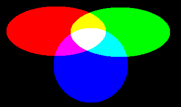
Stabilization of RGB LEDs in an LED Backlighting Example The technology used
in TFT monitors, in which each pixel is comprised of red, green and blue sub
pixels, offers a solution to backlight a display with these same primary colors.
By mixing the primary colors in the proportions of 64% green, 8% blue and 28% red, a white light can be created, ..., pdf file |
|
Concurrent
Contrast and Brightness Scaling for a Backlit TFT-LCD Display Backlight
Scaling and Contrast Fidelity, Concurrent Brightness and Contrast Scaling,
pdf file |
|
Design Challenges in
Backlighting LCD TVs pdf file |
|
Design Challenges in
Backlighting LCD TVs LCDs (liquid crystal displays) are electronically
controlled light valves. LCD TVs (liquid crystal display televisions) use a
white "backlight," typically cold-cathode fluorescent lamps (CCFLs), to
illuminate the color screen, pdf file |
|
Dimmable Cold-Cathode
Fluorescent Lamp Ballast Design This application note describes how to
design a resonant cold-cathode fluorescent lamp converter and liquid crystal
display (LCD) bias supply using the UC3871, pdf file |
Electronic Displays
Comparison This note compares advantages and disadvantages of Cathode Ray
Tubes, Electro-Luminescent, Flip-
Dot, Incandescent Light Bulbs, Liquid Crystal, Light Emitting Diode, Organic
LEDs, Polymer LEDs, Glow Discharge, Plasma Display Panels, and Vacuum
Fluorescent Display technologies, pdf file |
|
EEFL-Backlight
Technology EEFL-Backlight Technology
pdf file |
|
FULL BRIDGE LCD
BACKLIGHT CONTROLLER pdf file |
|
How ccfl works Cold Cathode fluorescent Lamp construction typically
includes a hollow glass cylinder which has been coated on the inside with a
phosphor material Composed of rare earth elements such as zinc silicate and
various types of halophosphates, ... |
|
LCD Backlight
Converter CCFL Lamp Characteristics, Basic
Operation Of Converter, PWM Control, LCD Backlight Converter, pdf file |
|
LCD
Backlighting Technologies CCFL, LED and EL are by far the most commonly used
forms of backlighting, pdf file |
|
LCD Backlight Technology |
|
LED
Display Backlighting LED Display Backlighting, provides a general overview
and comparison of light sources which are currently available for use in
backlighting applications, with a focus on the differences between cold cathode
fluorescent lamps (CCFL) and LEDs, pdf file |
|
LED
Display Backlighting LED Display Backlighting – Monitor Applications using
6-lead MULTILED, This application note describes two reference designs
for LCD backlighting using the 6-lead MULTILED, pdf file |
|
LED
Drivers for Display Backlighting and Other Portable Applications Series LED
Drive vs. Parallel LED Drive, Inductive Boost vs. Switched-Capacitor Boost for
the LED Drive Application, LED Drive Efficiency, pdf file |
|
LCD technology repair pdf file |
|
Optical Films and Illumination Sources for LCDs Optical Films and
Illumination Sources for LCDs, Polarized light-guide plate for liquid crystal
display |
|
Piezoelectric
transformers in CCFL backlight applications Understanding piezoelectric
transformers in CCFL backlight applications, pdf file |
|
Piezoelectric transformers in CCFL backlight application Piezoelectric
transformer combines actuators and sensors so that energy can be transformed
from electrical form to mechanical energy and back to electrical form.
Piezoelectric transformer can generate a high voltage by a low voltage input
through the utilization of the resonance phenomenon of the piezoelectric
transducer, pdf file |
|
Polarized light-guide plate for liquid crystal display Polarized light-guide
plate for liquid crystal display, novel polarized light-guide plate (LGP), pdf file |
|
Power Supply Drives TFT-LCD and LED Backlight The LT1942 is a highly
integrated, 4-output switching regulator designed to power small to medium size
TFT panels, pdf file |
|
Ultracompact LCD Backlight Inverters The LCD utilizes a cold cathode
fluorescent lamp (CCFL) as a light source to back light the display. The CCFL
requires a high voltage AC supply for operation. Typically, over 1000 volts RMS
is required to initiate lamp operation, with sustaining voltages ranging from
200VAC to 800VAC, pdf file |
|
White LED Step-Up Regulator
White LED Step-Up Regulator |
|
|
Home
|
Site Map
|
Email: support[at]karadimov.info
Last updated on:
2026-06-16
|
Copyright © 2011-2021 Educypedia.
https://educypedia.org
|
| |
|
|