Educypediathe educational encyclopedia
Electronics-theory
Analog
Audio - acoustics
Audio - electronics
Audio - loudspeakers
Components-active
Components-passive
Component - sensors
Digital - electronics
Digital - I2C - I2S
Digital - Programming
Electricity High Voltage
Electricity - machines
Electricity - theory
General overview
Miscellaneous
Optics
Power control systems
Power electronics
RF - antennas
RF - antenna - WLAN
RF - communication
RF - radio - tuning
Telephony
Tubes
TV-video-DVD
 
Utilities - tools
Animations & applets
Application notes
Cabling
Calculators
Circuits
Databank - tables
Datasheets
Measurement
Repair
Software - electronics
 
Local sitemap
Sitemap


Television and PC Monitor Experiments

Practical experiments with televisions and computer monitors reveal how display devices form an image and how their internal circuits behave. The cathode-ray tube (CRT), used in older televisions and monitors, is especially instructive because its operation can be observed and altered. An electron beam is generated at the back of the tube and accelerated toward a phosphor-coated screen, where it produces a glowing spot. Scanning this beam rapidly across and down the screen, while varying its intensity, builds up a complete picture line by line.

A key component in these experiments is the deflection yoke, a set of coils fitted around the neck of the tube. Currents through these coils create magnetic fields that steer the electron beam horizontally and vertically, sweeping it across the screen. Because the beam is deflected magnetically, bringing an external magnet near a CRT distorts and discolours the picture, an effect often demonstrated to show how the beam responds to magnetic fields. The colours can be disturbed because the beam is mis-steered relative to the coloured phosphors.

Experiments of this kind must be approached with caution. CRT displays contain very high voltages, and these can remain stored on internal capacitors even after the equipment is switched off and unplugged, posing a serious electric-shock hazard. The picture tube itself is under vacuum and can implode if broken. Because of these dangers, hands-on work inside televisions and monitors is for those who understand the risks and the necessary safety precautions; many instructive observations can be made safely from outside the cabinet.

Frequently asked questions

What does the deflection yoke do in a CRT?
Its coils produce magnetic fields that steer the electron beam horizontally and vertically, scanning it across the screen to build up the picture.
Why does a magnet distort a CRT picture?
The electron beam is steered by magnetic fields, so an external magnet mis-directs the beam, distorting the image and disturbing the colours.
Why are CRT experiments potentially dangerous?
CRTs use very high voltages that can remain stored after power off, and the evacuated tube can implode if broken, so safety precautions are essential.


Television and PC monitor experiments 
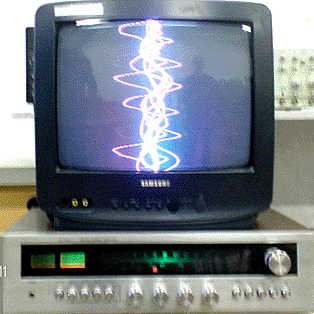
Audio-visualizer a CRT-tube turned into some audio-oscilloscope
CRT experiment pdf file
Flyback Driver The heart of the circuit is a ferrite-cored flyback transformer
How to convert a television into an oscilloscope
How to display sound on television, converting a TV into an oscilloscope
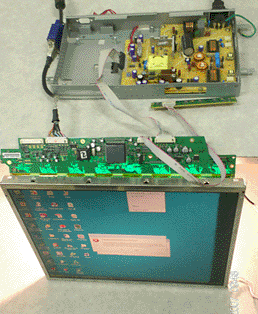
How to modifie a 15" TFT panel
How to reverse a CRT picture tube How to reverse a CRT picture tube
Liquid Crystal Movies
Modificatie van een defect LCD computerscherm pdf file
Old crt recycled as oscilloscope
Oscilloscope CRT Clock
Scribblevision provides instructions for modifying a television to display a moving image based on an audio source
Tele-Scope The Tele-Scope presented here allows a normal television (black and white or colour) to be used as an oscilloscope display. No modification is required to the television, connection being made via the aerial (or video input) socket
Things you can do with an old television screen or PC monitor but not with a LCD or Plasma screen How to make an oscilloscope out of a television
Greg's Homemade Oscilloscope Page TV as an Oscilloscope, Deflection Coils
TV music visualizer Sound on Television
TV Oscilloscope
TV-scope Using TV to display audio signals, The principal of this audio signal displaying is that when TV is normally operated the Deflection Yoke generates a magnetic field and use it to direct the electron beam in the cathode-ray tube. Deflection Yoke gets signals from
Use your TV as an Oscilloscope Using TV to display audio signals
VGA-to-Scope Converter A converter that converts a computer's VGA output to X, Y, and Z axes for an oscilloscope and turns the oscilloscope into a computer monitor

Sound on Television, CRT as Oscilloscope  LCD TFT display modification


Home | Site Map | Email: support[at]karadimov.info

Last updated on: 2026-06-24 | Copyright © 2011-2021 Educypedia.

https://educypedia.org

 
Powered by ITCom Solutions