| |
Television Colour Theory
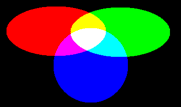
Colour television reproduces a full range of hues by combining just three primary colours of light: red, green and blue. This is additive colour mixing, in which lights of different colours add together to form others; equal amounts of all three produce white. A colour display generates these three primaries at each point of the picture in varying proportions, and the eye blends them so that the viewer perceives a continuous colour image. The human eye's three types of colour-sensitive cells are the reason three primaries suffice.
To transmit colour while remaining compatible with the structure of a television signal, the picture information is separated into a luminance component, which carries brightness, and chrominance components, which carry the colour information. Luminance corresponds to the black-and-white picture, while the chrominance signals describe how the colour departs from grey. This separation was originally devised so that colour broadcasts could still be displayed in monochrome on older receivers, and it also exploits the fact that the eye is more sensitive to detail in brightness than in colour, allowing the colour information to be transmitted with less bandwidth.
Different television standards encode the chrominance information in different ways. PAL, NTSC and SECAM each modulate the colour signals onto a subcarrier within the channel, using methods that affect how robustly colour survives transmission imperfections. The way the three primaries are produced depends on the display: a cathode-ray tube uses three phosphors, while LCD and plasma panels use coloured sub-pixels, but the underlying principle of combining red, green and blue remains the same.
Frequently asked questions
- Which primary colours does a television use?
- Red, green and blue light, combined by additive mixing in varying proportions to reproduce the full range of colours seen on screen.
- What is the difference between luminance and chrominance?
- Luminance carries the brightness or black-and-white part of the picture, while chrominance carries the colour information describing how each point departs from grey.
- Why is the colour signal separated from brightness?
- It allowed colour broadcasts to remain viewable in monochrome and lets colour be sent with less bandwidth, since the eye notices brightness detail more than colour detail.
|
|
Television: Color  |
| Circuits luminance
chrominance en Français |
|
Color bars and how To use them NTSC Color Bars |
|
Color CRTs
Spectral response of Cathode Ray Tubes |
| Color perception,
images, animation ppt file |
|
Colour and contrast in display
technology |
|
Colour rendering of spectra |
|
Color
Representation Visible Light Spectrum, Color Matching, Trichromatic Color
Theory, Psychophysics, CIE standard, RGB and CMYK Color Spaces, HLS Color Model |
| Color spectrum
references by Scott Ed |
|
Color Vision
Human perception of different wavelengths of light |
|
Colour-temperature and
whitepoints |
|
Eye cone respons
human eye spectrum |
|
Eye cone respons |
|
Eye cone respons |
|
Guide to comb filters: Y/C separation pdf file |
|
Introduction to Colour
Science |
|
NTSC color
signal |
|
NTSC/PAL
decoder pdf file |
|
NTSC/PAL Video Decoder pdf file |
|
NTSC
Video Measurements |
|
RGB color model The RGB color model is an additive model in which red,
green, and blue (often used in additive light models) are combined in various
ways to reproduce other colors, ... |
|
Television: composite video signal |
|
Anatomy of a video signal Video Scanning, Analog Video Signals, Analog
Standards, Digital Video Signals |
| Composite TV signal |
|
Composite TV signal
the fundamentals of analog video, Interlaced scanning system, Visual Resolution
in Television Systems, Y, B-Y, R-Y: Luma and color-difference signals, composite
video signal |
|
Composite
video signal Composite video signal |
|
Composite Video Separation
Techniques pdf file |
|
Component Video Sync
Formats Television Broadcast Systems, PAL system, NTSC sysrtem, PAL
Composite video, NTSC Composite video, pdf file |
|
NTSC Video Measurements The Basics Basic Video Testing — Waveform Monitor
Techniques, Checking Chrominance Phase, Checking Chrominance Gain, Checking
White Balance, pdf file |
|
PALplus
Television Systems, Enhanced 625-line Phased Alternate Line (PAL) television,
PALplus system, pdf file |
|
Pal systems pdf file |
|
Television Measurements - NTSC pdf file |
|
Understanding Analog Video Signals |
|
Video Comb Filters
Video Comb Filters, Comb filters are widely used in video circuits to separate
the luminance signals from the color signals |
|
Video pattern generator zip file |
|
Video resolution: an overview number of scan lines, or vertical resolution,
of NTSC/PAL/SECAM, horizontal resolution, digital TV and HDTV |
|
Video Signal
Formats |
|
Video Signal Measurement
and Generation Fundamentals |
| Video
signal standards
composite video, S-video, S-VHS, RGB, NTSC, PAL and SECAM |
|
YUV(YCbCr) to RGB
converter |
|
|
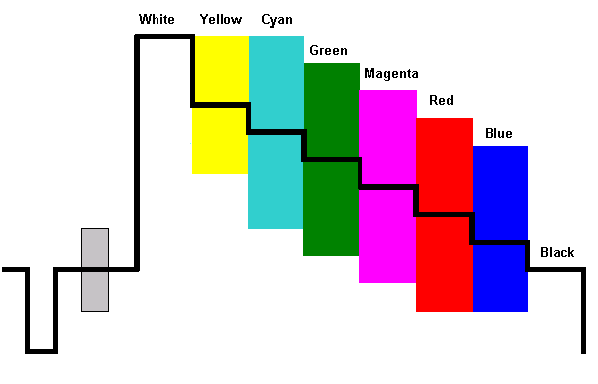
PAL video color signal: |
|
 |
|
|
Home
|
Site Map
|
Email: support[at]karadimov.info
Last updated on:
2026-06-24
|
Copyright © 2011-2021 Educypedia.
https://educypedia.org
|
| |
|
|