|
| |
Cantenna Design for Wi-Fi
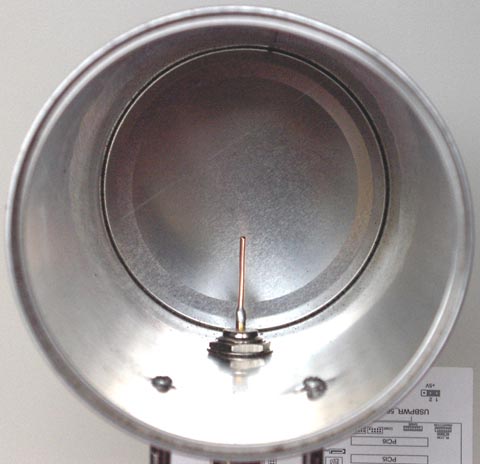
A cantenna is a directional antenna built from a cylindrical metal can, used to extend the range of wireless networks operating in the 2.4 GHz band. It is a homemade form of waveguide antenna: the conducting walls of the can guide and concentrate the radio waves, and a short probe mounted through the side couples energy from the feed cable into the cylinder. Because it is simple to make from readily available materials, the cantenna became a popular project among Wi-Fi (WLAN) experimenters.
The antenna works because a metal cylinder of the right diameter acts as a circular waveguide for microwaves at this frequency. The can's diameter must be large enough to support the propagating mode, the probe is positioned a specific fraction of a wavelength from the closed end, and the probe length is set to roughly a quarter wavelength so that energy transfers efficiently. Getting these dimensions right determines how well the cantenna radiates and how well it matches the cable, and small errors degrade performance.
A cantenna is a directional antenna: it concentrates radiated power into a relatively narrow beam along its axis rather than spreading it in all directions. This gives gain in the favoured direction, which can noticeably increase range and signal strength for a point-to-point link between two fixed locations, such as connecting two buildings. The trade-off is that the antenna must be aimed accurately, and it offers little coverage off-axis. For omnidirectional needs a different design, such as a groundplane or dipole antenna, is more appropriate.
Frequently asked questions
- How does a cantenna increase Wi-Fi range?
- It is directional, concentrating the radio energy into a narrow beam along its axis. This gain in the aimed direction raises signal strength and extends range for a point-to-point link.
- Why does the can's diameter matter?
- The can acts as a circular waveguide, and it must be wide enough to support the propagating mode at 2.4 GHz. An incorrect diameter prevents efficient operation.
- Is a cantenna suitable for general home coverage?
- Not really. Because it is highly directional it must be aimed at a specific point. Omnidirectional coverage is better served by a dipole or groundplane antenna.
|
|
WIFI - WLAN antenna
applications: Tin Can Antenna  related topics: HF datacommunication theory,
PC home networking
related topics: HF datacommunication theory,
PC home networking |
|
2.4 GHz Coffee Can Feed Antennas |
|
2.4GHz Waveguide antenna stuff |
|
802.11b Cantenna Calculator 802.11b Cantenna Calculator |
|
Building the
Cylinder (Can) Waveguide |
|
Building the
Rectangular Waveguide |
|
Cantenna
How To Build A Tin Can Waveguide Antenna for
802.11b Wireless Networks or other 2.4GHz Applications,
Cantenna design |
|
Cantenna
formulas how to calculate cantenna dimensions |
|
CantennaCalc
2,4GHz Cantenna Calculator, Cantenna calculator for 2.4GHz |
|
Cantenna building notes |
|
Cantenna project tin can broadband, Wireless across a very small valley |
|
Cantenna
software Cantenna Calculator (DOS) |
|
Circular Waveguide Feeds
Coffee-can feeds, Coffee-can with flange, VE4MA feed, Chaparral-style feeds, pdf file |
|
Coffee-can
feed |
|
Cookie Cantenna
2.4GHz Waveguide antenna |
|
Diagrams for using
EtherDesigns cAntennas |
|
How
To Build A Tin Can Waveguide WiFi Antenna Looking for an inexpensive way to
increase the range of your wireless network? A tin can waveguide antenna, or
Cantenna, WIFI 2.4 GHz antenna. How To Build A Tin Can Waveguide WiFi Antenna |
|
Lincomatic's Wireless Corner
Homebrew 2.4GHz Antennae for 802.11b, Inside the ORiNOCO Antenna Cover, Adding
an Antenna Jack to the US Robotics 2410, Comtelco 7.5dBi Patch Antenna Clone,
Mobile Mark 5dBi Ommi Clone, Trevor Marshall's BiQuad, Bazooka Cantenna |
|
Making a Cantenna |
|
Tetra-Brik Antenna
How-To silver-plated type N male coaxial connector, 802.11b Antenna |
|
Tin Cantenna Made With Compact / Dongle USB Wireless Adapter,
USB
cantenna photo,
Dlink USB adaptor |
|
Wave Guide antenna |
|
Wlan
antenna Waveguide type |
|
|
|
|
 |
|
|
Home
|
Site Map
|
Email: support[at]karadimov.info
Last updated on:
2026-06-24
|
Copyright © 2011-2021 Educypedia.
https://educypedia.org
|
| |
|
|
| |