| |
Wireless Data Communication
Wireless data communication carries digital information between devices using radio waves instead of cables. The data, a stream of bits, is impressed on a radio carrier through digital modulation and transmitted through the air to a receiver that recovers the original bits. Because radio is a shared medium, wireless systems include techniques to let many devices coexist without interfering with one another, and to keep the link reliable in the presence of noise and reflections.
Bluetooth is a short-range wireless standard designed to connect personal devices over distances of a few metres, replacing cables between items such as headphones, keyboards and phones. It uses a technique called frequency hopping, in which the transmitter rapidly changes the carrier frequency in a predetermined sequence many times per second. Hopping spreads the signal across many channels, which reduces the effect of interference on any single frequency and makes the link more robust.
Wireless LAN (WLAN), widely known by the Wi-Fi name, connects computers and other devices to a network and to the internet over ranges of tens of metres, typically within a home or office. It operates in unlicensed radio bands and uses access points that bridge wireless devices to a wired network. Both Bluetooth and Wi-Fi operate in shared, unlicensed frequency bands, so they must tolerate interference from each other and from other equipment. They achieve this through a combination of spread-spectrum methods, error detection and protocols that retransmit data that arrives corrupted.
Frequently asked questions
- What is frequency hopping and why does Bluetooth use it?
- Frequency hopping rapidly changes the carrier frequency in a set sequence, spreading the signal over many channels so interference on any one frequency has little effect, which makes the link more robust.
- How do Bluetooth and Wi-Fi differ?
- Bluetooth links personal devices over a few metres to replace cables, while Wi-Fi connects devices to a network over larger areas such as a home or office.
- How do wireless systems cope with interference?
- They use spread-spectrum techniques, error detection and protocols that retransmit corrupted data, allowing reliable communication in shared, unlicensed radio bands.
|
|
RF
datacommunication theory  related subjects:
Datacommunication techniques (part of computer),
Modems,
Networking,
WLAN antenna applications
related subjects:
Datacommunication techniques (part of computer),
Modems,
Networking,
WLAN antenna applications |
|
Baseband communications techniques
Baseband Digital Communications, Baseband Modulation, Baseband PAM Signals, pdf file |
|
Carrier and code
synchronization |
| Communications
analog and digital overview: a tip,
animated |
|
Data
communication glossary - technology |
|
Different Types
of Connectivity Compared Wi-Fi, 802.11a, 802.11b, 802.11g, GPRS, IrDA and
Bluetooth |
| Introduction
to networking and data communication By Eugene Blanchard, networking, voice channels, data
channels, ISO, LAN, MAN, WAN, modems, twisted pair, coaxial cable, optical
fibre, RF propagation, ground waves, transmission media, RS232, asynchronous
transmission, line encoding, synchronous transmission, manchester line
encoding, EBCDIC, ASCII, telephone networks, propagation delay, crosstalk,
distortion, jitter, AM, FM, PM, FSK, TDM, STDM, FDM, ISO ,OSI , IEEE 802.3,
IEE 802.2, networking, repeaters, hubs, bridges, routers, gateway, token ring,
ISDN, ADSL, TCP/IP, X25, UDP, frame relay |
|
Mobile Computing Cellular networks overview, GSM-Air Interface, GSM-Network
Architecture, GPRS, CDMA, Mobile Applications, WAP, Wireless TCP/IP, 802.11
WLANS, 802.11 QoS, Mobile IP, TCP over Wireless, TCP and Mobility,
RFID Networks, Mobile Data Management |
| Optical
communications a tip, animated |
|
Ultra Wide Band (UWB) Communications Systems The UWB channel, propagation
and antennas, • Frequency domain solutions, advantages and limitations, Time
Domain solutions, advantages and limitations, pdf file |
|
Wireless ppt file |
|
|
Frequency spectrum of GSM, UMTS, GPRS, WLAN
networking |
|
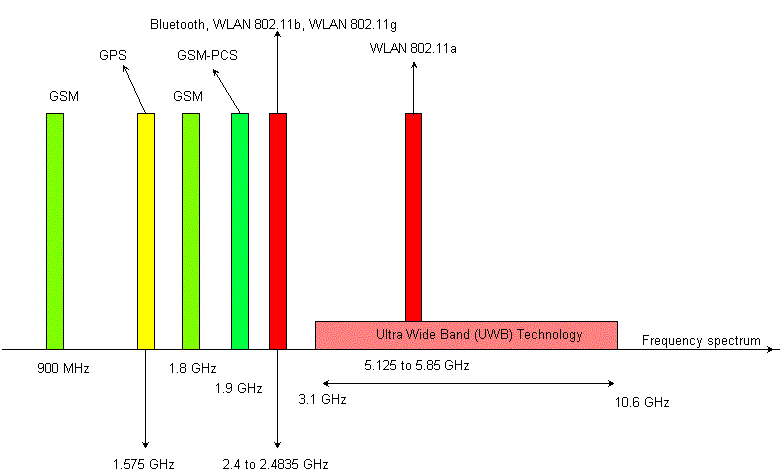
UMTS (Universal Mobile Telecommunication System): frequency bands: 1885-2025 MHz
and 2110-2200 MHz
GPRS (General Packet Radio Service): frequency bands: 900 MHz, 1800 MHz, 1900
MHz
Bluetooth: 2.400 – 2.4835 GHz |
|
|
Home
|
Site Map
|
Email: support[at]karadimov.info
Last updated on:
2026-06-24
|
Copyright © 2011-2021 Educypedia.
https://educypedia.org
|
| |
|
|
