|
| |
Resistor Colour Code
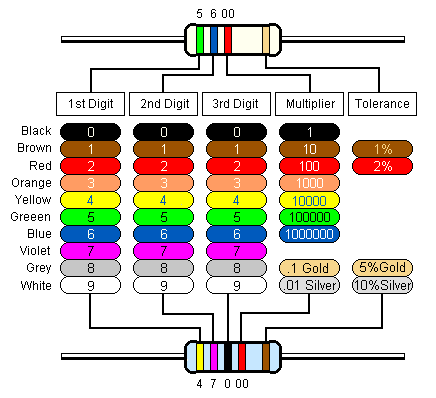
The resistor colour code is a system of coloured bands printed around the body of a resistor to indicate its resistance and tolerance. It was adopted because small resistors have too little surface area for printed numbers to be read easily, and coloured rings remain legible whatever the orientation of the part. Each colour stands for a digit, a multiplier or a tolerance, and reading the bands in the correct order gives the value in ohms. Colour-code calculators automate this translation in both directions.
In the common four-band scheme, the first two bands give the first two significant digits of the value, the third band is a multiplier that sets the number of zeros (a power of ten), and the fourth band gives the tolerance, the percentage by which the actual resistance may differ from the marked value. The colours follow a fixed sequence in which black is zero, brown one, red two, and so on through the spectrum to white at nine, with gold and silver used for small multipliers and for tolerance. Reading the bands from the end nearest the first band yields the resistance.
More precise resistors use a five-band code, which adds a third significant digit before the multiplier, allowing finer values to be marked. Some high-precision parts add a sixth band for the temperature coefficient. Colour-code calculators let a user enter the band colours and read off the resistance and tolerance, or enter a desired value and obtain the band colours to look for, which is helpful when the printing is faded or the colours are hard to distinguish. They remove the need to memorise the colour-to-digit table and reduce errors when identifying parts from a mixed collection.
Frequently asked questions
- What do the bands on a resistor mean?
- In a four-band resistor the first two bands give significant digits, the third is a multiplier, and the fourth gives the tolerance. Each colour stands for a specific number.
- How does a five-band code differ from a four-band code?
- A five-band code adds a third significant-digit band before the multiplier, allowing more precise values to be marked than the two digits of a four-band code.
- What is the tolerance band for?
- It states the percentage by which the resistor's actual value may differ from its marked value, indicating the precision of the part.
|
|
Resistor color code calculators  related topics: Resistors,
Resistor codes
related topics: Resistors,
Resistor codes |
|
Calculate resistor values from color codes 4 band
(color to value), Calculate Resistor Values from Color Codes |
|
Graphical
resistor calculator 4 band (color to value),
Resistor color code |
|
Kleurcode kleur
naar waarde, tot 6 ringen, in Dutch |
|
My Resistor - Resistor color code
calculator This calculator will help you determine the value of the
resistor based on its color code. How many bands are there on the resistor? |
|
Resistor Calculator
Have you ever needed to use a resistor value which isn't part of the
standard E12, E6, E3 or E1 range? Have you ever needed a resistor and found
you don't have that value to hand? |
|
Resistors colour code one of the best, scroll down |
|
Resistor
color code calculator 4,5 band (color to value),
4,5,6 band resistor color code calculator (color to
value) |
|
Resistor
color code calculator 4 band (color to value), 4 band (value to color) |
|
Resistor
color code calculator 4 band (color to value),
Resistor color code calculator |
|
Resistor
color code calculator 4 band, 5 band, 6 band |
|
Resistor
color code calculator 4 band, 5 band |
| Resistor
color code calculator
4 band (color to value) |
|
Resistor color code calculator
six band color to value converter |
|
Resistor Colors
Resistor Colors, swf
file |
|
Resistor
colour-code calculator
Resistor colour-code calculator |
|
Resistor Colour
Codes 4 band (color to value) |
|
Resistor Value Calculator select a color coding from each band table and
press calculate |
|
|
Resistor color
code chart |
|
|
|
|
Home
|
Site Map
|
Email: support[at]karadimov.info
Last updated on:
2026-06-24
|
Copyright © 2011-2021 Educypedia.
https://educypedia.org
|
| |
|
|
| |
