|
|
|
|
|
| |
UMTS (Universal Mobile Telecommunications System)
UMTS, the Universal Mobile Telecommunications System, is one of the main third-generation (3G) mobile phone standards. It was developed as a successor to the second-generation GSM system to provide higher data rates alongside voice calls, enabling mobile internet access, video calling and other data services. UMTS was standardised within the framework set by international cooperation among telecommunications bodies and was deployed by network operators in many countries.
The defining technical feature of UMTS is its radio access method, Wideband Code Division Multiple Access (WCDMA). In CDMA techniques, many users share the same frequency band at the same time, and their signals are separated by unique codes rather than by being assigned different time slots or frequencies. This contrasts with GSM, which combines frequency division and time division multiple access to give each call a slot. The wideband approach of WCDMA spreads each signal across a broad channel, supporting higher data throughput.
UMTS networks typically built on existing GSM infrastructure, and handsets were often designed to work with both so calls could continue where 3G coverage was unavailable. Over time, enhancements raised data speeds further, and UMTS was eventually succeeded by faster fourth-generation and later mobile technologies. It nonetheless marked an important step in the move from voice-centred mobile networks toward systems built around mobile data and the wireless internet.
Frequently asked questions
- What is UMTS?
- UMTS is a third-generation mobile telephone standard that succeeded GSM, offering higher data rates for mobile internet, video calling and other services alongside voice calls.
- How does WCDMA differ from GSM's access method?
- WCDMA separates users by unique codes sharing a wide frequency band, while GSM divides access by time slots and frequencies. The wideband approach supports higher data throughput.
- How does UMTS relate to GSM?
- UMTS was built as the 3G successor to the 2G GSM system, often sharing infrastructure, and many phones supported both so service continued outside 3G coverage.
|
|
UMTS: W-CDMA Technology 
|
| 3g generation
3rd generation technology based on Wide Code Division Multiple Access
(W-CDMA), pdf file |
|
An
Introduction to Direct-Sequence Spread-Spectrum Communications A tutorial
overview of spread spectrum principles. Covers both direct sequence and fast
hopping methods. Theoretical equations are given to allow performance estimates.
Relation to CDMA and TDMA is provided. Schematic of a code sequence generator is
shown. Spectral plots are shown for DSSS and FHSS methods |
|
Behaviour modelling of Wideband - Code Division Multiple Access pdf file |
|
Comprehending the technology behind the UMTS wideband CDMA physical layer
The physical layer of the universal mobile telecommunications system (UMTS) wideband code-division multiple access (WCDMA)
standard uses direct sequence spread spectrum (DSSS) modulation with a chip rate
of 3.84 Mcps, pdf file |
|
Dynamic Channel
Allocation in UMTS |
|
Evolution Towards UMTS This paper provides a high level overview of 2G and
3G wireless cellular technologies and the expected evolutionary path between
them, pdf file |
|
Overview of UMTS-WCDMA Technology Standardization, CDMA Technology, WCDMA
Features, Spreading and Coding, WCDAM Air Interface Protocol, Uplink Physical
Channels, pdf file |
|
Overview of UMTS |
|
Practical Tips on
WCDMA Measurements This is a practical Wideband Code Division Multiple
Access (WCDMA) measurement procedures note. The objective of this note is to
present measurement tips and procedures which will help a field-based network
technician or RF engineer conduct Node B measurements on WCDMA access networks, pdf file |
|
Radio frequency bands for GSM and UMTS GSM bands, GPRS bands, EDGE Bands, UMTS bands |
|
RF
Microelectronics for W-CDMA Mobile Communication Systems Third generation
(3G) mobile communication systems, A total bandwidth of 230 MHz for the use with
3G systems was identified by the 1992 WARC (World Administrative Radio
Conference), pdf file |
|
UMTS
Universal Mobile Telecommunications System (UMTS) Protocols and Protocol
Testing, Universal Mobile Telecommunications System (UMTS) is envisioned as the
successor to Global System for Mobile Communications (GSM). UMTS signals the
move into the third generation (3G) of mobile networks. UMTS, also referred to
as wideband code division multiple access (W–CDMA), is one of the most
significant advances in the evolution of telecommunications into 3G networks,
... |
|
UMTS |
|
UMTS: 3G Mobile Communication System With UMTS the user will benefit all the
advantages of GPRS; i.e. be always-on, pay for the data, which has been used,
but at a still higher throughput, pdf file |
|
UMTS frequency spectrum IMT2000 (3G/UMTS) |
|
UMTS Protocols and Protocol Testing
pdf file |
|
UMTS: spectrum frequency allocations Mobile Phones for the Next Generation,
UMTS - the Universal Mobile Telecommunications Service - represents the Third
Generation of mobile telecommunications |
|
UMTS Technology Explained UMTS Technology Explained,
ppt file |
|
UMTS Terrestrial Radio
Access (UTRA) pdf file |
|
Understanding Spread
Spectrum for Communications |
|
W-CDMA/UMTS Wireless Networks This technical brief introduces the reader to
W-CDMA/UMTS wireless networks and provide some understanding and insight to the air interface to enable base station/Node B
maintenance personnel to effectively maintain them. pdf file |
|
W-CDMA Technology
W-CDMA Technology: Overview of W-CDMA Physical Channels (L1) and Protocol (L2,
L3) Introduction, pdf file |
|
Wideband
CDMA Radio Transmission Technology pdf file |
|
Wideband CDMA
systems Introduction to 3G systems. Radio channel models, Evolution from GSM
to UMTS, Introduction to WCDMA |
|
|
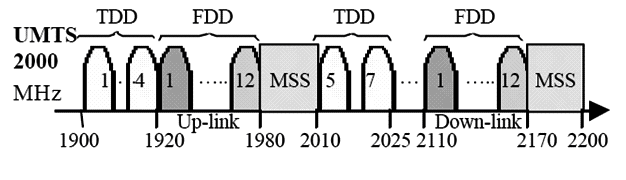
TDD: Time Division Duplex
FDD: Frequency Division Duplex, offset: 190 MHz.
MSS: Mobile Satellite Services
|
|
|
Home
|
Site Map
|
Email: support[at]karadimov.info
Last updated on:
2026-06-24
|
Copyright © 2011-2021 Educypedia.
https://educypedia.org
|
| |
|
|
| |
|