Pyramids and Temples of Ancient Egypt: general
overview  |
| Ancient
Egypt pyramids and temples |
|
Egypt
pyramid index |
|
Egyptian
royal tombs of the new kingdom although the royal tombs of Valley of
the Kings are fascinating and numinous objects, it is rare to find any
explanation of their structure |
| Pyramids:
the inside story learn about the pharaohs for whom these
monumental tombs were built |
|
Royal & private tombs |
| Seven wonders of the ancient world |
| Valley
of the kings Theban mapping project |
| Valley of the Kings
valley of the Kings near
Luxor in the south of Egypt |
| Pyramids,
temples
and tombs of Egypt |
|
Abydos temple
Abydos temple |
| Abu
Sir: land of the forgotten pyramids pyramid of Sahure, pyramid of
Neferirkare, pyramid of Niuserre |
| Djoser
complex
the Step Pyramid Complex of Djoser (also spelled Zozer) was built during the
Third Dynasty (ca. 2800 B.C.) in what is now Saqqara, Egypt. Djoser's Step
Pyramid is generally considered the first tomb in Egypt to be built entirely
of stone |
|
El Kab
El Kab is perhaps most famous for its beautiful Tombs, but there are also a
few Temple ruins in the area. This region was sacred to the goddess Nekhbet,
"She of Nekhen", who was the Goddess of Upper Egypt, ... |
|
Giza pyramids |
|
Giza pyramids
from space jpg file |
| Giza
pyramids: the vanishing point the Giza complex incorporates a vanishing point in its design |
|
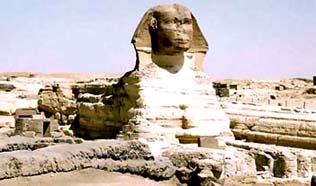
Giza sphinx &
pyramids |
|
Gizeh Gizeh Sphinx et pyramide de Chéops - 4e dynastie - 2500 av. J.-C |
| Guardian's
cyberjourney to Egypt |
| Guardian's Dashur
Dahshur, Sneferu, Bent pyramid, red pyramid, black pyramid |
| Guardian's
Giza visit the pyramids of Giza, the great
pyramid, the pyramid of Khafre, the pyramid of Menkaure, the great Sphinx,
the Giza plateau, a tip |
| Guardian Sfinx
the Sphinx of Giza is a symbol that has
represented the essence of Egypt for thousands of years |
| Great
pyramid of Giza |
|
Great
pyramid of Giza |
| Khufu's
great pyramid it's 756 feet long on each side, 450 high and is
composed of 2,300,000 blocks of stone, each averaging 2 1/2 tons in weight.
Despite the makers' limited surveying tools no side is more than 8 inches
different in length than another, and the whole structure is perfectly
oriented to the points of the compass |
|
Khufu's
great pyramid building Khufu's great pyramid building
animation |
| Neferchichi's
tomb chihuahua pharaoh, mummification, tutankhamun, pharaoh, mythology, anubis, sphinx, pyramid, osiris, isis, canopic
jar |
| Pyramid
at Meidum five miles south of Saqqara stands the tower-like pyramid of
Meidum, which scarcely resembles a typical pyramid at all |
|
Pyramid
of Merenre I |
| Pyramid of Cheops the upuaut project,
explores the shafts of the pyramid of Cheops |
| Pyramid
of Djedefre Djedefre, son of Khufu chose to build his pyramid at a
different site from that of his father. If completed at all, the tomb was
not as big as that of his father, though it may have had the steepest
angle of any known pyramid |
| Pyramid of Menkaure |
| Qadash Kinahnu -
Canaanite Phoenician temple Qadash Kinahnu, a Canaanite Phoenician Temple, a place to learn about and worship the ancient deities El, Baal, Asherah, Anat, and more |
| Saqqara:
home of the first known large stone pyramid |
|
Senusert I's pyramid |
|
Sun temple of Niuserre |
|
Temple of Abu Simbel |
| Temple of
Deir el Bahari |
|
Temple of
Philae Pictures of the Philae temple near Assuan, dedicated to the
Egyptian goddess Isis. The temple has been dismantled and reassembled on the
Aglika island, some 550 meters from its original location on Philae island |
| Temple of Ramesses II
temple of Ramesses II |
|
Temple palace of Rameses III temple palace of Rameses III at Medinet
Habu 1175 BC |
| The great pyramid
the great pyramid is the only one of the seven wonders of the ancient world still standing. It is one of the oldest structures on the face of
the earth and arguably the best built |
|
Sphinx facts, schematics, tunnels, and chambers |
|
Sphinx
the Sphinx is one of the best known monuments of ancient Egyptian
architecture. Unusual to the form of most Egyptian pyramid structures, it
stands as a symbol of the strength of the ancient necropolis of Giza and
as a homage to the strength of the King |
|
Tombe de Ramsès
en Français |
| Tomb of Harwa
tomb from the 25th dynasty in Egypt |
| Tomb of Niankhkhnum and Khnumhotep
in 1964 in the ancient necropolis of Saqqara, Egyptian archaeologist Ahmed
Moussa discovered a series of tombs with rock-cut passages in the
escarpment facing the causeway that lead to the pyramid of Unas |
|
Tomb of
Senneferi the tomb of Senneferi is one of the 'Tombs of the Nobles' on
the west bank at Luxor in Egypt |
|
Tomb of Tuthmosis I and
Hatshepsut |
| Tombs
of the pyramid builders at Giza |
|
Tombs of
the unknown workers (CNN) |
|
Pyramid topics |
|
3D
Illustration of Giza and Saqqara |
|
Analysis of the new shaft plug Found in
Khufu's pyramid |
|
Ancient Egyptian chambers explored one of the mysteries of Egypt's Great
Pyramid deepened early last September when archaeologists penetrated a
4,500-year-old blocked shaft only to find another stone blocking their way |
|
Construction of the pyramids |
|
The shaft, the
subway and the causeway the evidence behind stories of tunnels in the
Giza plateau |
|
Update: third "door" found in great pyramid scientists
exploring the Great Pyramid in Egypt sent a robot into the northern shaft in
the past few days, discovering another blocking stone. The "door" appears to
be identical to the one in the southern shaft that was already known |
|
|
Home
|
Site Map
|
Email: support[at]karadimov.info
Last updated on:
2026-06-24
|
Copyright © 2011-2021 Educypedia.
https://educypedia.org
|
| |