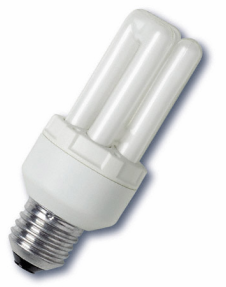
| |
Fluorescent Lighting
Fluorescent lighting is a form of electric lighting based on the gas-discharge lamp. A fluorescent lamp produces light by passing an electric current through a low-pressure gas, rather than by heating a filament as an incandescent bulb does. Because much less of the energy is wasted as heat, fluorescent lamps are considerably more efficient than incandescent bulbs and were for many decades the dominant technology for lighting offices, schools and commercial buildings.
A typical fluorescent tube is a sealed glass cylinder containing a small amount of mercury vapour and an inert gas, with an electrode at each end. When current flows through the tube, it excites the mercury vapour, which emits mainly ultraviolet light. This ultraviolet radiation strikes a phosphor coating on the inside of the glass, and the phosphor fluoresces, converting the invisible ultraviolet into visible light. The choice of phosphor blend determines the colour appearance of the lamp, from cool white to warmer tones.
Because a gas discharge does not by itself limit the current it draws, fluorescent lamps require a device called a ballast to regulate the current and prevent the lamp from destroying itself. Older designs used a magnetic ballast together with a separate starter to initiate the discharge, while modern lamps commonly use electronic ballasts that operate at high frequency, reducing flicker and improving efficiency. Compact fluorescent lamps applied the same principle in a smaller, screw-in form, though light-emitting diode (LED) lighting has since become the more common efficient alternative.
Frequently asked questions
- How does a fluorescent lamp produce light?
- Current excites mercury vapour inside the tube, which emits ultraviolet light. A phosphor coating then converts that ultraviolet radiation into visible light.
- Why does a fluorescent lamp need a ballast?
- A gas discharge does not limit its own current, so a ballast is required to regulate the current and keep the lamp operating safely and stably.
- Why are fluorescent lamps more efficient than incandescent bulbs?
- They generate light through a gas discharge and phosphor conversion rather than heating a filament, so far less energy is lost as heat.
|
|
Fluorescent lighting  |
|
Ballast circuit types
In all fluorescent lighting systems, the ballast performs two basic tasks: 1.
Provides the proper voltage to establish an arc between the two electrodes.
Regulates the electric current flowing through the lamp to stabilize light
output, pdf file |
|
CCFL Characteristics Cold Cathode Fluorescent Lamps (CCFL) are used as
white-light sources to backlight liquid crystal displays (LCDs), pdf file |
|
CFL
bulb CFL bulb, A compact fluorescent lamp (CFL), also known as a compact
fluorescent light or energy saving light (or less commonly as a compact
fluorescent tube [CFT]), is a type of fluorescent lamp. Many CFLs are designed
to replace an incandescent lamp and can fit into most existing light fixtures
formerly used for incandescents |
|
CFL Lamp
Self Oscillating 25W CFL Lamp Circuit, pdf file |
|
Compact fluorescent lamp Helical compact fluorescent lamp |
|
Compact Fluorescent
Light Bulbs CFLs produce light differently than incandescent bulbs. In an
incandescent, electric current runs through a wire filament and heats the
filament until it starts to glow. In a CFL, an electric current is driven
through a tube containing argon and a small amount of mercury vapor. This
generates invisible ultraviolet light that excites a fluorescent coating (called
phosphor) on the inside of the tube, which then emits visible light |
|
Cold Cathode
Fluorescent Lamp CCFL Characteristics, Cold Cathode Fluorescent Lamps (CCFL)
are used as white-light sources to backlight liquid crystal displays (LCDs) |
|
Cold Cathode
Fluorescent Lamp (CCFL) Cold Cathode Fluorescent Lamp, pdf file |
|
Cold Cathode Fluorescent
Lamp application note pdf file |
|
COLD CATHODE FLUORESCENT
LAMPS (CCFL’s) pdf file |
|
Compact fluorescent lamps
compact fluorescent technology |
|
Compact Fluorescent Lamp
(CFL) Electrical construction, Lamp start, Normal operation, Failures,
Repair of electronic, Mechanical construction, Reviewing, Links, Schematics and
photos |
|
EEFL
External Electrode Fluorescent Lamp, EEFL, The EEFL (External Electrode
Fluorescent Lamp) differs from other fluorescent lamps, with its electrodes
outside of the Lamp.External electrodes power the electric field in the lamp,
then making plasma come into being, The light source of this Lamp is Plasma
which is derived by External electrode of electric field inside the Lamp |
|
EEFL-Backlight
Technology EEFL-Backlight Technology |
|
Fluorescentielampen in Dutch |
|
Fluorescent en Français, pdf file |
|
Fluorescent lamp Fluorescent lamps: How Fluorescent lamps works |
|
Fluorescent lamp control gear control gear for the Low-Pressure, mercury lamps, HID (sodium, highpressure, mercury and Metal Halide Lamp) circuits,
electronic ballasts and controllers, dimmers, pdf file |
|
Fluorescent lamps Fluorescent lamps,
Driving a fluorescent tube, starter, lamp ballast, pdf file |
|
Fluorescent lamps
Fluorescent lamps, IR21571: Dual Lamp Series Configuration, ballast, pdf file |
| Fluorescent lamps
rapid start lamp |
|
Fluorescent lamps
rapid start lamp, ppt file |
|
Fluorescent lamps, ballasts, and fixtures |
| Fluorescent
lamps, ballasts, and fixtures principles of operation, circuits, troubleshooting, repair. Fluorescent lamps are a type of gas discharge tube
similar to neon signs and mercury or sodium vapor street or yard lights |
|
Fluorescent lighting |
|
Fluorescent
Lighting document Fluorescent Fixtures and Ballasts, Wiring for preheat
fluorescent fixtures, Wiring diagram for single tube rapid or trigger start
ballast, Wiring diagram for two tube rapid start ballast |
|
Fluorescent Tubes Linear Fluorescent Bulb Types |
|
Gas
discharge lamps, ballasts, and fixtures |
|
Lichtexplosie in een
microgolfoven |
|
Lichtexplosie in een
microgolfoven 2 |
|
Lichtexplosie in een
microgolfoven 3 |
|
Lighting Tutorial |
|
Tl-buizen Hoe werkt een tl-buis?
Ballasten |
|
Tube
fluorescent animation |
|
|
Home
|
Site Map
|
Email: support[at]karadimov.info
Last updated on:
2026-06-24
|
Copyright © 2011-2021 Educypedia.
https://educypedia.org
|
| |
|
|