| |
Synchronous Motors
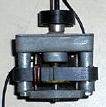
A synchronous motor is a type of alternating-current (AC) machine in which the rotor turns at a speed precisely locked to the frequency of the supply. The rotating magnetic field produced by the stator windings and the magnetic field of the rotor remain in step, so the motor runs at a constant synchronous speed determined by the supply frequency and the number of magnetic poles, regardless of the load within its capacity.
The defining feature of a synchronous machine is that there is no difference between the speed of the rotating field and the speed of the rotor. This contrasts with the induction motor, the most common AC motor, in which the rotor must turn slightly slower than the rotating field in order to generate torque. That speed difference in an induction motor is called slip, and it is what allows current to be induced in the rotor. A synchronous motor has no slip, but for this reason it does not produce starting torque on its own and usually needs an auxiliary means to bring it up to speed before it can lock into synchronism.
Synchronous motors are valued where constant speed is important, and large synchronous machines can also be adjusted to improve the power factor of an electrical system. Smaller permanent-magnet synchronous motors are common in precise drives and, with electronic control, in many modern applications. Understanding torque, slip and the relationship between speed and supply frequency is central to comparing synchronous and induction motors and to choosing the right machine for a given task.
Frequently asked questions
- What makes a motor “synchronous”?
- Its rotor turns exactly in step with the rotating magnetic field set by the supply frequency, giving a constant speed that does not vary with load.
- What is the difference between synchronous and induction motors?
- An induction motor's rotor turns slightly slower than the field, a difference called slip, while a synchronous motor runs with no slip, exactly at synchronous speed.
- Why might a synchronous motor need help to start?
- Because it has no slip, it does not generate starting torque by itself, so an auxiliary method is usually required to bring it up to speed before it locks into synchronism.
|
|
Synchronous motors  related topic: Generators
 |
|
3-Phase PM Synchronous Motor Control with Quadrature Encoder The PM
Synchronous motor is a rotating electric machine where the stator is a classic three phase stator like that of an induction motor and the
rotor has surface-mounted permanent magnets, pdf file |
|
Machine synchrone en Français, pdf file |
|
Machine synchrone
bipolaire simplifié, en Français, pdf file |
|
Machine synchrone
machine synchrone triphasée tétrapolaire, en Français, pdf file |
| Machine synchrone en Français, pdf file |
|
Machine synchrone en Français, pdf file |
|
Machine synchrone triphasée en Français |
| Moteur synchrone
3f en Français |
| Moteur synchrone en Français |
|
PRINCIPLES OF OPERATION OF SYNCHRONOUS MACHINES pdf file |
|
Speed Control of Induction Machines Speed Control of Induction Machines, pdf file |
|
Synchrone machines
in Dutch, pdf file |
|
Synchronous Machine pdf file |
|
Synchronous Machine Armature Windings pdf file |
|
Synchronous Machines |
|
Synchronous Machines synchronous generator, synchronous motor, automatic
voltage regulator, V-curves, synchronizing power, hunting, excitation system, pdf file |
|
Synchronous Machines Phasor diagram of a synchronous motor in under
excitation, unit power factor, and over excitation mode,
pdf |
|
Synchronous motor pdf file |
|
Synchronous Motor pdf file |
|
Synchronous motor characteristics synchronous motors are three-phase AC motors which run
at synchronous speed, without slip, pdf file |
|
Synchronous
Motor Characteristics Synchronous Motors are three-phase AC motors which run at synchronous
speed, without slip, The rotation of a synchronous motor is established by the
phase sequence of the three-phase AC applied to the motor stator, Synchronous
motor characteristics, pdf file |
|
Synchronous motor (V-curves) How Does a Synchronous Motor Work, pdf file |
|
Synchronous
Machines Synchronous motor, Synchronous machines are AC machines that a
field circuit supplied by an external DC source Synchronous generators or alternators are synchronous machines used to convert
mechanical energy into electrical energy. Synchronous motors convert electrical
energy into mechanical energy, pdf file |
 |
|
|
|
|
Home
|
Site Map
|
Email: support[at]karadimov.info
Last updated on:
2026-06-24
|
Copyright © 2011-2021 Educypedia.
https://educypedia.org
|
| |
|
|