| |
Robotics
Robotics is the field concerned with designing, building and controlling machines that can sense their surroundings and act on them. A robot generally brings together three kinds of parts: sensors that gather information about the environment, a controller that decides what to do, and actuators that produce movement. The controller, often a microcontroller such as a small programmable board, reads the sensors, runs a program and sends commands to the actuators, closing the loop between perception and action.
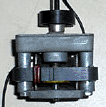
Motors are the most common actuators in robotics, and several types serve different needs. A brushed DC motor is simple and spins faster as more voltage is applied, making it suitable for driving wheels, though it gives no direct information about its position. A stepper motor moves in fixed angular steps each time it is pulsed, so a controller can position it precisely by counting steps without needing a position sensor. A servo motor combines a motor with feedback that reports its position, allowing it to be commanded to a specific angle and hold it; small hobby servos are widely used to move robot arms and joints.
Brushless DC motors replace the mechanical commutator of a brushed motor with electronic switching, giving longer life and higher efficiency, and servo systems may be built around brushed, brushless or AC motors depending on the precision required. Beyond the hardware, robotics involves controlling motion smoothly, interpreting sensor data, and programming behaviour so the machine responds appropriately to changing conditions. These elements combine in machines ranging from simple educational robots to industrial arms and mobile vehicles.
Frequently asked questions
- What are the basic parts of a robot?
- Most robots combine sensors that perceive the environment, a controller that decides what to do, and actuators such as motors that produce movement.
- How does a stepper motor differ from a servo motor?
- A stepper moves in fixed steps that a controller counts to set position without a sensor, while a servo uses position feedback to be commanded to a precise angle and hold it.
- Why are brushless DC motors used in robotics?
- They replace the wearing mechanical commutator with electronic switching, giving longer life and higher efficiency than brushed motors.
|
|
Robotics
info  related jubject: Basic stamp,
Motor control circuits
related jubject: Basic stamp,
Motor control circuits |
|
2 robots in achtervolging |
|
A Technical Guide To
Building Fighting Robots
How can I use that really cheap motor?", "How can I build my own speed
controller?", "Why do I lose radio contact when the motors start?", "How big a
battery do I need?" , can I build my own circuit |
|
AVR Robot Controller
The controller is built around the powerful Atmel ATMEGA16 processor with 16kb
of memory running at 8 MHz for an 8 mip processing speed |
| BEAM
Circuits
Motor drivers, Solar engines, simple contact sensors, acoustic
proximity sensors, schematics |
|
Halloween projects |
|
Kronos Robotics
Robot Toys and Devices, Build Your First Walker Robot Workbook, Robot Forum,
Weather Related Projects |
|
Lego robots
building pdf file |
|
Lego robots course notes a tip |
| Robobricks
project the robobricks project consists of a bunch of modules, called RoboBricks, that can be assembled together to create interesting robotic
platforms |
|
Robot
building lessons, projects squirting autonomous mobile robot, autonomous six legged walking robot, serpentine robot, pipe climbing and inspection
robots, reconnaissance robot |
|
Robot Control The robot
applet provides a simulation of a robot perceiving and acting under the control
of a set of customizable robot controller functions |
|
Robot Control |
|
Robotic projects
OOpic, 90S2313 robot board, IR encoder/decoder, schematics included |
|
Robotics
Basic Control Methods, Feedback Control, Open-Loop Control, Feed-Forward
Control, principles of operation and applications of various robotics sensors,
Describes basic mechanics, friction, and the simple machines that comprise the
building blocks of more complex machines, like robots |
|
Robotic projects
related jubject: Basic stamp,
Motor control circuits |
|
3 robots in rij |
|
BEAM Circuits |
|
Build a Darning needle motor
Build a Darning needle motor |
|
Desktop Line
Following Robot line follower, photo-reflectors, vibration motors,
Tracking control |
| Electric powered
Go-Cart |
|
Floppy Disk Drive Construction and Operation takes a look at the basic
components and physical operation of a floppy disk drive |
|
Floppy disk
robot "Hacking" a Mac floppy disk eject motor |
|
Floppy drive robot
Converting a floppy disk drive into a simple robot |
|
Hard Disk Spindle Motor
The spindle motor, also sometimes called the spindle shaft, is responsible for
turning the hard disk platters, allowing the hard drive to operate |
| Line tracking
robot pdf file |
|
Line
Following Robot Line Following Robot, AVR microcontroller, Sensor Circuit,
Motor Interface and Control Circuit, pdf file |
|
Micro-Bot
Micro-Bot Main Board Schematics, Hardware, Switches & Mechanical
Drawing, Basic RF Remote Control, 40KHz IR Carrier Generation Without Hardware
PWM, CDS Photocell & Infrared Navigation, RF Remote Control & IR Navigation,
a tip |
| Pitronics
een licht-etende robot, idem van hierboven maar in het Nederlands, click here for the English version,
vision, IR radar |
|
Radio control and
electronics The Electronic Motor Speed Controller, PPM Radio Control System |
|
Robot als lijnvolger |
|
Robot in doolhof |
|
Robot in doolhof2 |
| Solarbotics
useful collection of material for beam roboticists of all experience levels and abilities |
|
Solar bug |
|
Solar
robot tutorial |
| Sonar
sensor for the robot |
|
Speed and direction converter circuits |
| Wheel encoders for robotics
rate encoders with 30 degree and 10 degree increments, quadrature encoder, 2 bit binary encoder, 4 bit Gray code encoder |
|
|
Home
|
Site Map
|
Email: support[at]karadimov.info
Last updated on:
2026-06-24
|
Copyright © 2011-2021 Educypedia.
https://educypedia.org
|
| |
|
|