| |
Digital Codes and Numbering Systems
Digital systems represent numbers and characters using coding schemes that assign patterns of binary digits to values. The natural binary system is positional, with each bit weighted by a power of two, but many other codes exist that trade this simplicity for properties useful in particular applications. Encoders and decoders are circuits that translate between such codes and other representations, for example converting a decimal input into its binary code or driving a display.
Several weighted and special codes are common. Binary-coded decimal (BCD), or the 8421 code, represents each decimal digit by its own four-bit binary group, which simplifies decimal display and arithmetic at the cost of efficiency. The Gray code is arranged so that consecutive values differ in only one bit, which avoids the ambiguity that can occur when several bits change at once, making it valuable in position encoders. The Excess-3 code offsets each decimal digit, giving self-complementing properties helpful in some arithmetic circuits.
Because stored and transmitted data can be corrupted, error-detecting and error-correcting codes add redundancy to guard against mistakes. The simplest is a parity bit, which records whether the number of ones in a group is even or odd and so detects any single-bit error. More powerful schemes, such as the Hamming code, add several check bits positioned so that not only is an error detected but its location can be identified and corrected. Character codes such as ASCII and EBCDIC assign binary values to letters and symbols, and floating-point formats encode real numbers with a sign, exponent and fraction.
Frequently asked questions
- What is BCD code?
- Binary-coded decimal represents each decimal digit by a separate four-bit binary group. It eases decimal display and arithmetic but uses bits less efficiently than pure binary.
- Why is Gray code useful?
- In Gray code only one bit changes between consecutive values. This avoids transient errors when multiple bits would otherwise switch at once, which is valuable in position and angle encoders.
- How does a Hamming code correct errors?
- It adds several check bits placed so that, when an error occurs, the pattern of failed checks points to the exact bit in error, allowing it to be flipped back and corrected.
|
|
Decoders and encoders  related topic: Barcode,
Magnetic stripe technology
related topic: Barcode,
Magnetic stripe technology |
|
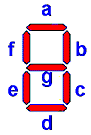
7 segment decoder
7 segment decoder, 7 segment display decoder |
|
7-Segment Decoder Driver and Display to demonstrate the operation of a
decoder-driver circuit that accepts a binary or BCD input code and generates the
7 segment display signals to produce the numbers 0 through 9 and other
characters |
|
7-Segment Display 7-Segment Display, There are two types of displays
available, common anode and common cathode,
pdf file |
|
7-Segment Displays 7-Segment Displays decoder |
|
7-Segment LED
Displays
pdf file |
|
7 segment LED driver |
|
7-Segment To Nixie
Decoder |
|
BCD naar 7-SEGMENT
in Dutch |
|
BCD to 7-segment decoder
BCD to 7-segment decoder, 4511 BCD to 7-segment decoder |
|
BCD to 7-segment latch/decoder/driver HEF4511B,
pdf file |
|
BCD TO 7-SEGMENT
DECODER/DRIVER
pdf file |
|
CD4511 BCD-to-7 Segment Latch/Decoder/Driver
pdf file |
|
Combinational
Circuits full adder, decoders, encoders, adders, multiplexers,
ppt file |
|
Combinational
circuits decoders, encoders, adders, multiplexers, demultiplexers,
pdf file |
|
Combinational
logic decoders, encoders, adders, multiplexers, demultiplexers |
|
Combinational Logic Building Blocks Half and Full Adder, decoders, encoders, adders, multiplexers, demultiplexers,
pdf file |
|
Combinational
logic & systems tutorial guide combinational
logic & systems tutorial guide |
|
Data compression pdf
file |
|
Decimal-to-BCD Encoder Decimal-to-BCD Encoder |
|
Decoders
Decoders can detect a code and activate a single output to signal the presence
of that code. Decoders have many applications, from producing system alerts in
alarm systems to performing the task of driving multiple devices in
microprocessor systems (e.g. memory), ... |
| Decoders in Dutch, pdf
file |
| Decoders
and encoders Decoders and encoders, ppt file |
|
Decoders
and encoders decoders and encoders, multiplexers, pdf file |
|
DM74LS47 BCD to 7-Segment Decoder/Driver with Open-Collector Outputs |
|
Encoders: 4 bit gray code 4 bit gray code |
| Multiplexers in Dutch,
pdf file |
| Multiplexers
pdf file |
|
|
 |
|
|
Home
|
Site Map
|
Email: support[at]karadimov.info
Last updated on:
2026-06-24
|
Copyright © 2011-2021 Educypedia.
https://educypedia.org
|
| |
|
|

