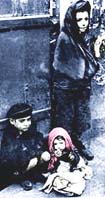
Concentration
camps in Europe - list  |
|
Auschwitz
Auschwitz was designated to be the central site of the nazi genocide by
Heinrich Himmler, Reichsführer S.S. and Rudolf Höss,
commandant of the Auschwitz concentration camp |
| Auschwitz
Auschwitz Concentration camp |
|
Auschwitz
work will set you free, the motto and first thing seen by prisoners as they entered Auschwitz. Once through the front gate an
orchestra of gaunt, malnourished prisoners in dirty-stripped uniforms played
music for the prisoners going to and returning from their daily labor |
|
Auschwitz
Auschwitz Concentration camp |
|
Auschwitz
Auschwitz Concentration camp |
|
Auschwitz
Auschwitz Concentration camp, Interactive Map of Auschwitz |
|
Auschwitz |
|
Auschwitz
the dentist of Auschwitz |
| Auschwitz -
album a timeline of the events of the Holocaust with over 300 events and brief entries on each,
comprehensive
collection of over 200 documents on the destruction of the Jews of Germany and Austria, Poland and the Soviet Union |
| Auschwitz -
a virtual tour the written and photographic record of five days spent
visiting two Nazi concentration camps in and near Oswiecim, Poland, known as
Auschwitz and Birkenau |
| Auschwitz
endstation vernichtung Auschwitz is the site where the planned and organised
genocide took place; its victims were not buried, but burnt and their ashes
spread over the fields in the vicinity |
| Auschwitz
the one who does not remember history is bound to live through it again, Virtual
tour of Auschwitz the written and photographic record of five days spent
visiting two Nazi concentration camps in and near Oswiecim, Poland in
September 1993. Known as Auschwitz and Birkenau, the two camps were liberated
in January 1945 |
| Auschwitz
holocaust Adolf Hitler and his kz deathcamps vs Oscar Schindler, a
tip |
| Auschwitz
- Birkenau
Auschwitz Birkenau - " The death factory " |
|
Auschwitz FINAL STATION EXTERMINATION |
| An Auschwitz alphabet
the most significant facets of life and death in Auschwitz |
|
Beendorf |
| Belzec
death camp in Poland where 600,000 people, all Jews and a few hundred gypsies,
were killed, Testimonies
of Belzec SS-Men |
| Belzec
Belzec was the laboratory for murder which was carried out in the main by
civilians and German police officers drafted into the euthanasia program (T4)
who were then dressed up in SS uniforms. They were not SS as we know the term.
They were bogus SS-Scharfuhrers given the rank and uniform by default |
|
Belzec |
| Bergen-Belsen
a concentration camp established in 1943 originally to hold prisoners to be
used in political exchanges |
|
Bisingen
Bisingen a satelite camp of Natzweiler |
|
Breendonk
concentration camp |
|
Breendonk |
| Breendonk |
|
Breendonck Breendonck concentration camp in Belgium |
| Breitenau
in German |
|
Buchenwald
liberation the concentration camp Buchenwald during World War II |
| Buchenwald
Buchenwald memorial is situated about 8 kilometres north of the city centre of
Weimar |
| Buchenwald:
fifty years later, Liberation
of Buchenwald |
| Chelmno
the first Nazi camp in which mass killings were carried out by gas (Vernichtungslager
Kulmhof =German) |
| Chelmno
death camp for total extermination |
|
Chelmno
extermination camp |
| Chelmno
extermination camp, Photos |
|
Dachau
Scrapbook |
| Dachau
liberation |
|
Dachau and its liberation |
| Debica
(Dembitsa), Poland |
|
Drancy
concentation camp in France, the camp of Drancy was a transit camp located not far from Paris. Like many other
camps in France, it was created by the government of Philippe PÈtain and was under the control of the French police |
|
Drütte
Drütte concentration camp |
|
Emslandlager |
|
Esterwegen |
|
Flossenbürg
after Dachau, Buchenwald and Sachsenhausen, Flossenbürg was the fourth concentration camp established in Germany by the Nazis |
| Flossenbürg
Flossenbürg is gelegen in de Oberpfalz, Bayern, Duitsland. Op de weg naar
Pilzen, ongeveer 3 km voor de Tsjechische grens |
| Flossenbürg |
| Flossenburg
concentration camp |
| Forgotten prisoners of Rabaul |
|
Fuhlsbüttel concentration camp, police prison, detention barracks, satellite camp |
| Gardelegen |
|
Gross Rosen |
| Gurs
concentration camp in Toulouse, France. Camp Gurs est un camp de concentration
français d'abord destiné aux réfugiés républicains espagnols, puis aux juifs
qui, livrés par la France, finiront dans les camps de la mort,
en Français |
| Hinzert
police custody and SS "re-education camp" for workers who found
disfavor |
| Kamp Vught
kamp Vught was één van de grote en belangrijke concentratiekampen in het SS terreursysteem, in Dutch |
| Kamp Westerbork
short walk through the former internmentsite Kamp Westerbork in the Dutch province of Drente, Photos |
| Koldychevo
camp Koldychevo - Koldyczewo in Polish, first was used as a forced labor camp in Belorussia established by the Nazis late in 1941. Later it became an
extermination camp for Russians and Poles |
| Ladelund
in German |
|
Majdanek
Concentration Camp - history of a Nazi death camp
like Auschwitz, Majdanek was both a labor camp and an extermination center. Situated
on the southern perimeter of the historic Polish city of Lublin, Majdanek was
the only killing center in the General Government that was not devoted primarily
to the murder of Jews |
| Majdanek
located approximately three miles (five kilometers) from the center of the Polish city of Lublin, was the second largest Nazi concentration camp, Photos,
Photographs
from Maidanek (Majdanek) |
|
Majdanek and Lublin |
|
Majdanek and Lublin |
|
Majdanek report |
|
Maly Trostenets |
|
Mauthausen-memorial |
| Mauthausen
WWII Holocaust Shoah Mauthausen gusen Bergkristall concentration camp |
| Mauthausen
- Gusen the KZ Gusen I, II and III concentration camp complex was the largest and most brutal within the Mauthausen camp system |
| Mittelbau
Dora |
|
Mittelbau Dora photos |
|
Mittelbau Dora photos |
|
Mittelbau Dora photos |
|
Mittelbau Dora virtual reality movies |
|
Natzweiler-Struthof
first designated as a "camp for civilian war prisoners" and officially became a concentration camp on January 8,
1942 |
|
Natzweiler-Struthof
in German |
|
Neuengamme |
| Neuengamme, Concentration
camp memorial Neuengamme |
|
Neuengamme concentration camp in Germany |
| Nizkor project
dedicated to the millions of Holocaust victims who suffered and died at the hands of Adolf Hitler and his nazi regime,
a lof of useful archival material presented here |
| Nordhausen
honor to all who rescued the prisoners of Dora/Nordhausen concentration camps and to those who lived and died there |
|
Nordhausen- The "Boelcke Kazerne" by Ragene Farries |
|
Oranienburg |
|
Poppenbüttel Plattenhaus
from September 1944 until May 1945 a satellite camp of Neuengamme concentration camp was set up in the outlying
Hamburg district of Sasel. Besides political detainees and Sinti gypsies, the
majority of the 500 women held in the camp were Jewish and had been deported
from the Lodz ghetto to Sasel via Auschwitz concentration camp |
|
Ravensbrück
Ravensbrück, located 70 km north of Berlin, was Germany's largest women's
concentration camp. From 1939 to 1945, approximately 132,000 women from 47
countries were imprisoned there due to their race, religion, ideology or their
social behavior |
|
Ravensbrück |
| Ravensbrück |
| Ravensbrück
2 in German |
| Sachsenhausen
the camp had an installation for mass execution by shooting, disguised as a prisoners' examination room. Of the 30,000 people who perished there, the main
group killed, were Soviet prisoners of war |
| Sachsenhausen
Sachsenhausen was located in the town of Oranienburg about 20 miles north of Berlin. The camp was opened in September, 1936. Built for 10,000,
nearly 200,000 passed through the camp with about 100,000 dying |
| Sachsenhausen Oranienburg |
|
Sandhofen |
|
Sobibor
concentation camp in Poland |
| Sobibor
Sobibor exterminationcamp was build about a 5 kms from the little village of Sobibor. In this camp up to 260.000 Jews were killed, Sobibor, Adolf Hitlers
deathcamp only one purpose: to kill as many Jews as quickly as possible |
| Sobibor (Pologne)
in French |
| Steiermark |
|
Stutthof
in September 1939, the Germans established the Stutthof camp in a wooded area west of Stutthof (Sztutowo), a town about 22
miles east of Danzig (Gdansk) |
|
Terezin |
|
Treblinka |
| Treblinka
Treblinka, established in 1941 as a forced labor camp for those accused of crimes by the occupation authorities was located 50 miles northeast of Warsaw,
Poland |
| Treblinka |
| Treblinka,
Acts
of resistance and the organization of the revolt in Treblinka |
|
Uckermark
concentration camp Uckermark was a concentration camp for girls mostly aged
16-21, although girls as young as 8 years old are known to have been imprisoned
here. After the war, the camp was used as a hospital and then the buildings were
burned when no longer needed |
|
Vaihingen |
|
Westerbork |
|
Westerbork |
|
Westerbork
during the Nazi occupation of the Netherlands, Westerbork became the main transit camp to send Dutch Jews and Roma to death camps in
Poland |
|
|
Home
|
Site Map
|
Email: support[at]karadimov.info
Last updated on:
2026-06-24
|
Copyright © 2011-2021 Educypedia.
https://educypedia.org
|
| |