|
|
|
|
|
|
| |
Photographs of the Holocaust
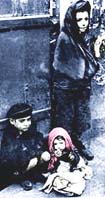
Photographs are among the most powerful records of the Holocaust, providing direct visual evidence of events that words alone struggle to convey. Surviving images come from several sources, including official German military and propaganda photographers, perpetrators who documented their own actions, members of resistance and underground groups, and the Allied forces who liberated the camps. Together these photographs form an important part of the historical record of the genocide carried out by Nazi Germany during World War II.
The surviving images capture many stages of the persecution. Some show life and suffering inside the ghettos, others record deportations and the arrival of prisoners at camps, and many were taken by liberating soldiers who found the camps and their survivors at the end of the war. These liberation photographs, showing emaciated survivors and the evidence of mass death, shocked the world and became central to public understanding of what had occurred. A number of images were also used later as evidence in war-crimes trials.
Photographs must be interpreted with care. The context of who took an image, why, and what lies outside the frame all affect its meaning, and propaganda photographs in particular were staged to serve the regime's purposes. Historians and archives work to verify, date and caption such images accurately. Preserved in museums and memorial institutions, Holocaust photographs continue to serve as evidence, as a means of remembering the victims as individuals, and as a warning for future generations.
Frequently asked questions
- Who took the photographs of the Holocaust?
- They came from several sources, including German official and propaganda photographers, perpetrators, resistance members, and the Allied soldiers who liberated the camps at the end of the war.
- Why are liberation photographs significant?
- Photographs taken when the camps were liberated revealed the scale of the suffering and death to the wider world and became key evidence of the crimes, shaping public understanding of the Holocaust.
- Why must Holocaust photographs be interpreted carefully?
- The source, purpose and framing of an image affect its meaning, and some were staged as propaganda. Historians verify, date and caption photographs to ensure they are understood accurately.
|
|
Holocaust
photos  |
|
Air photo evidence-maps of Auschwitz and
other WW2 camps |
|
Auschwitz album |
|
Auschwitz photographs
1979-1981 photographs- Auschwitz-Birkenau |
| Auschwitz
today |
| Birkenau -
photographs Birkenau - photographs |
|
Buchenwald
on April 11, 1945 the lead elements of the 80th Infantry Division arrived in Weimar, Germany. Home to the former republic
and the infamous concentration camp. Over 56,000 people of all nationalities
were murdered at Buchenwald between 1935 & 1945. In fact the guards of
Buchenwald were still in the process of attempting additional executions even as
the American army was literally at the gates to the camp |
|
Cybrary of the Holocaust: images |
| Dachau |
|
Dachau |
| Deportation
transports from Westerbork to Auschwitz and Sobibor |
|
Einsatzgruppen |
| Flossenburg
concentration camp |
| Hitler's victims |
|
Holocaust album |
|
Holocaust images |
|
Holocaust images |
|
Holocaust images |
|
Holocaust
movies |
|
Holocaust
photographs |
|
Holocaust photos |
|
Holocaust photos
view of the kitchen barracks, the electrified fence, and the gate at the main
camp of Auschwitz. In the foreground is the sign "Arbeit Macht Frei" 1945 |
| Holocaust
photos a glimpse of the horrors of Nazi Germany's Final Solution of the
Jews during World War II |
|
Holocaust pictures |
|
Holocaust
pictures exhibition a mass execution of Jews in Nazi occupied Soviet Union,
SS women at the Belsen camp, scenes of horror at Nazi concentration camps, gas chamber inventory, cites shower heads and gas tight door |
|
Holocaust virtual reality quicktime |
| Images
for reflection images of the Jewish Holocaust from the camera of amateur photographer and world traveler Scott L. Sakansky,
germany, Auschwitz, Belzec, Birkenau, Buchenwald, Dora/Nordhausen, Majdanek, Mauthausen, Ninth Fort, Paneriai, Ravensbruck, Sachsenhausen, Small Fortress, Theresienstadt, Treblinka, Umschlagplatz, Warsaw Ghetto Memorial, Yad Vashem, Zamosc, Sakansky |
|
Liberation of the Western concentration camps- 1945 |
|
Krakow
Ghetto 1940 - 1943 |
| Learning about the Holocaust through
art |
|
On-line
exhibitions |
| Paintings by
Survivor Jan Komski |
|
Paintings by Survivor Tamara Deuel |
|
Photographs
documenting the holocaust in Hungary when the Soviet Army captured Budapest
on January 17-18, 1945, it was too late to save the lives of 564,500 Jews who
had been sent to the various death-camps run by the Nazis |
|
Photos of
Natzweiler-Struthof Nazi concentration camp in Alsace |
| Photos:
the Nuremberg trials |
|
Shoah, the Holocaust
containing a selection of documentary photographs, texts, essays and poetry on
the Shoah. Most of the material concerns the annihilation of Jews by the Nazis in
the occupied Poland in the years 1939-1944. There are sections on the
Kristallnacht, annihilation of Jews in small towns, the Warsaw Ghetto, the
Warsaw Ghetto Uprising, Auschwitz, Treblinka, Chelmno, Belzec, and Majdanek Nazi
death camps |
|
Teacher's
guide to the holocaust |
| The
last expression art from Auschwitz |
|
Uckermark
concentration camp |
|
Virtual guide to the holocaust a tip |
|
Warsaw ghetto |
|
Warsaw ghetto |
|
Warsaw ghetto
Warsaw ghetto photographs |
|
Warsaw ghetto uprising |
|
Wavs & images of the holocaust |
|
Westerbork
photographs |
|
|
Home
|
Site Map
|
Email: support[at]karadimov.info
Last updated on:
2026-06-24
|
Copyright © 2011-2021 Educypedia.
https://educypedia.org
|
| |
|
|
| |
|