| |
Magnetic Reed Switches
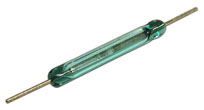
A reed switch is a simple electrical switch operated by a magnetic field. It consists of two thin ferromagnetic blades, or reeds, sealed inside a small glass envelope with their ends overlapping but not touching. When a magnetic field is brought near, the reeds become magnetised with opposite polarities at the overlap, so they attract one another, bend and make contact, completing the circuit. When the field is removed, the springiness of the reeds pulls them apart and the switch opens.
The glass envelope is usually filled with an inert gas or sealed under vacuum, protecting the contacts from oxidation and contamination and giving reed switches long service life and reliable operation. Because they are operated without physical contact to the actuating magnet, reed switches are well suited to position and proximity sensing, for example detecting whether a door or window is closed in a security system, or sensing the level of a float in a tank. A reed relay places a reed switch inside a coil so that an electric current, rather than a permanent magnet, operates it.
Like any mechanical switch, reed switches exhibit contact bounce: when the contacts close they may briefly open and re-close several times before settling. In circuits that count pulses or drive logic, this bounce must be removed by debouncing, using hardware filtering or software timing. Reed switches handle modest currents and voltages and are valued for their simplicity, hermetic sealing and contactless operation.
Frequently asked questions
- How does a reed switch close?
- A nearby magnetic field magnetises the two ferromagnetic reeds with opposite poles at their overlap, so they attract, bend together and make electrical contact.
- What is the difference between a reed switch and a reed relay?
- A reed switch is operated by an external magnet, whereas a reed relay surrounds the switch with a coil so an electric current operates the contacts.
- Why does a reed switch need debouncing?
- Its mechanical contacts can bounce briefly when they close, producing extra pulses that must be filtered out in counting or logic circuits.
|
|
Reed switches  related subject: Relays,
Switches
related subject: Relays,
Switches |
|
Basic Electrical Parameters of Reed Switch Products pdf file |
|
Basic reed switch A Reed Switch consists of two ferromagnetic blades
(generally composed of iron and nickel) hermetically sealed in a glass capsule,
..., pdf file |
|
Handling and Load Precautions when using Reed Switches in various Sensor and Relay Applications pdf file |
|
How Reed Switches are used with a Permanent Magnet Reed Switch Operational
Characteristics, pdf file |
|
Load Switching and
Contact Protection The Reed Switch contact rating is dependent on the switch
size, gap size or ampere turn rating, contact material and atmosphere within the
glass capsule. To receive the maximum life for a given load some precautions may
be necessary, pdf file |
|
Magnetic reed switch principals of operation
magnetic reed switch principals of operation, pdf file |
|
Permanent magnets for reed switch operation pdf file |
|
Reed relay protection
a reed relay consists of a coil wrapped around a reed switch. The switch is
composed of two overlapping ferromagnetic blades (called reeds) that are
hermetically sealed within an inert-gas-filled glass capsule. When current flows
through the coil, a magnetic field is produced that pulls the two reeds together |
|
Reed
relays how reed relays work, pdf file |
|
Reed
sensor applications Reed switches and reed sensors find applications in vast
areas, from simple position sensing in doors to more complicated ones used in the military and in sophisticated cellular phone radio
frequency (RF) switching electronics, pdf file |
|
Reed Sensors Vs. Hall
Effect Sensor pdf file |
|
Reed switch
the reed switch consists of a pair of flexible reeds made
of a magnetic material, and sealed in a glass tube filled with inert gas. The
reeds are overlapped but separated by a small gap,
Educypedia |
|
Reed switches gives detailed information right from the basics of reed
switches, magnets, different ways of actuation, magnet selection etc. A glossary
section with meanings to the most widely used reed switch terms is also
available, pdf file |
|
Reed
switches applications The Reed Switch used as a Reed Relay,
how reed switches are used with a permanent magnet,
magnetic reed switches and their uses, glass reed switches, pdf file |
|
Reed
switch |
|
Reed switch bounce
Reed switch bounce, Reed relay bounce, pdf file |
|
Reed switch pdf file |
|
Reed Switch in Comparison with Mechanical Switch pdf file |
|
Reed switches
detailed information right from the basics of reed switches like how they work
to the more advanced topics like magnet selection, and contact protection. The
basic reed switch consists of two identical flattened ferromagnetic reeds,
sealed in a dry inert-gas atmosphere within a glass capsule, thereby protecting
the contact from contamination. The reeds are sealed in the capsule in
cantilever form so that their free ends overlap and are separated by a small air
gap |
|
Reed switches
reed swtches: FAQ |
|
Reed switches
a reed switch consists of two or three springy metal reeds
having plated, long-life contacts at the tips and encapsulated in a sealed glass
tube. The two-reed type has normally open
(NO) contacts which close when operated, and the three-reed
type is a changeover, i.e. it has a pair of normally open (NO) and a pair of
normally closed (NC) contacts. When the switch
is operated, both these pairs change to the opposite state |
| Reed
switch motor,
Transistor based motor |
|
Reed Switch Selection |
|
Reed switch structure operation, actuation, applications, pdf file |
|
|
Home
|
Site Map
|
Email: support[at]karadimov.info
Last updated on:
2026-06-24
|
Copyright © 2011-2021 Educypedia.
https://educypedia.org
|
|
|