|
|
|
|
|
|
| |
Homemade Batteries
A homemade battery is a simple electrochemical cell built from everyday materials to demonstrate how chemical reactions can produce electricity. A basic cell consists of two different metals, called electrodes, placed in a conducting solution called an electrolyte. Because the two metals have different tendencies to give up electrons, a voltage develops between them, and connecting them through an external circuit allows a small electric current to flow.
Common classroom examples use a lemon, potato, or cup of saltwater or vinegar as the electrolyte, with strips of copper and zinc as the electrodes. The fruit or solution itself does not store much energy; instead it provides the ionic medium that lets the reaction proceed. At one electrode metal atoms release electrons, while at the other electrode a reduction reaction consumes them, and the difference drives current. A single cell typically produces only a fraction of a volt, so several cells are often linked in series to light a small LED or power a low-energy device.
Homemade batteries illustrate the same principles that govern commercial cells, including the role of electrode materials and the gradual depletion of reactants. They are widely used in physics and chemistry teaching because they make the otherwise invisible movement of electric charge tangible, connecting ideas about energy, oxidation and reduction, and the conversion of chemical energy into electrical energy.
Frequently asked questions
- Does a lemon battery store energy in the lemon?
- No. The lemon juice acts as an electrolyte; the energy comes from chemical reactions involving the two different metal electrodes.
- Why are two different metals needed?
- The metals must differ in how readily they release electrons. This difference creates the voltage that drives current through a circuit.
- Why is the voltage so small?
- A single simple cell produces only a fraction of a volt, so cells are usually connected in series to reach a useful voltage.
|
|
Homemade batteries  |
|
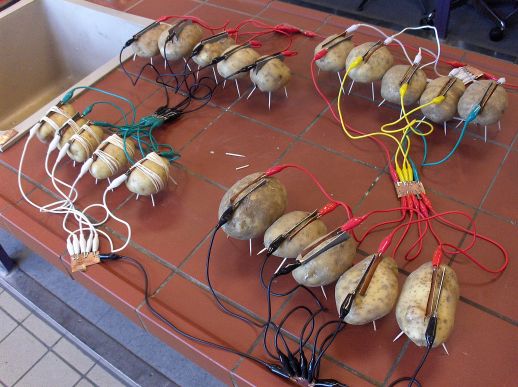
500 lb Potato Battery |
|
Aluminum Air Battery A simple battery can be made from aluminum foil, salt
water and activated charcoal that will make 1 volt and 100 milliamps |
|
Building a lemon battery Building a lemon
battery |
|
Building a lemon battery How To Create A Lemon Battery |
| Building
a lemon battery or a tomato battery lemon battery, How does the Daniell's Cell work? Volta's
Pile, how to make a Tomato battery |
|
Building a Lemon Powered Battery 1 lemon, 1 copper wire, 1 zinc coated nail,
wire leads with alligator clips, pdf file |
|
Carrot Experiments |
|
Fruit Power
Did you know that some of the fruits and vegetables you eat could also help you
make electricity? |
|
Fruit Power |
|
Hand Battery
Your skin and two different metals create a battery |
|
Homemade batteries
Carrot, Potato, Vinegar, Salty water, Banana, Voltmeter,
Two Different metals (Iron, Copper), Beaker, Wires |
|
Home-made battery
One simple homemade battery is just a piece of crumpled aluminum foil in a
stainless steel bowl of vinegar and salt |
|
Home-made battery
This battery is built on a plastic ice cube tray with 14 gauge copper wire and
galvanized screws from the hardware store. Screws have more surface area than
nails. There are four cells. It puts out over three volts open circuit and about
2ma thru the led, ... |
|
How to
make a potato battery? How to make a potato battery? |
|
La pile électrique
(type pile Volta) |
|
Lemon battery |
|
Lemon battery
Creating a battery from a lemon, Batteries consist of two different metals
suspended in an acidic solution. Copper and Zinc work well as the metals and the
citric acid content of a lemon will provide the acidic solution, ... |
|
Lemon Power Website
Lemon-powered LED, Lemon-powered calculator, Lemon-powered clock, Lemon-powered
buzzer, lemon-powered and other favorite chemical demonstrations |
|
LIGHT FROM SALT WATER With this exhibit, you are going to make a battery
yourself that can make a lamp light up. The only things you need are beakers of
salt water, electrical wires and aluminum foil, pdf file |
|
Making Batteries from Fruits and Vegetables Making Batteries from Fruits and
Vegetables |
|
Potato Battery |
|
Potato battery
Batteries generate electricity through a chemical reaction between two different
electrodes and one electrolyte. Use of Copper and Zinc electrodes and Sulfuric
acid as electrolyte is a proven method for this process, ... |
|
Potato Battery Activity
Potato battery, When strips of two different metals are inserted into a
potato, electrons move through the potato from one strip to the other, ...,
ppt file |
|
Potato
Battery Many household appliances make use of dry cells to power them. Most
use more than one dry cell to provide the necessary amount of electrical
current. A cell produces electrical energy by causing a chemical reaction to
take place between an electrolyte (a conductive medium) and two different
metals, pdf file |
|
Potato
Battery make energy from patatoes |
|
Potato clock |
|
The
SHOCKING Truth about Fruit doc file |
|
Vinegar
Battery Vinegar Battery |
|
What other fruits
can make a ’lemon battery’? |
|
Zinc and copper in Galvanic Cells
and in an orange battery Zinc and copper in Galvanic Cells and in an orange
battery |
|
|
Energy from patatoes: patato battery |
|
 |
|
|
Home
|
Site Map
|
Email: support[at]karadimov.info
Last updated on:
2026-06-24
|
Copyright © 2011-2021 Educypedia.
https://educypedia.org
|
| |
|
|
| |
|