| |
Human anatomy and the body's systems
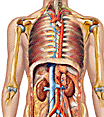
Human anatomy is the study of the structure of the body and the arrangement of its parts, while physiology examines how those parts function. The body is organised into levels of increasing complexity: cells form tissues, tissues combine into organs, and organs that work together form organ systems. This hierarchy makes a large and intricate body easier to understand by grouping its many structures according to the tasks they perform.
Several major systems carry out the body's essential work. The skeletal system of bones gives the body its frame, protects organs and provides attachment points for muscles. The muscular system produces movement, including the facial muscles that drive expression. The nervous system, centred on the brain and controlled through nerves, gathers information and coordinates responses, while the cardiovascular system, driven by the heart, circulates blood to deliver oxygen and nutrients and remove waste.
Other systems handle further vital roles: the respiratory system, including the larynx and lungs, exchanges gases; the digestive system breaks food down for absorption, with the salivary glands beginning the process; and the reproductive system enables the continuation of life. Anatomy is often studied region by region as well, examining areas such as the skull, neck, shoulder, hand and wrist, the vertebral column and the pelvis, along with sense organs like the eye and ear. Genetics underlies it all, since the DNA in every cell carries the instructions that build and run the body.
Frequently asked questions
- What is the difference between anatomy and physiology?
- Anatomy describes the structure and arrangement of the body's parts, while physiology explains how those parts work and interact.
- How is the human body organised?
- Cells form tissues, tissues form organs, and organs that cooperate make up organ systems such as the skeletal, muscular and nervous systems.
- What does the nervous system do?
- Centred on the brain and acting through nerves, it gathers information from the body and surroundings and coordinates the body's responses.
|
|
| General
overview related topics: Medical info,
Medical images |
|
Anatomy and physiology II: lecture notes
blood, heart, blood flow and blood
pressure, lymphatic/immune system, respiratory system, digestive system, urinary
system, reproductive system - male, reproductive system - Female |
|
Anatomy
powerpoint presentations blood, heart, blood flow and blood pressure,
lymphatic/immune system, respiratory system, digestive system, urinary system,
reproductive system - male, reproductive system - Female |
| Atlas
of human anatomy Skeletal system, Digestive, Muscular, Lymphatic, Endocrine,
Nervous, Cardiovascular, Male Reproductive, Female Reproductive, Urinary |
| Atlas of radiological anatomy |
| Atlas of
the human body general health, anatomy, body, torso, brain, circulatory system, circulation, digestive system,
endocrine system, ear, endocrine system,
female reproduction, reproductive, organs, pregnancy, hand, carpal tunnel, respiratory system, respiration, muscles, nerves, nervous system, skeleton,
skull, bones, skin, urinary system |
|
Biomedical Hypertexts |
| Bioplek
anatomie, plantkunde, een tip, in Dutch |
| Biotech
biology and chemistry, dictionary, chemical acronyms database, human biochemistry,
medicinal botany which describes various botanical compounds used in cancer treatment and the plants that produce them,
bioinformatics |
|
Biotopics biology, anatomy, botany, biochemistry,
Educypedia |
| Blue histology - notes |
| Cell tissue human
body
cellular structure, cellular function, tissue, systems of organs of
human body, acetylcholine, action potential, alveolus, bone, centriole,
chloroplast, chromosome, cilium, clathrin, desmosome, digestive, ear, endocrine,
endocytosis, endoplasmic reticulum, epithel, epithelial cell, erythrocyte,
exocytosis, eye, gap junction, glutamate ion channel, Golgi body, hearing,
heart, inner ear, liver, lung, lymph, megakaryocites, meiosis, microtubule,
mitochondrion, mitosis, motor proteins, muscle spindle, nerve cell, neuron, NMDA
ion channel, nose, olfactory, organ of balance, pacinian corpuscle, papilla,
pituitary, platelets, reproductive system, respiratory system , ribosome,
sensory cells, skeleton, skin, sodium ion channel, stem cells, synapse, taste,
teeth, tight junction, tongue taste areas, tooth, touch, urinary system, white
blood cells |
| Center for human simulation
a synthesis of human anatomy and computed three-dimensional imaging, 3-D
models of the human body |
| Chemicals &
human health renal toxicology, learn the effect of metals on the kidneys
and on kidney cells, fundamental principles of toxicology, basics of lung
anatomy and function and learn about toxicology in the lungs, diseases of the
lungs, and environmental tobacco smoke |
| Digital anatomist
interactive atlases 2-D and 3-D views of the brain, 3-D views of thoracic
organs, views of the knee |
| DirectAnatomy
to familiarize more people with the human body using an interactive interface
that allows you to navigate through the body |
| Getbodysmart
anatomy and physiology website |
|
Human anatomy
The Digestive System, The Intestinal System, The Circulatory System, The Nervous
System, The Immune System, The Respiratory System, The Glandular System, The
Urinary System, The Structural System |
|
Human anatomy
Shoulder and Arm, Elbow and Forearm, Wrist and Hand, Arteries and Nerves, Hip
and Thigh, Knee and Leg, Ankle and Foot, Arteries and Nerves |
|
Human
anatomy and histology |
| Human
anatomy and histology
Organization and Regulation, Integumentary Integumentary additions only,
Skeletal, Muscular system, Cardiovascular, Respiratory, Digestion, Nutrition,
Urinary, Nervous, Special Senses, Reproduction, Immune System |
| Human anatomy and physiology
Chemistry for Human Anatomy and Physiology and Practice Test Cells, Tissues,
Integument: Skin, Hair and Nails, Bone Tissue, Axial Skeleton, Appendages and
Joints, Muscle Tissues and Physiology, Human Muscles, Nervous Tissues and
Physiology, Spinal Cord and Spinal Nerves, Brain and Cranial Nerves, Autonomic
Nervous System, Senses |
| Human anatomy and physiology |
|
Human biology
The Circulatory System, The Respiratory System, The Immune System, Control of
Gene Expression, Cancer, Biotechnology, DNA and Protein Synthesis, Genetics,
Chromosomes, Human Genetics, Cell Reproduction, Mitosis, Mitosis animation,
Meiosis, Cell Membranes, Energy and Enzymes, DNA Structure, DNA Synthesis |
| Human
biology tissues, skeletal system, muscular system, blood, heart and blood
vessels, immune system, respiratory system, nervous system, special senses,
endocrine system, all ppt files |
| Human
biology
cell structures, tissues, bone tissue, muscle tissue, digestive
system, cardiovascular, blood, the heart, blood vessels, lymphatic and immune
system, respiratory system, urinary system, nervous system, senses,
neuroendocrine system, reproductive and STD's |
| Human
body the Human body |
|
Human body systems
biology, human body, genetics, skeleton, nervous system,
muscles, circulation, organs, find out where organs are within the body and
learn about the different aspects of the body such as the nervous system,
muscles and skeleton |
|
Human Physiology |
| Innerbody inner
exploration of the human anatomy, human sexuality, learning, health, baby, pregnancy, biomedical,
medicine, health care, body, each topic has animations |
| Online biology book |
| Orthopedics and anatomy |
|
Printable blank outline pictures of the human anatomy
eye, ear, skin,
digestive system, respiratory system, circulatory system |
|
The virtual body
interactive
tour of the human body |
| The visible human
project navigate through a human cadaver, see also Marching
through the visible woman |
| Visible human cross sections java applets |
| Visible
human sections X-ray of a child's hand and wrist, section through the abdomen,
section through the pelvis, cross-section through the thigh, section through the face, demonstrating the air
sinuses, anterior thorax |
|
Web
anatomy home WebAnatomy is an interactive quiz program |
Miscellaneous
topics  related subjects: Biology: virus info,
Microbiology, Medical
Resources,
related subjects: Biology: virus info,
Microbiology, Medical
Resources,
|
| Acid-base balance
tutorial respiratory and metabolic, acid base, Java, pH, [H+], hydrogen ion concentration |
|
Biological
timing tutorial the human clock |
| Endoplasmic
reticulum: structure and function endoplasmic reticulum is a network of tubules, vesicles and sacs that are
interconnected. They may serve specialized functions in the cell including protein synthesis, sequestration of calcium, production of steroids, storage
and production of glycogen, and insertion of membrane proteins
|
|
Metabolisme in Dutch |
| Microbe
zoo discover the many worlds of hidden microbes |
| Odyssey of
life embryonic development and evolution |
| Vertebrate anatomy comparative vertebrate anatomy |
|
|
Home
|
Site Map
|
Email: support[at]karadimov.info
Last updated on:
2026-06-24
|
Copyright © 2011-2021 Educypedia.
https://educypedia.org
|
| |
|
|