|
| |
Dipole Antennas
The dipole is one of the most fundamental antenna types and serves as a reference against which others are compared. In its common half-wave form it consists of two straight conductors in line, fed at the centre, with a total length close to half the wavelength of the operating frequency. At that length the antenna is resonant, presenting a convenient impedance to the feed line and radiating efficiently. Because wavelength depends on frequency, a dipole is cut to a specific band, and its physical size grows as the frequency falls.
A half-wave dipole has a well-defined radiation pattern. It radiates most strongly broadside, in the directions perpendicular to the wire, and very little off the ends, producing a doughnut-shaped pattern around the conductor. This modest directivity gives it a small gain over an isotropic radiator. The dipole is linearly polarised in the direction of the wire, so a horizontal dipole produces horizontally polarised waves and a vertical one produces vertical polarisation, a factor that affects how well it communicates with other antennas.
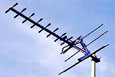
The folded dipole is a widely used variant in which a second parallel conductor connects the two ends, forming a narrow loop. This raises the antenna's feed impedance to about four times that of a simple dipole, which conveniently matches common balanced feed lines, and it also broadens the usable bandwidth. Folded dipoles are familiar as the driven element of Yagi antennas and in television receiving antennas. The dipole's simplicity and predictable behaviour make it the starting point for many more elaborate designs.
Frequently asked questions
- How long is a half-wave dipole?
- Its total length is close to half the wavelength at the operating frequency, slightly shorter in practice because of end effects. Lower frequencies require physically longer dipoles.
- In which directions does a dipole radiate best?
- A half-wave dipole radiates most strongly broadside, perpendicular to the wire, and least off its ends, giving a doughnut-shaped pattern around the conductor.
- Why use a folded dipole?
- The folded dipole raises the feed impedance to about four times that of a plain dipole, matching common feed lines, and it provides a wider bandwidth. It is often the driven element in Yagi and TV antennas.
|
|
Antenna types: Dipole antenna  |
|
6dB COLINEAR VHF ANTENNA |
| Broadband
Dipole Antennas The broadband dipole antenna provides excellent performance
for short to medium range circuits, ... |
|
Coaxial Cable
Dipole for 10MHz |
| Dipole antenna
dipole antenna radiation, pdf file |
| Dipole antenna
How does a dipole antenna work |
|
Dipole antenna How does a dipole antenna work. A dipole antenna, is a radio
antenna that can be made by a simple wire, with a center-fed driven element.
These antennas are the simplest practical antennas from a theoretical point of
view; the current amplitude on such an antenna decreases uniformly from maximum
at the center to zero at the ends |
| Dipole
antenna How does a dipole antenna work |
|
Dipole
antenna pdf file |
|
Dipole Antenna
Calculator construction details included |
|
Dipole antenna radiation pattern
dipole antenna radiation pattern measurement, pdf file |
|
Dipole antenna radiation pattern
Radiation Pattern of a Dipole Antenna as a Function of Dipole Length |
|
Dipole: folded dipole
a folded dipole antenna input impedance calculator |
| Dipole: folded dipole How does a
folded dipole antenna work |
| Dipole for 88-108
MHz A simple dipole antenna can be used for improved reception of FM
broadcast signals |
| Dipole: satellite
omni antenna |
|
Dipool eindgevoede
halve golf dipool, impedantie, bandbreedte, aanpassing, in
Dutch, pdf file |
|
Folded dipole antenna
folded dipole antenna, pdf file |
|
Folded dipole antenna
A two wire folded dipole can increase the characteristic feed impedance of a
dipole and offer a good match to 300 Ohm balanced feed line, ... |
|
Halve Golf Dipool in
Dutch, pdf file |
|
Half-Wave Dipole A Center-Fed Half-Wave Dipole is probably the simplest of
antennas to construct and use, recommended height for a dipole is 1/2 wavelength
above ground |
| Horizontal
Dipole Antennas A center-fed half-wave dipole consists of a straight wire,
one-half wavelength long and fed in the center, ... |
|
How to make a Simple
Dipole Antenna |
|
Inverted-V Dipole
A multi-band inverted-V dipole for portable operation, pdf file |
|
Inverted-V Dipole
2 A multi-band inverted-V dipole for portable operation, pdf file |
|
Inverted-V Antenna Inverted-V Antenna, a dipole with the center raised on a
mast and the endpoints near ground |
|
Inverted V
feedpoint impedance |
|
Short Off-Center-Loaded Dipoles diagram of a lumped-constant loaded dipole
antenna that is intended to fit in available space, ... |
| Twin lead dipole
a folded dipole is an efficient TV antenna that is easy to construct. It will not compete with a good high-gain directional antenna, but it sure beats rabbit
ears |
|
Verkorte dipool
spin antenna, in
Dutch, pdf file |
|
|
Home
|
Site Map
|
Email: support[at]karadimov.info
Last updated on:
2026-06-24
|
Copyright © 2011-2021 Educypedia.
https://educypedia.org
|
| |
|
|
| |