J-Pole Antenna Design
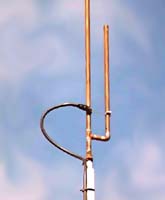
The J-pole is a vertical antenna whose shape resembles the letter J, widely used by radio amateurs for VHF and UHF communication. It is an end-fed half-wave antenna, meaning the main radiating section is about half a wavelength long and is driven from its lower end rather than from the centre as a dipole would be. Its appeal lies in giving omnidirectional coverage in the horizontal plane while needing no radial ground plane, so it can be mounted simply on a mast or pole.
The difficulty with feeding a half-wave element at its end is that the impedance there is very high, which would badly mismatch an ordinary feed line. The J-pole solves this with the short parallel section that forms the foot of the J: a quarter-wave matching stub. This stub acts as an impedance transformer, and by connecting the feed line a short distance up from the bottom of the stub, the builder finds a point where the impedance matches the cable. Adjusting that tap point is the key step in tuning the antenna for a low standing-wave ratio.
Because the radiating element is vertical, the J-pole produces vertically polarised, omnidirectional radiation suited to mobile and repeater communication, where signals may arrive from any direction. A popular compact variant, the Slim Jim, folds the design to reduce its height while keeping similar performance. The J-pole's combination of simple construction, no required ground plane and reliable omnidirectional coverage explains its enduring popularity for amateur and utility stations.
Frequently asked questions
- Why does a J-pole have a short parallel section at the bottom?
- That section is a quarter-wave matching stub. It transforms the very high impedance at the end of the half-wave radiator down to a value that matches the feed line.
- Does a J-pole need a ground plane?
- No. Unlike a quarter-wave groundplane antenna, the J-pole is a self-contained end-fed half-wave design and works without radials, which simplifies mounting.
- What radiation pattern does a J-pole produce?
- Mounted vertically it gives vertically polarised, omnidirectional coverage in the horizontal plane, which suits mobile and repeater use.