| |
Antenna design and characteristics
Designing an antenna means choosing a geometry that radiates efficiently at the wanted frequency while meeting practical constraints on size, gain and direction. The starting point is usually resonance: an element whose electrical length is a simple fraction of the wavelength presents a real, manageable feedpoint impedance and radiates strongly. From that basis a designer adjusts element spacing, the number of elements and the feed arrangement to shape how the energy is distributed in space.
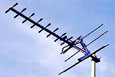
Key characteristics distinguish one antenna from another. Bandwidth is the range of frequencies over which the antenna stays well matched and efficient. Gain and the shape of the radiation pattern describe whether energy is spread roughly equally in all directions, as with a simple dipole or loop, or focused into a narrow beam, as with a Yagi-Uda array or a parabolic reflector. Front-to-back ratio indicates how well a directional antenna rejects signals arriving from behind, which is useful for reducing interference. Polarization must usually match between transmitting and receiving antennas for a strong link.
Different families suit different jobs. Dipoles and ground-plane antennas are simple and broadly useful. Loop antennas, including small magnetic loops, are compact and can be made directional. Yagi and log-periodic arrays add gain and directivity for fixed point-to-point or broadcast reception. Helical antennas produce circular polarization favoured for satellite links, while horn and dish antennas dominate at microwave frequencies and in radar, where short wavelengths make high-gain apertures practical at modest physical sizes.
Frequently asked questions
- What is antenna bandwidth?
- Bandwidth is the span of frequencies over which an antenna remains acceptably matched and efficient, often defined by a limit on reflected power or standing-wave ratio.
- Why use a directional antenna instead of an omnidirectional one?
- A directional antenna concentrates energy toward a wanted direction, increasing range and signal strength on that path while rejecting interference from other directions.
- What is front-to-back ratio?
- It compares the signal an antenna radiates or receives in its main forward direction with the much weaker level to the rear, expressed in decibels.
|
|
Antenna
topics  related topics: Decibels, Electro magnetic waves,
RF transformers,
Transmission lines
related topics: Decibels, Electro magnetic waves,
RF transformers,
Transmission lines |
| 11 meter CB
antennas 11 meters yagi cubical quad antennas |
|
AM Band Antennas
AM Band antenna, A good AM Band antenna can be a simple long-wire strung between
two trees or across the top of the roof |
| Antenna calculations
impedance antenna matching, antenna impedances |
|
Antenna characteristics antenna characteristics, doc file |
|
Antenna
coil design pdf file |
|
Antenna Design
Calculating of the antenna input circuit, Ferrite material, Practical antenna
design |
|
Antenna formulas Antenna Basics, Antenna Polarization, Radiation Patterns,
Frequency-Phase |
|
Antenna
gain and beamwidth antenna gain and beamwidth, Antenna Gain: The relative
increase in radiation at the maximum point expressed as a value in dB above a
standard, in this case the basic antenna, a ½-wavelength dipole, ... |
Antenna
Height and Communications Effectiveness The purpose of this paper is to
provide general information about communications
effectiveness as related to the physical height of antennas, pdf file |
|
Antenna Near Field Free Space Loss, FSL, Fresnel Zone, Receiver
Sensitivity, Antenna Gain, Transmit Power, Effective isotropic radiated power
(EIRP), System Operating Margin, Multipath Interference, Line of Sight, Fresnel
boundaries, Clearance, Refraction, Signal-to-noise ratio (SNR) |
|
Antenna
radiation patterns understanding and using antenna radiation patterns, antenna radiations patterns, discone antenna, dual
polarized sinuous, guide fed slot, helix antenna, normal mode helix, axial mode,
horn antenna, linear dipole array, log periodic, loop antenna, circular antenna,
loop, alfred, loop, square, luneberg lens, microstrip patch, monopole |
| Antenna
radiation patterns the radiation pattern is a graphical depiction of the relative field strength transmitted from or received by the antenna |
| Antenna
radiation patterns pdf file |
|
Electromagnetic Waves what are Electromagnetic Waves, Electromagnetic Waves
explained, the description of an oscillating electric dipole, Energy and
Momentum in EM Waves |
|
Ferrite Rods, Bars, Plates
and Tubes Ferrite rods, bars, plates and tubes are primarily used in radio
antennas and chokes. They are available in materials from permeability of 20 to
10, 000 |
|
Field Intensity Units What is the difference between dBu, dBm, dBuV, and
other units? |
|
Free Space Field and Loss Calculations |
|
Gain of Directional
Antennas
Polarization of antennas, Directive Gain from a Hypothetical Antenna, Antenna
Efficiency, Aperture, Type Antennas, Directive Gain and Beamwidth, Antenna Gain
and Polarization, pdf file |
|
Impedance Matching of Open–Ended Waveguide Radiating Elements Impedance
matching of open–ended waveguide radiators in a planar phased–array environment |
|
Isolation between antenna network and TV/radio equipment a ground loop in your AV system caused by antenna connection or TV cable is very common if you
have your computer connected to the same system. This type of ground loop problem can be solved by using suitable isolation between your AV system and the
antenna cable |
|
Isotropic antenna
isotropic antenna: an ideal antenna that radiates power with unit gain uniformly
in all directions |
|
Isotropic antenna
isotropic antenna calculations, dBi, or decibels relative to isotropic |
| Linear arrays
Definition of Antenna Pattern, Relative pattern, Two-Isotropic-element Array, Array of two isotropic sources, Three-dimensional pattern, Parallel dipole two-element array,
Geometrical positioning of pattern for two dipoles, Multi-element Uniform Linear Arrays, Broadside Linear Arrays, Beamwidth and Gain of Broadside Linear Arrays, doc file |
| POWER
DENSITY
pdf file |
| Power splitters
a 0° splitter is a passive device which accepts an input signal and delivers multiple output signals with specific phase and amplitude characteristics,
pdf file |
| Putting a
balun and a tuner together A two wire transmission line as a three
terminal Device, The W2DU and W7EL models of a choke balun, Baluns on the input
and output of unbalanced tuners, The effectiveness of a balun |
|
Radar technology
provides an introduction to radar concepts and terminology |
| Radar:
the origins of radar |
|
Radiation
patterns Antenna Radiation Patterns,
pdf file |
|
Radiation resistance What is radiation rsistance |
|
RF amplifier for ferrite bar antennas RF amplifier for ferrite bar antennas |
| Smith
chart spectral simulation, the Smith chart can help
us translate the reflection coefficient into impedance |
|
Smith
chart What is a Smith chart |
|
Smith chart Excel Graph |
|
Smith Chart
Tutorial This Smith Chart Tutorial Consists of 5 Flash programs with
embedded audio. These programs will allow you to learn the Smith Chart through
interactive flash programs |
| Tower and
Antenna Wind Loading as a Function of Height
pdf file |
| Understanding
electromagnetic fields and antenna radiation pdf file |
| Why an antenna
radiates the basic principles of radiation, Why an Antenna Radiates |
|
Why an antenna
radiates How an Antenna radiates, Radiation from an antenna, Near and Far
Field Regions, Field regions around an antenna, Far field radiation from wires,
Spherical co-ordinate system for a Hertzian dipole, Radiation Pattern, what are
Antenna Performance Parameters, Radiation pattern of a generic directional
antenna, what is Directivity of an antenna, radiation intensity of the antenna,
input impedance of an antenna, Voltage Standing Wave Ratio (VSWR), Return Loss
(RL) parameter, antenna efficiency, Antenna gain parameter, Polarization of a
radiated wave, bandwidth of an antenna, Half Wave Dipole, Radiation pattern for
Half wave dipole, monopole antenna, Radiation pattern for the Monopole Antenna,
Loop Antennas, Radiation Pattern of Small and Large Loop Antenna, helical
antenna or helix, Radiation Pattern of Helix Antenna, Horn antennas, pdf file |
|
dBi: = Gain of antenna with respect to isotropic antenna given in dB = 10 log
(power max / power isotropic)
dBd = Gain of antenna with respect to a dipole antenna given in dB = 10 log
(power max/ power max of half-wave dipole antenna)
dBi = dBd + 2.15 dB |
|
|
Home
|
Site Map
|
Email: support[at]karadimov.info
Last updated on:
2026-06-24
|
Copyright © 2011-2021 Educypedia.
https://educypedia.org
|
| |
|
|