| |
Antenna types
Antennas come in many forms, each shaped by the frequency it must work at and the pattern of radiation required. The most basic is the dipole, two collinear conductors fed at the centre, typically a half wavelength long and radiating broadside to its axis. Removing one half and working it against a conducting surface gives the monopole or ground-plane antenna, widely used for vertical, omnidirectional coverage on vehicles and base stations.
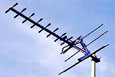
For directional performance, several designs concentrate energy into a beam. The Yagi-Uda antenna adds a reflector and one or more director elements to a driven dipole, producing forward gain that made it the classic rooftop television aerial. Loop antennas, from small magnetic loops to larger resonant loops such as the quad, offer compact size and useful directivity. Helical antennas wound as a coil radiate circular polarization in their axial mode, which suits satellite and space communication where the relative orientation of the link keeps changing.
At higher frequencies, aperture antennas dominate. The horn is a flared waveguide that radiates a clean beam and is often used as a feed or as a reference standard. The parabolic dish uses a reflecting surface to focus microwave energy into a very narrow, high-gain beam, the form familiar from satellite reception and radar. Choosing among these types is a trade-off between gain, beamwidth, bandwidth, polarization and the physical space available.
Frequently asked questions
- What is the simplest antenna type?
- The half-wave dipole, two equal conductors fed at the centre, is the basic building block from which many other antennas are derived.
- Why are dish antennas used at microwave frequencies?
- Short microwave wavelengths let a reflector of practical size focus energy into a very narrow, high-gain beam, which is hard to achieve with wire antennas.
- What makes a helical antenna useful for satellites?
- In its axial mode a helical antenna produces circular polarization, which keeps a link working even as the relative orientation of the satellite and ground antenna changes.
|
|
Antenna
types overview  |
|
Antenna Construction pdf file,
50 Mbyte |
|
Antenna design curves Dipoles in front of a Reflector Plane, Cavity Backed
Dipole Antenna, Yagi Antenna, Disk Yagi Antenna, Patch Driven Yagi Antenna, Log
Periodic Dipole Array, Dual Band LPDA, Loaded Broadband Skeletal Antenna,
Inverted F Antenna, Helical Antenna |
|
Antenna pictures
fed dish satellite antenna, cassegrain antenna, marconi
antenna, zagi-antenna, waveguide-horns, crossed-field-antenna, helix antenna,
yagi antenna, ideband UHF antenna, broadband UHF TV antenna, polyrod antenna,
mobile phone mast |
|
Antenna typesEducypedia, The educational encyclopedia |
|
Antenna types pdf file |
| Antenna types
and antenna patterns pdf file |
|
Antennas ppt file |
|
Antennas pdf file |
| Antennes
Les antennes pour très hautes fréquences, en Français |
|
Antennes
en Français |
|
Antennas Yagi antenna, magnetic loopantenna for VHF, ground plane antenna |
|
Antennas
EMC Antenna Fundamentals, Antenna Pattern and Beamwidth, Loop and Magnetic Field
Coil, Rod or Monopole Antennas, Dipole Antennas, Biconical Antennas, Calculable
Biconical Antenna, Log Periodic Dipole Arrays, Bicon/Log Hybrid, Conical
Log-Spiral Antenna, Broadband Ridged Waveguide Horn |
|
Antennas for
low power applications
Basic Full-size Whip, Printed Open Stub, Radiation
Pattern of Open Stub Antenna, Short Whip, Loaded Whip Antenna, Short PCB Stub,
Spiral Antenna, Helical (Coil) Antenna, “Chip” Antenna, Loop Antenna, Folded
Dipole Antenna, Half Open Slot Antenna, pdf file |
| Antenna
selection tips |
| Common TV antenna types
radiation diagram for a 9-element Yagi antenna |
|
FM,
TV & STL antennas |
| Microwave antennas
microwave antennas, pdf file |
|
Microwave antennas
microwave antennas |
|
Radiation
patternsEducypedia, The educational encyclopedia |
|
Radio frequency antenna types |
| TV and FM antennas
anything that conducts electricity is an antenna, (usually a wire, but it could be your body) but the basic unit from which we build antennas is a wire, 1/2
wave length long having a connection in the middle to equipment. Called a dipole, it is an efficient radiator of alternating current electrical energy and
is a standard of reference for other antennas |
| Types of
antennas
halfwave dipole, single dipole, Yagi antenna, feed horn, ferrite
rod antenna |
| VE2ZAZ
amateur radio website |
| VHF/UHF antenna
design pdf file |
|
|
Home
|
Site Map
|
Email: support[at]karadimov.info
Last updated on:
2026-06-24
|
Copyright © 2011-2021 Educypedia.
https://educypedia.org
|
| |
|
|