Radar and Antenna Technology
Radar, short for radio detection and ranging, is a system that uses radio waves to detect distant objects and measure their range, direction and speed. A transmitter emits a pulse or continuous beam of radio energy, and any object in its path reflects part of that energy back. By measuring the time taken for the echo to return, the system calculates distance, since radio waves travel at the speed of light. The frequency shift of the returning signal, caused by the Doppler effect, reveals how fast the target is moving toward or away from the radar.
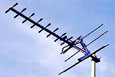
Antennas are central to radar and to all radio communication, because they convert electrical signals into radiating electromagnetic waves and capture incoming waves in return. The dipole is the basic reference antenna, a straight conductor fed at its centre. Adding parasitic elements in front of and behind a dipole produces the Yagi antenna, which concentrates the radiation into a beam and is familiar as the rooftop television aerial. A groundplane antenna radiates equally in all horizontal directions and is common for mobile and base-station use.
Other designs serve particular needs. Loop antennas are compact and respond to the magnetic component of a wave, which makes them useful for direction finding. Horn antennas and parabolic dish antennas are used at microwave frequencies, where the dish focuses energy into a narrow, high-gain beam suited to radar and satellite links. Helical antennas radiate circularly polarised waves and are used in satellite work. Key antenna characteristics include gain, radiation pattern, beam width, polarisation and bandwidth, which together describe how strongly and in which directions an antenna concentrates energy.
Frequently asked questions
- How does radar measure distance?
- It times how long a transmitted radio pulse takes to reflect off an object and return; because radio waves travel at the speed of light, this time gives the range.
- Why is a Yagi antenna directional?
- Parasitic reflector and director elements placed near the driven dipole reinforce the wave in one direction and cancel it in others, forming a focused beam with higher gain.
- What is antenna gain?
- Gain measures how strongly an antenna concentrates radiated energy in its preferred direction compared with a reference antenna that radiates equally everywhere.