| |
Classifying antenna types
Antennas can be sorted into a few broad structural families, which helps in understanding why each is suited to particular tasks. Wire antennas are built from thin conductors and include the dipole, the monopole working against a ground plane, and the loop. They are simple, inexpensive and effective from low frequencies up through the VHF range, where their resonant lengths remain physically reasonable.
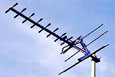
Array antennas combine several radiating elements so their individual fields add in some directions and cancel in others, producing higher gain and a controlled beam. The Yagi-Uda array, with its driven element, reflector and directors, is the best-known example; log-periodic arrays extend useful operation over a wide band, and phased arrays steer the beam electronically by varying the phase fed to each element. Aperture antennas radiate through an opening rather than from a bare conductor: the horn is a flared waveguide, and reflector antennas such as the parabolic dish use a shaped surface to focus energy from a small feed into a narrow beam.
Within these families specialised forms address particular needs. Helical antennas provide circular polarization for satellite work; biquad and patch antennas are compact planar designs popular at microwave frequencies and in wireless networking; and groundplane verticals give omnidirectional coverage. The right choice depends on the operating frequency, the gain and beamwidth wanted, the polarization required, and the space and budget available.
Frequently asked questions
- How are antennas grouped into families?
- Common groupings are wire antennas, array antennas, and aperture or reflector antennas, based on how each structure produces and shapes its radiation.
- What does an array antenna achieve?
- By combining several elements with controlled spacing and phasing, an array reinforces radiation in wanted directions and suppresses it elsewhere, giving higher gain and a defined beam.
- What is an aperture antenna?
- An aperture antenna radiates through an opening, such as the mouth of a horn or the surface of a parabolic reflector, rather than directly from a thin conductor.
|
|
Antenna types  |
|
AM Band Antennas
AM Band Antennas |
|
A remotely-tuned loop
receiving antenna for LW and MW |
| Corner
antenna Corner antenna |
| Corner reflector
antenna UHF antenna |
|
Corner reflector
antenna Corner reflector antenna |
| Cubical
quad antenna part of EI7BA's amateur
radio pages |
|
Cubical
quad antenna calculator Cubical quad antenna calculator |
| Discone VHF-UHF
antenna pdf file |
|
Discone antenna: UHF Discone
antenna UHF antenna |
|
Double Quad Antenna for 1296 MHz Double Quad Antenna for 1296 MHz, 23 cm
antenna, a gain of about 10dB over a dipole |
| Flag antenna
construction and test results the flag antenna is in the family of terminated loops that can yield a cardioid (heart-shaped, single-direction null)
pick-up pattern. Its name comes from its horizontal rectangular shape,
educypedia |
|
GPS Antenna
GPS Patch Antenna. The purpose of this application note is to give the reader an
understanding of the basic properties of patch antennas in relation to GPS
reception and help in defining the right patch antenna for his or her
application, pdf file |
| Groundplane
animated, a tip |
| Horn
antennas pdf file |
|
Liquid Metal Antenna
what is a Liquid Metal Antenna |
|
Log Periodic Antennas |
|
Log-periodic dipole antenna pdf file |
|
Metal-plate lens antennas pdf file |
|
Mobile phone
detector Simple demonstration to explore the radio waves generated by a
mobile phone |
|
Rhombic antennas
A rhombic antenna is a broadband directional antenna, mostly used in HF (high
frequency, also called shortwave) ranges, ... |
|
Rhombic antennas Rhombic antennas |
|
Rhombic antennas
Why do Rhombics work? |
| Rhombic
Antenna for 30m - 6m Rhombics are high gain directive wire antennas |
| Rhombic Antenna
for Shortwave Radio Broadcasting The rhombic antenna is a diamond-shaped
antenna, suspended between 4 masts. The 3 parameters of a rhombic antenna are: l
: antenna leg length, g : one half of the large
interior angle, h : antenna height, ... |
|
Waveguides
doc file |
|
Zagi antenna
Zagi antenna,
pdf file |
|
Antenna types: Whip antenna-Vertical
antennas |
|
1/4 wave Ground
Plane 1/4 wave Ground Plane 446 MHz |
|
5/8
l UHF antenna
5/8 Lambda VHF/UHF Antenna |
|
ANTENNAS FOR LOW POWER
APPLICATIONS |
|
Build A 9 dB, 70cm,
Collinear Antenna From Coax velocity factor for coaxial cable, RF slows down
by the velocity factor when traveling through coaxial cable, collinear array,
pdf file |
|
Coaxial Monopole
pdf file |
|
Modeling of a Half
wave Modeling of a Half wave Monopole Monopole Antenna on a Antenna on a
portable radio Portable antennas,
pdf file |
|
Omni Directional Antenna
Build A 9 dB, 70cm, Collinear Antenna From Coax, Omni Directional Antenna |
|
Vertical
Antenna A vertical antenna in its simplest form, is electrically equivalent
to one-half of a dipole antenna stood on end. When the antenna is mounted close
to the ground, the earth below takes the place of the "missing" half of the
dipole, ...,
pdf file |
|
Vertical Antennas
Vertical antennas, THE QUARTER-WAVE VERTICAL, Radiation Patterns, Vertical
pattern of vertical monopoles over ideal ground, Vertical radiation pattern of a
monopole over real ground, reflection coefficient, radiation patterns produced
by a vertical monopole over perfect ground, Radiation Resistance of Monopoles,
...,
pdf file |
| Vertically
polarised omnidirectional aerial
How to make a Weatherproof Vertically Polarised Omnidirectional Aerial |
|
Whip antennas
Whip antennas |
|
Whip antennas Whip antennasEducypedia, The educational
encyclopedia |
|
Vertical Antennas, Ad Hype and Technobabble |
|
|
Home
|
Site Map
|
Email: support[at]karadimov.info
Last updated on:
2026-06-24
|
Copyright © 2011-2021 Educypedia.
https://educypedia.org
|
| |
|
|