|
| |
Yagi-Uda antenna
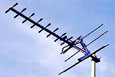
The Yagi-Uda antenna, usually shortened to Yagi, is a directional antenna made from a row of parallel rod elements mounted along a supporting boom. Only one element, the driven element, is connected to the feed line; the others are parasitic, meaning they are not fed directly but pick up energy from the driven element and re-radiate it with a phase that reinforces the beam in one direction. The design was developed in Japan in the 1920s by Shintaro Uda and Hidetsugu Yagi, whose name became attached to it in the wider world.
The elements have specific roles set by their length and spacing. The driven element is typically a half-wave dipole at the operating frequency. Behind it sits a slightly longer reflector that pushes radiation forward, and in front of it one or more slightly shorter directors that draw the beam in their direction. Adding more directors narrows the beam and raises the gain, which is why long Yagis carry many closely related director elements along the boom.
The result is an antenna with substantial forward gain, a fairly narrow main beam and good rejection of signals from the rear, all in a structure that is light and inexpensive. These qualities made the Yagi the standard rooftop television and FM aerial for decades, and it remains widely used in amateur radio, point-to-point links and other applications where moderate directional gain over a modest bandwidth is wanted. Because it is directional, a Yagi must be pointed toward the wanted station and matched in polarization with it.
Frequently asked questions
- What are parasitic elements?
- They are the reflector and director rods that are not connected to the feed line; they couple to the driven element and re-radiate energy to shape the beam.
- How do you increase a Yagi's gain?
- Adding more director elements in front of the driven element narrows the beam and raises forward gain, at the cost of a longer boom and narrower bandwidth.
- Where did the Yagi antenna come from?
- It was developed in Japan in the 1920s by Shintaro Uda and Hidetsugu Yagi, which is why it is properly called the Yagi-Uda antenna.
|
|
Antenna types: Yagi antenna  |
|
2M antennas |
|
3- ,4- and
5-Element-Yagis for the 10m, 12m, 15m, 17m and 20m-Band |
|
Cheap
Antennas Dimensions of the Driven Elements, pdf file |
|
DTT antennas
( 470 - 862 MHz ), Digital Terrestrial Television reception, known as DTT |
|
Le
gain d'une antenne Yagi-Uda |
|
Portable 2-element VHF yagi a portable
2-element VHF yagi |
|
Stacking Yagi
Antennas
The capture area of an antenna - usually known to professionals as its effective
aperture - is roughly defined as the area covered by a planar or aperture array
with the same gain and beamwidth characteristics, Vertical Stacking for Two
Identical Yagis, Horizontal and Vertical Stacking, Antennas for Different
Bands... the Principle |
|
VHF direction antenna
Here is a VERY narrow nulling VHF Direction Finding (DF) antenna that can be
folded up int he back of the car, then you can leap out, assemble it and take a
'fix' in something like 10 seconds, ... |
|
VHF, UHF, and Microwave frequency range antenna This page is a JavaScript
enhanced web page that implements the design of an antenna in the VHF, UHF, and
Microwave frequency range with High Gain (11.8 to 21.6 dBd) and Long Boom
Lengths (2.2 to 39 Wavelengths) |
|
Wire
and Plate Zagi Elements what is a Zagi antenna, pdf file |
|
Yagi antenna
A Yagi-Uda Antenna, commonly known simply as a Yagi antenna or Yagi, is an
antenna consisting of an array of a dipole and additional parasitic elements,
... |
|
Yagi antenna
Yagi antenna,
The Yagi-Uder array is named after its inventors (in practice it's usually just
called a “Yagi”). It consists of one driven element plus one or more Directors
on one side and a Reflector on the other, ... |
| Yagi: 4
element Yagi discussion of all the different antenna principles |
|
Yagi antenna construction Yagi antenna construction |
| Yagi antenna
design How does a Yagi antenna work, pdf file |
|
Yagi Antenna Design for Animal Tracking How does a Yagi antenna work, |
|
Yagi: build an Yagi antenna, Dimension of the Yagi
antenna |
|
Yagi Folded Dipole Feed |
| Yagi-Uda
antenna
a Yagi-Uda antenna is familiar as the commonest kind of terrestrial TV antenna to be found on the rooftops of houses |
|
Yagi-Uder antennas Yagi-Uder antennas |
|
Yagis and Quads
Yagi and cubicalquad antennas, Modeling Yagi Antennas,
pdf file |
|
Zagi antenna
antenna based on a "slow-wave" structure,
pdf file |
|
|
Home
|
Site Map
|
Email: support[at]karadimov.info
Last updated on:
2026-06-24
|
Copyright © 2011-2021 Educypedia.
https://educypedia.org
|
| |
|
|
| |