|
|
| |
Mechanical engineering machine parts
Machines are built from a relatively small set of standard parts and mechanisms that transmit motion and force in predictable ways. A mechanism is an arrangement of connected components that converts an input movement into a desired output movement — changing its direction, speed or type. Understanding these building blocks is central to mechanical engineering, because most complex machinery is assembled from combinations of the same fundamental elements.
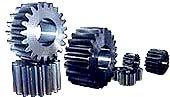
Gears are toothed wheels that mesh to transmit rotation between shafts; by pairing wheels of different sizes they change rotational speed and the turning force, or torque, that is delivered. Pulleys and belts perform a similar role over a distance and can also provide mechanical advantage when lifting loads. Cams convert rotary motion into a precisely timed back-and-forth movement, as in an engine's valve gear, while linkages — bars joined by pivots — turn one motion into another, for example changing rotation into straight-line travel.
Other essential parts support and guide these moving elements. Bearings reduce friction where shafts rotate, allowing smooth motion and carrying loads, and shafts, couplings and keys transmit power between components. Screws and screw threads convert rotation into linear motion and provide clamping force, while springs store and release energy. These parts appear throughout mechanical devices, from small instruments to large industrial equipment such as winding gear and engines, and the discipline draws on related topics including vibration, thermodynamics and fluid dynamics to design machines that work reliably.
Frequently asked questions
- What does a gear train do?
- Meshing gears of different sizes transmit rotation between shafts while changing the speed and the turning force, or torque, that is delivered.
- What is the purpose of a cam?
- A cam converts steady rotary motion into a precisely timed back-and-forth movement, such as opening and closing the valves in an engine.
- Why are bearings used in machines?
- Bearings reduce friction where shafts rotate and carry the loads on them, allowing parts to move smoothly and last longer.
|
|
Mechanisms  |
|
Bearings
Bearings are needed whenever one part of a machine slides against another.
Bearings can be classified as providing sliding or rolling contact.
Fluid Film Bearings, Antifriction Bearings, Tapered Roller Bearings, Rotary
Bearings: Load/Life, Linear Bearings |
|
Bearings
air bearing basics |
|
Bearing Units Handbook |
|
Bearings
Ball and Roller Bearings, Needle Roller Bearings, Constant Velocity Joints,
Bearing Units, Plain Bearings |
|
Gearbox
Architecture The Effect of Gearbox Architecture on Wind Turbine
Enclosure Size |
|
Gear Design
pdf file |
|
Gears |
| Gears
pdf file |
|
Gears and gear trains
gears and gear trains, gear trains are used to either increase output
velocity (VR > 1) or increase output torque (VR < 1) |
|
Gears and gear trains gears are a means of changing the rate of rotation of
a machinery shaft. They can also change the direction of the axis of
rotation and can change rotary motion to linear motion |
|
Gears and
pulleys gears and pulleys |
|
Gears and
pulleys gears and pulleys, doc file |
|
Gears: epicyclic trains |
| Gear ratios
about gear ratios and gear trains |
|
Gear trains How Gear trains work |
|
Introduction to Mechanisms |
|
Katrollen pdf file |
|
Ketting en
riemoverbrenging pdf file |
|
Pulleys and blocks
The physics of blocks and pulleys |
|
Pulleys and blocks
pulleys and blocks, pdf file |
|
Spring design
spring design calculators |
|
Spring design
spring design,
some basic information about springs, what they look like, what their
parts are, and how they work,
compression springs, extension
springs, vise-grip pliers, torsion springs, pdf file |
|
Springs How torsion springs work |
|
Tandwielen pdf file |
| Winding
gear in deep mines, shafts have to be lowered to reach the coal. The winding gear is there to allow coal to be raised to the surface as well as
to allow men to reach the pit face |
|
|
Home
|
Site Map
|
Email: support[at]karadimov.info
Last updated on:
2026-06-24
|
Copyright © 2011-2021 Educypedia.
https://educypedia.org
|
| |
|
|
| |