Educypediathe educational encyclopedia
Science
Automotive
Biology
Biology-anatomy
Biology-animals
Biology-botany
Chemistry
Climate
Geography
Geography-geology
Mathematics
Mechanics
Physics
Physics-Energy
Space
 
Experiments
Chemistry experiments
Energy experiments
Physics Experiments
 
Utilities - Tools
Automotive-animations
Biology-animations
Calculators-online
Chemistry animations
Climate-weather
Energy production
Geography- Geology
Human anatomy
Math-animations
Mechanics-animations
Miscell. - animations
Physics-animations
Science databank
Space-animations
 
Local sitemap
Sitemap
 

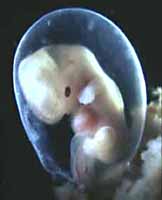
Embryo


The cardiovascular system and blood

The cardiovascular system, also called the circulatory system, transports blood throughout the body. Its central pump is the heart, a muscular organ divided into four chambers: two upper atria that receive blood and two lower ventricles that pump it out. One-way valves between the chambers and at the exits keep blood flowing in a single direction. With each heartbeat the heart drives blood through a network of vessels, and animations are well suited to showing this continuous, rhythmic flow that is hard to convey with a still picture.

Blood travels in a double circuit. The pulmonary circulation carries oxygen-poor blood from the right side of the heart to the lungs, where it releases carbon dioxide and takes up oxygen, then returns to the left side. The systemic circulation then pumps this oxygen-rich blood from the left side out to the rest of the body and back again. Arteries carry blood away from the heart under high pressure, veins return it, and tiny capillaries connect the two and allow the exchange of oxygen, nutrients and waste with the surrounding tissues.

Blood itself is a tissue made of liquid plasma carrying red blood cells, which contain haemoglobin and transport oxygen; white blood cells, which defend against infection; and platelets, which help blood to clot. Together the heart, vessels and blood deliver oxygen and nutrients to every cell, remove waste, distribute heat and hormones, and carry the immune defences that protect the body.

Frequently asked questions

What are the four chambers of the heart?
Two atria, which receive incoming blood, and two ventricles, which pump blood out. The right side serves the lungs and the left side serves the rest of the body.
What is the difference between arteries and veins?
Arteries carry blood away from the heart, usually under high pressure, while veins return blood to the heart. Capillaries link them and allow exchange with tissues.
What does blood carry?
Blood transports oxygen and nutrients to cells, removes carbon dioxide and waste, and carries immune cells, hormones and heat around the body.



Human anatomy animations:    
Cardiovascular System - Blood Genetics Overview
Ear anatomy Immune system Reproductive System - Embryo
Eye anatomy Organs Senses - brain

Cardiovascular System - Blood 
Angigenesis Angigenesis
Animated heart animation
Arrhytmias Arrhytmias
Blood Flow Blood Flow, swf file
Blood Pressure
Blood Pressure Blood Pressure
Blood Type Rh Blood Factor Explanation, Determining A-B-O Blood Types, Blood Agglutination By Antibodies, A-B-O Donor-Recipient Compatibility
Cardiac Cycle
Cardiovascular Embryology
Cardiovascular System Cardiovascular System
Cardiovascular System The main components of the human cardiovascular system are the heart and the blood vessels. It includes: the pulmonary circulation, a "loop" through the lungs where blood is oxygenated; and the systemic circulation, a "loop" through the rest of the body to provide oxygenated blood
Cardiovascular System Cardiovascular System, Blood system
Circulatory System Interactive Tutorial
Circulatory System
ECG simulator ECG simulator, swf file
EKG animation A Primer on Electrocardiogram (ECG)
Electrocardiogram (ECG) Electrocardiogram animation, Electrocardiogram (ECG)
Electrocardiogram
Glomerulus Glomerulus, swf file
Heart conducting system of the heart
Heart Front view without blood, Front view with blood, Right heart with blood, Left heart with blood, Right heart valves, Left heart valves
Heart anatomy of the Heart Animation
Heart Attack Animation Heart Attack Animation, swf file
Heart Attack How a Heart Attack Occurs, Excess circulating fats in the blood stream can build up between the walls of a coronary arteriy. These buildups are referred to as fatty streaks or plaques. If the plaques become large enough, they can push out into the coronary artery itself, creating a blood clot or blockage and possibly a heart attack
Heart beats Heart beats, swf file
Heart regulation Heart regulation
Heart sounds
Heart's structure and action The heart and circulation, Animated heart structure
Heart's electrical system in action
Heart valve Heart valve, swf file
Heart wall
Hemoglobin swf file
Het transportstelsel bloedsomloop, hart, bloed, animaties, in Dutch
Measuring Blood Pressure
Measuring Blood Pressure Measuring Blood Pressure, swf file
The effects of exercise on heart rate
Valvular

Home | Site Map | Email: support[at]karadimov.info

Last updated on: 2026-06-24 | Copyright © 2011-2021 Educypedia.

https://educypedia.org


Powered by ITCom Solutions