|
|
|
|
|
|
| |
Lightning and Thunder
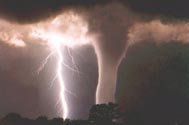
Lightning is a sudden, powerful electrical discharge that occurs during thunderstorms. Inside a storm cloud, strong updrafts and collisions between ice particles and water droplets separate electric charge, leaving the upper part of the cloud positively charged and the lower part largely negative. When the difference in charge becomes large enough to overcome the insulating effect of the air, a rapid discharge takes place, either within the cloud, between clouds, or between the cloud and the ground.
The discharge heats the surrounding air almost instantly to an extremely high temperature, causing it to expand explosively. This rapid expansion produces a shock wave that is heard as thunder. Because light travels far faster than sound, the flash is seen before the thunder is heard, and the delay between them indicates how far away the strike occurred. The brightness and branching shape of a lightning bolt reflect the path the discharge follows through the air.
A rare and poorly understood phenomenon called ball lightning is sometimes reported as a glowing sphere that appears during storms, though it remains difficult to study. Because lightning seeks the easiest path to the ground, tall structures are especially exposed, and lightning protection systems use conductors and grounding rods to safely carry the current into the earth. Factors such as humidity, air density, and temperature influence how storms develop and how readily discharges occur.
Frequently asked questions
- What causes lightning?
- Charge separation inside storm clouds builds up an electric field that eventually discharges as lightning when it overcomes the resistance of the air.
- Why do we see lightning before hearing thunder?
- Light travels much faster than sound, so the flash reaches the eye almost instantly while the thunder arrives moments later.
- How does lightning protection work?
- Conductors and grounding rods give the discharge a safe, low-resistance path to the earth, steering it away from the structure being protected.
|
|
Lightning and thunder  related subject: ESD (electro static
discharge), Grounding and
shielding techniques
related subject: ESD (electro static
discharge), Grounding and
shielding techniques |
| Ball lightning
ball lightning |
| Ball lightning
explained ball lightning appears as a glowing, hovering ball of light that moves slowly near the ground before disappearing or exploding. The ball
usually measures about 30 cm in diameter, although two park rangers in the Australian outback reported seeing one in 1987 that was 100 metres wide |
|
Bliksem pdf file |
|
How lightning works |
|
Lightning
The explanation of lighning is quite simple. It is the movement of electrons
down a gradient from a region of more negative charge to a region of less
negative charge |
|
Lightning pdf file |
| Lightning
and atmospheric electricity lightning, movies from the space shuttle, city lights at night from space, storm cells |
| Lightning
an interactive lesson that teaches kids about the weather phenomenon lightning and thunder |
|
Lightning and electrostatic charge effects and protection design Lightning
and electrostatic charge effects and protection design, pdf file |
| Lightning
animation |
|
Lightning detector
A lightning detector is a device that detects lightning produced by
thunderstorms, ... |
|
Lightning explorer
actual lightning information Europe |
|
Lightning facts compendium of information about lightning |
|
Lightning hits plane lightning protection |
| Lightning in a
pan |
| Lightning photography |
| Lightning physics |
| Lightning physics
lightning is the result of the build up of electrostatic charge in clouds. Positive and negative charges separate, negative usually towards the bottom of
the cloud, while positive goes to the top. After a certain amount of time, the negative charge leaps, connecting with either another cloud or even the ground |
|
Lightning primer A lightning flash is composed of a series of strokes
with an average of about four. The length and duration of each lightning
stroke vary, but typically average about 30 microseconds, ... |
| Lightning photography |
| Lightning strike pictures
lightning strike pictures |
|
Lightning strike prevention Lightning strike prevention |
| Listen
to sferics, tweeks, whistlers, chorus, jupiter, solar, pulsars |
|
Luchtelektriciteit en Bliksem in Dutch, pdf file |
|
Luchtelektriciteit en onweer in Dutch, een tip |
|
Meteorology and
weather the earth's atmosphere, the science of meteorology, wind,
atmospheric turbulence, thunder and lightning, global warming |
|
Secondary effects of lightning activity electro magnetic puls, Atmospheric Transients, Electrostatic Pulses, Grounding Current EMP, pdf file |
| Shuttle lightning
observations |
| Sound of
thunder |
|
Static
electricity |
|
Thunder and
lightning Clouds, Electricity, Thunder, thunderstorm, Electrical
discharges, Ball lightning |
|
Thunder and
lightning Thunderstorms are generated by temperature imbalances in the
atmosphere, Lightning is an effect of electrification within a thunderstorm |
|
THUNDERSTORM
ANATOMY AND DYNAMICS The purpose of this paper is to present a broad
overview of the various cloud structures displayed during the life cycle of a thunderstorm and the atmospheric
dynamics associated with each, pdf file |
| Thunderstorms
and lightning a thunderstorm is a storm that contains thunder and lightning, usually accompanied by gusty
surface winds and heavy rain. The storm may result from single cumulonimbus cloud or a cluster of clouds extending for more than 100 kilometers |
|
Transient Surge Protection
Transient Surge Protection |
| VLF sounds |
|
Weather and lightning photography |
|
|
Home
|
Site Map
|
Email: support[at]karadimov.info
Last updated on:
2026-06-24
|
Copyright © 2011-2021 Educypedia.
https://educypedia.org
|
| |
|
|
| |
|