| |
Hurricanes, tornadoes and tropical storms
Hurricanes, tornadoes and tropical storms are among the most powerful and destructive forms of weather. Although all involve strongly rotating air, they differ greatly in size, origin and duration. A hurricane is a large tropical cyclone — a vast, organised system of thunderstorms that rotates around a low-pressure centre, or eye. The same kind of storm is called a typhoon in the western Pacific and simply a cyclone in some other regions. These systems form over warm ocean water, which supplies the heat and moisture that fuel them.
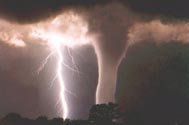
A tropical storm is an earlier or weaker stage of the same kind of system; when its sustained winds reach a defined threshold it is reclassified as a hurricane. Tornadoes, by contrast, are much smaller and shorter-lived. A tornado is a narrow, violently rotating column of air reaching from the base of a thunderstorm to the ground, often only a few hundred metres across, yet capable of extreme local wind speeds. Tornadoes can form within the rain bands of a hurricane but also occur on their own, especially where warm, moist air meets cooler, drier air.
Meteorologists monitor these systems using satellites, radar and weather aircraft, and they issue forecasts and warnings to give communities time to prepare or evacuate. Predicting the track and intensity of a hurricane has improved considerably, although tornadoes, because they are small and develop quickly, remain harder to forecast far in advance. Storm-protection measures and early-warning systems are central to reducing the loss of life from these events.
Frequently asked questions
- What is the difference between a hurricane and a tornado?
- A hurricane is a very large tropical cyclone forming over warm oceans, while a tornado is a small, short-lived rotating column of air beneath a thunderstorm over land.
- When does a tropical storm become a hurricane?
- A tropical storm is upgraded to a hurricane once its sustained wind speeds rise above a defined threshold set by meteorological agencies.
- Why do hurricanes form over warm oceans?
- Warm ocean water provides the heat and moisture that power the storm; without that energy source, a hurricane weakens, which is why it fades after moving over land.
|
|
Hurricanes, tornadoes & tropical storms:
overview  related topic Geology: disasters,
Tsunamis
related topic Geology: disasters,
Tsunamis |
|
Current storms world wide storm prediction systems, Hurricanes, climate,
Weather |
| Earthforces
earth science, plate tectonics, volcano, earthquake, tsunami, floods |
| Hurricanes,
floods and tornadoes from space also clouds and volcanoes |
| Hurricanes, typhoons
and tropical cyclones FAQ the terms "hurricane" and "typhoon" are
regionally specific names for a strong "tropical cyclone". A tropical cyclone is
the generic term for a non-frontal synoptic scale low-pressure system over tropical or sub-tropical waters with organized convection (i.e. thunderstorm
activity) and definite cyclonic surface wind circulation |
| Savage
earth if our planet is a sleeping giant, it slumbers
fitfully, slowly and insidiously, earthquakes, volcanoes, tsunamis, and other natural disasters. Highlights include animated illustrations |
|
Severe and hazardous weather tornadoes, hurricanes, hail, thunderstorms,
blizzards |
| Tropical
cyclone and hurricane glossary Hurricane glossary, climate, Weather |
| Hurricanes
& cyclones - tropical storms |
|
Anatomy of a hurricane exhaust, hot air, atmosphere, storm clouds, spiral, storm eye,
cool air, warm air, eye wall, storm's winds, spiraling winds,
pdf file |
|
Anatomy of a hurricane
Hurricanes evolve and decay from weather anomalies through defined stages.
Tropical storms are loosely defined as a warm-core, non frontal, low pressure
large weather system with a defined counter clockwise wind rotation that form
over tropical or subtropical waters |
|
Current Tropical Cyclone
Information Western North Pacific Ocean and South China Sea, Caribbean Sea,
Gulf of Mexico, North Atlantic and eastern North Pacific Oceans |
|
Cyclone names Worldwide Tropical Cyclone Names |
|
Cyclones Tropical cyclones (also known as hurricanes in North America and
typhoons in Asia) are giant whirlwinds of air and dense cloud spiraling at over
120 km/hr around a central 'eye' of extreme low pressure, ... |
|
Details of the
hurricane eye's structure |
| How a
hurricane forms Hurricane |
|
How do tropical cyclones form ? |
|
How hurricanes work Hurricanes only form over really warm ocean water of
26.5° C or more, ... |
|
How hurricanes work |
| Hurricane archives
hurricane information including charts on the track of the storm plus a text based table of tracking information |
|
Hurricanes
hurricanes, also called typhoons or cyclones in different parts of the world, have always struck mankind |
|
Hurricanes &
Tropical Cyclone Neighborhoods tropical cyclones, hurricanes, typhoons,
and cyclones) |
| Hurricanes,
typhoons and tropical cyclones The terms "hurricane" and "typhoon" are
regionally specific names for a strong "tropical cyclone". A tropical
cyclone is the generic term for a non-frontal synoptic scale low-pressure
system over tropical or sub-tropical waters with organized convection, ...,
a tip |
| National
hurricane center tropical prediction center, tropical analysis and
forecast branch |
|
Hurricane Katrina -
August 2005 Explore the impact of Hurricane Katrina on the New Orleans
area |
| Hurricanes |
| Hurricanes
hurricanes are formed over tropical oceans where there are warm waters, humid air and converging winds. It takes a lot of energy for a hurricane to
be created- not to mention just the right conditions. Hurricanes start out as a group of storms that begin to rotate when they encounter converging
winds |
| Hurricanes
introduction to hurricanes and their associated features |
| Hurricanes
and other cyclones |
|
Hurricane
Storm List and Maps |
|
Hurricane Visualizations |
|
Nature and Structure of
Tropical Cyclones |
| Parts of a
tropical storm |
| Storms
storm protection, climate, Weather |
|
Saffir-Simpson Hurricane Intensity Scale Saffir-Simpson Hurricane Intensity Scale |
|
Saffir-Simpson Hurricane Scale
Saffir-Simpson Hurricane Scale |
|
Saffir-Simpson Hurricane Scale
Saffir-Simpson Hurricane Scale |
| The
eye: satellite images hurricane structure |
|
Tropical cyclone glossary |
| Tropical
cyclone categories (Australia) |
|
Tropical
cyclones tropical cyclones are low pressure systems in the tropics that,
in the Southern Hemisphere, have well defined clockwise wind circulations
with a region surrounding the centre with gale force winds (sustained winds
of 63 km/h or greater with gusts in excess of 90 km/h) |
|
Tropical Cyclone Formation |
|
Tropical Cyclone Formation Regions |
| Types of
tropical cyclones Tropical depression, Tropical storm, Hurricane |
|
Tropical
Twisters Most people associate twisters with tornadoes, but in fact tropical
twisters come from hurricanes. Hurricanes are what scientists call "strong
Tropical Cyclones" |
|
|
Home
|
Site Map
|
Email: support[at]karadimov.info
Last updated on:
2026-06-24
|
Copyright © 2011-2021 Educypedia.
https://educypedia.org
|
| |
|
|