| |
Earth in the Solar System
Earth is the third planet from the Sun and the largest of the four rocky inner planets. It is the only world known to support life, a circumstance linked to its distance from the Sun, its substantial atmosphere, and the presence of liquid water across much of its surface. Earth orbits the Sun at an average distance of about 150 million kilometres, a span used as a standard unit of measurement in astronomy.
Two motions govern everyday experience of time on Earth. The planet spins on its axis roughly once every twenty-four hours, producing the cycle of day and night, and it completes one orbit of the Sun in about 365 days, defining the year. Because Earth's rotation axis is tilted relative to its orbit, different parts of the planet receive sunlight more or less directly through the year. This tilt, not any change in distance from the Sun, is what produces the seasons, which occur in opposite halves of the year in the northern and southern hemispheres.
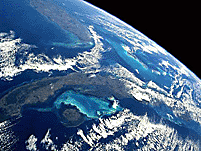
Earth has a single large natural satellite, the Moon, which orbits it roughly once a month and whose changing illumination gives the lunar phases. The gravitational pull of the Moon, together with the Sun, drives the ocean tides. Seen from space, Earth appears as a blue and white sphere, its colour reflecting the oceans, atmosphere and clouds that distinguish it from its drier, more barren planetary neighbours.
Frequently asked questions
- What causes day and night on Earth?
- Earth rotates on its axis about once every twenty-four hours, so each location turns toward the Sun and then away from it, giving day and then night.
- Why does Earth have seasons?
- Its rotation axis is tilted, so over the year sunlight strikes each hemisphere more or less directly. This changing angle, not distance from the Sun, produces the seasons.
- How far is Earth from the Sun?
- About 150 million kilometres on average, a distance defined in astronomy as one astronomical unit.
|
|
Solar system: the earth
 related topics:
Earth and above,
Geology related topics:
Earth and above,
Geology |
|
Atmospheric
Structure of the Earth What is the Atmospheric Structure of the Earth,
The troposphere, The stratosphere, The ozone layer, The mesosphere, The
thermosphere, The exosphere, The ionosphere, The plasmasphere, The
magnetosphere |
|
Aurora
the Earth and magnetosphere, pdf file |
|
Aurora and the Geomagnetic field |
|
Auroral Activity |
|
Aurora
Forecast |
|
Aurora Page A source for Information, links and images about the
"Northern Lights" |
|
Composition of Earth's atmosphere |
|
Earth's atmosphere |
|
Earth from space NASA Space Shuttle earth observations: 250000 images |
|
Earth and moon viewer the earth in relation to our solar system, earth,
viewer, moon, weather, satellite, image |
|
Earth's orbital parameters Orbital Variations, Changes in orbital
eccentricity affect the Earth-sun distance. Currently, a difference of only
3 percent (5 million kilometers) exists between closest approach
(perihelion), ... |
|
Earth's orbital parameters
Earth's orbital parameters as seen from a view above the Earth's geographic
North Pole, ... |
|
Earth - sun geometry |
|
Earth viewer from satellite to view the Earth as currently seen from a
satellite in Earth orbit, choose the satellite from the list, click here for
a
View from the sun,
Earth day and night regions |
|
Earth's magnetic field |
|
Earth's magnetic field
3D simulation of Earth's magnetosphere |
|
Earth's magnetosphere the magnetosphere is the region of space to which
the Earth's magnetic field is confined by the solar wind plasma blowing
outward from the Sun, extending to distances in excess of 60,000 kilometers
from Earth |
|
Earth's magnetosphere
Solar wind and the magnetic field, Magnetospheric regions |
|
Earth's magnetosphere
The Earth's Magnetic Field |
|
Earth's
magnetosphere |
|
Earth's magnetosphere |
|
Earth's magnetosphere |
|
Exploration of the earth's magnetosphere space science, physics,
magnetism, magnetosphere, plasma, radiation belt, space weather, magnetic
storms, history, ions in space, magnetic trapping, magnetic drift, electric
drift, polar aurora, sun, solar wind, solar activity, sunspot cycle,
Birkeland currents, substorms, auroral acceleration, planetary
magnetospheres,
Educypedia |
|
Exploration of the earth's magnetosphere earth's magnetosphere |
|
Earth's motion
the Earth's motion causes the sky to appear to move and understanding this
motion is very important for understanding observational astronomy |
| ESA Earthnet
Observing the Earth, eoPortal, Disasters Charter, Earth Watching,
Earthimages |
|
Exploration of the earth's magnetosphere |
|
Ideal atmosphere |
|
Introduction to the day and night sky |
|
Ionosphere
Ionospheric Characteristics, Ionospheric Variability, Ionospheric
Scintillation, pdf file |
|
Milankovitch Cycles The first of the three Milankovitch Cycles is the
Earth's eccentricity, Axial tilt, the second of the three Milankovitch
Cycles, Earth's precession |
|
Retrograde
Motion This applet demonstrates retrograde motion. Watch Mars' apparent
motion across the Earth's sky as the Earth passes Mars in their orbits
around the Sun |
|
Solar terrestrial activity report |
|
The earth
Earth - our home planet |
|
The earth and the moon |
|
The Earth when compared to other planets, the sun, and some of the other stars |
|
Visible earth
searchable directory of images, vizualizations and animations of the earth |
|
|
Home
|
Site Map
|
Email: support[at]karadimov.info
Last updated on:
2026-06-24
|
Copyright © 2011-2021 Educypedia.
https://educypedia.org
|
| |
|
|