Educypediathe educational encyclopedia
Electronics-theory
Analog
Audio - acoustics
Audio - electronics
Audio - loudspeakers
Components-active
Components-passive
Component - sensors
Digital - electronics
Digital - I2C - I2S
Digital - Programming
Electricity High Voltage
Electricity - machines
Electricity - theory
General overview
Miscellaneous
Optics
Power control systems
Power electronics
RF - antennas
RF - antenna - WLAN
RF - communication
RF - radio - tuning
Telephony
Tubes
TV-video-DVD
 
Utilities - tools
Animations & applets
Application notes
Cabling
Calculators
Circuits
Databank - tables
Datasheets
Measurement
Repair
Software - electronics
 
Local sitemap
Sitemap


Analog RF Modulation Techniques

Modulation is the process of impressing an information-bearing signal onto a higher-frequency carrier wave so that it can be transmitted efficiently through a channel such as free space, a cable or an optical fibre. The original low-frequency signal is called the baseband or message, and the carrier is usually a sine wave. By altering one property of the carrier in step with the message, the information is shifted up to a frequency band suited to the antenna and propagation conditions in use.

In amplitude modulation (AM) the instantaneous amplitude of the carrier is varied in proportion to the message, producing a carrier plus two sidebands that mirror the baseband spectrum. Double-sideband (DSB) transmission sends both sidebands, and suppressing the carrier or one sideband gives the more bandwidth-efficient suppressed-carrier and single-sideband variants. In frequency modulation (FM) the carrier amplitude stays constant and its instantaneous frequency is shifted by the message; this trades wider bandwidth for greater immunity to amplitude noise, which is why FM is used for high-fidelity broadcasting.

Animations and applets are valuable here because modulation links a time-domain waveform with a frequency-domain spectrum. Watching the carrier envelope follow the message, or seeing sidebands appear and move as the modulation index changes, makes the connection between the two views concrete. Simulations also allow comparison between AM and FM under noise, and exploration of how the bandwidth of each scheme depends on the message and on the depth of modulation.

Frequently asked questions

What is the difference between AM and FM?
AM varies the carrier's amplitude with the message; FM varies its frequency while keeping amplitude constant. FM uses more bandwidth but resists amplitude noise better.
What are sidebands?
Sidebands are bands of frequencies above and below the carrier created by modulation. They carry the actual information; the unmodulated carrier itself conveys none.
Why modulate a signal at all?
Modulation shifts low-frequency information to a carrier band suited to practical antennas and propagation, and it lets many signals share a channel on different carrier frequencies.




Analog Modulation Techniques 
AM and FM radio to illustrate how a signal is sent via AM or FM radio
AM modulation AM modulation, upper side band, lower side band, carrier
Amplitude modulation amplitude modulation was the original method used for transmitting audio signals over radio frequency waves. It is still used today in AM radio. This applet demonstrates the modulation process
Amplitude modulation 2 The applet shows an amplitude modulated signal
Amplitude modulation 3 Frequency modulation is the process of varying the frequency of a carrier wave in proportion to the instantaneous amplitude of the modulating signal, ...
Amplitude modulation 3 simulation of AM
Amplitude modulation
Démodulation d'amplitude
Double sideband modulation double sideband modulation, DSB, Educypedia
DSB Double side band Suppressed Carrier System (DSB/SC)
FDM: Frequency Devision Multiplex
FM spectra the spectrum generated by an FM pair centers on the carrier frequency, with sidebands found at multiples of the modulating frequency added and subtracted from the carrier. The power at each sideband is determined by the index of modulation (modAmp/modFreq) and a Bessel function, Frequency modulation and Bessel functions
Foxhole Radio What is the Foxhole Radio? What are the Components?
Frequency and Phase Modulation
Frequency modulation Phase Modulation, PM
Frequency modulation in frequency modulation the amplitude is kept constant and the frequency is modulated by the amplitude of the modulating signal
Frequency Modulation Frequency modulation is a technique in which the carrier's frequency The number of cycles a radio wave completes in a given period of time. varies in response to changes in the modulating signal. For a variety of technical reasons, conventional FM Frequency Modulation generally produces more pleasing audio than AM Amplitude Modulation, but uses much more bandwidth
Frequency modulation and Bessel functions the spectrum of a frequency modulated signal must be determined using Bessel functions
Frequency modulation fundamentals
Frequency modulation frequency modulation, FM
Modulation AM
Modulation AM Italian
Modulations d'amplitude et de fréquence en Français
Modulation d'amplitude en Français
Modulation FM Italian
Power Content of Frequency Modulation and Phase Modulation This Demonstration illustrates frequency modulation (FM) and phase modulation (PM) using one sinusoidal tone as the modulating signal
Power Efficiency Of Amplitude Modulation This Demonstration illustrates the effect of changing the modulation factor (also called the modulation depth) on the power efficiency of ordinary amplitude modulation (AM) technique. A modulation factor greater than 1 results in envelope distortion, causing difficulties during demodulation
Single side band demodulation in single-side-band demodulation, the carrier is reinserted before the modulation signal is extracted using envelope detection. The amplitude of the reinserted carrier determines how close the demodulated signal is to the original modulating signal
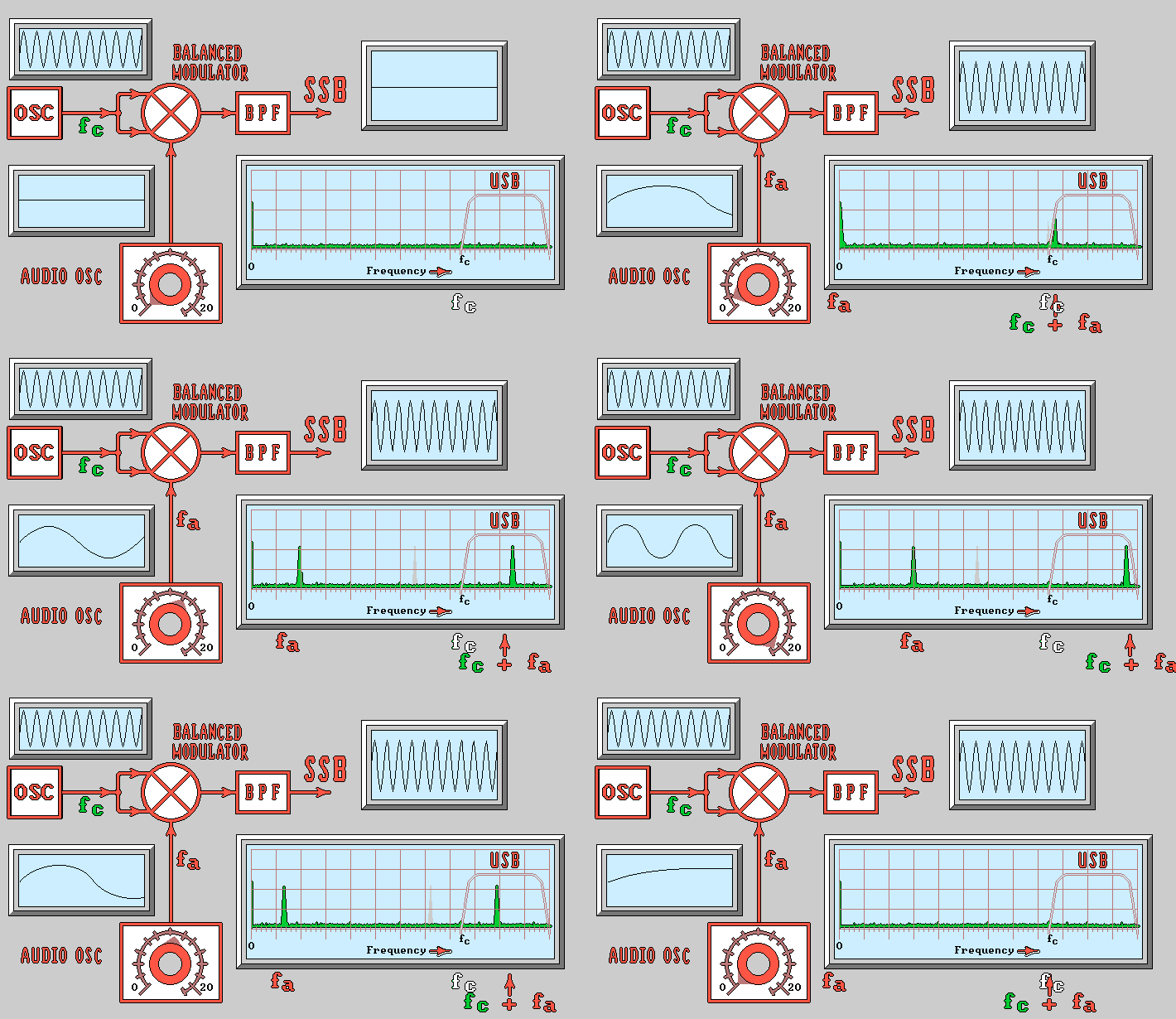
Single sideband modulation single sideband modulation, SSB
Single Side band suppressed Carrier Single Side band suppressed Carrier (SSB/SC) Filter method of producing SSB/SC signals. In a more efficient technique, single sideband, the carrier A radio wave that has been modulated to carry information. and one of the sidebands Radio signals whose frequencies are the sum and difference of the original Radio Frequency and Audio Frequency signals. are suppressed. Only the remaining sideband, either upper or lower, is transmitted. An SSB single sideband signal needs only half the bandwidth of an AM Amplitude Modulation signal and is produced only when a modulating signal is present. Thus, SSB systems are more efficient both in the use of the spectrum, which must accommodate many users, and of transmitter power. Almost all of the transmitted power goes into the information-carrying sideband
SSB

Home | Site Map | Email: support[at]karadimov.info

Last updated on: 2026-06-24 | Copyright © 2011-2021 Educypedia.

https://educypedia.org


Powered by ITCom Solutions