| |
Nuclear power plants and nuclear energy
A nuclear power plant generates electricity using the heat released by nuclear fission, the splitting of heavy atomic nuclei. The fuel is most often uranium, whose nuclei can be split when struck by a neutron. Each fission releases energy and additional neutrons, which can split further nuclei in a self-sustaining chain reaction. The energy appears as heat, which the plant uses to make steam in much the same way a fossil-fuel station burns coal or gas.
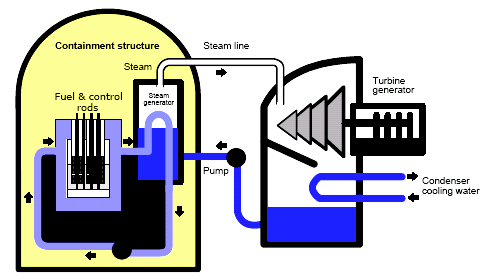
The reactor is the heart of the plant. It contains the fuel, a moderator that slows neutrons so they can sustain the reaction in many common designs, and control rods made of neutron-absorbing material that are inserted or withdrawn to regulate the rate of fission. Coolant circulating through the core carries heat away; this heat boils water into steam, the steam spins a turbine connected to a generator, and the generator produces electricity. The steam is then condensed and returned, completing the cycle.
Nuclear power supplies a significant share of electricity in many countries and produces very little carbon dioxide during operation, which is a major reason for continued interest in it. Its drawbacks include the long-lived radioactive waste that must be safely stored, the high cost and complexity of building plants, and the need for strict safety measures to contain radioactive material. Multiple layers of containment and backup cooling are designed to prevent the release of radiation even if equipment fails.
Frequently asked questions
- How does a nuclear power plant make electricity?
- Nuclear fission heats water into steam, the steam drives a turbine connected to a generator, and the generator produces electricity.
- What are control rods for?
- They are made of neutron-absorbing material and are moved in or out of the reactor core to speed up, slow down or stop the chain reaction.
- Does nuclear power emit carbon dioxide?
- It releases very little during operation, though its main challenges are radioactive waste storage, high construction costs and safety.
|
|
Nuclear Powerplants  related subjects: Nuclear science
 |
|
Basics of Nuclear Chemistry
Nuclear Structure, Radioactivity, Alpha Decay, Beta Decay, Gamma Decay,
Half-Life, Reactions, Fusion, Fission, Cosmic Rays |
|
Belgian Nuclear Research
SCK.CEN Belgian Nuclear Research |
|
Boiling Water Reactor
(BWR) |
| Chernobyl:
ten years on radiological and health impact |
|
Cooling Towers What are cooling towers? pdf file |
|
Cooling Tower
Animation |
|
CrossFire Fusion Reactor The Magnetic and Electrostatic Nuclear Fusion
Reactor, or simply CrossFire Fusor, is a nuclear fusion reactor designed by
Moacir L. Ferreira Jr. for confining and fusing light atomic nucleus at
significant rates, in order to produce enormous quantities of energy without
pollution and no neutron hazards. |
| EDF energy
British energy, nuclear power, electricity supply, nuclear electric, reactor,
advanced gas - cooled reactor, fission, electricity pool, nuclear energy, environment, global warming, acid rain |
|
Electrical
power plant nuclear, fossil, and solar energy sources. Analysis and design of
steam supply systems, electrical generating systems, and auxiliary systems.
Power plant efficiency and operation |
|
Elektrische energiesystemen in Dutch, pdf file |
|
Energy systems Nuclear Physics: Fission and Fusion, Light Water,
Reactors and Advances Breeder, Reactors and Fusion Energy, Nuclear Waste
Disposal |
|
GAS-COOLED FAST REACTOR SYSTEM pdf file |
|
Glossary of
nuclear terms |
|
INSC International
Nuclear Safety Center |
|
International nuclear power
plants There are currently approximately 437 nuclear power reactors in
operation in over 25 countries around the world, with a total output of some
350,000 megawatts. An additional 36 reactors (27,000 MWe) are currently
under construction, ... |
| Nuclear
energy FAQ discusses nuclear energy as a part of a more general discussion
of why human material progress is sustainable and should be sustained |
|
Nuclear Power Plant Fuel
Nuclear power plants do not burn any fuel. Instead, they use uranium fuel,
consisting of solid ceramic pellets, to produce electricity through a process
called fission |
|
Nuclear Reactor
Technology How it works, Reactor types, Classifications, Classification by
type of nuclear reaction, Classification by moderator material, Classification
by coolant, Classification by generation, Classification by phase of fuel,
Classification by use, Current technologies, Advanced reactors, Generation IV
reactors, Generation V+ reactors, Fusion reactors |
|
Nuclear Power -
energy from splitting Uranium atoms Nuclear power is generated using
Uranium, which is a metal mined in various parts of the world |
|
Nuclear Power Plant Control The Nuclear Power Plant (Demonstration) |
| Nuclear power
plants around the world Basic Process, Reactor Construction, Coolants,
Fuel Construction, Spent Fuel Decay - Trends, Comparisons-power generation,
Radwaste-Lo & Hi Level, Low Level Waste Considerations, High Level Waste
Considerations, Xenon 135 - An Intro to Neutron Poisons |
| Nuclear power plant
databases |
|
Nuclear Power Plant Operations The major difference between nuclear power
plants and fossil fuel power plants is that nuclear plants use the process of
fission to make steam instead of burning gas, coal or other fossil fuels. The
fission process and how nuclear power plants operate will be discussed in this
section |
| Nuclear
power plants in America a critical approach |
| Nuclear Power
Reactors Most nuclear electricity is generated using just two kinds of
reactors which were developed in the 1950s and improved since, ... |
|
Nuclear Power Reactors
and Uranium Requirements World Nuclear Power Reactors 2006-07 and Uranium
Requirements |
|
Nuclear
reactors how nuclear reactors work, NRC Strategic Plan (Reactor Section),
NRR Task Action Plans, Spent Fuel Storage, Spent Fuel Transportation, High-Level
Waste Disposal, Nuclear Security and Safeguards, Decommissioning of Nuclear
Facilities, Quality Assurance for Nuclear Power Plants |
|
Parts of the nuclear reactor |
|
Pressurized Water Reactor
Power Plant pdf file |
|
Pressurized Water
Reactor (PWR) |
|
Pressurized Water
Reactors (PWR) PWRs keep water under pressure so that it heats, but does not
boil. Water from the reactor and the water in the steam generator that is turned
into steam never mix. In this way, most of the radioactivity stays in the
reactor area |
|
Pressurized
Water Reactor (PWR) Systems pdf file |
|
Pressurized Water Reactors pdf file |
|
Types of Radioactivity |
|
Understanding
nuclear Different types of nuclear power, Fission, Uranium Radiation and
Radioactivity, Plutonium Sources of Radiation, Fuel rods and control rods, How a
PWR power station works, Reprocessing, How an AGR power station works |
|
Uranium Radiation Properties |
|
Virtual power plant tour
Have you ever wondered how electricity is generated at a power plant? This
virtual power plant tour shows you how it's done, from start to finish, by
taking you on a simulated tour. Using sound, animation, video and games to show
you how electricity is produced, just as if you were there -- letting you visit
a power plant without ever leaving your home |
|
|
 |
|
|
Home
|
Site Map
|
Email: support[at]karadimov.info
Last updated on:
2026-06-24
|
Copyright © 2011-2021 Educypedia.
https://educypedia.org
|
|
| |
|