| |
Water Wheels and Hydropower
A water wheel is a machine that converts the energy of moving or falling water into rotary mechanical motion. Water possesses energy by virtue of its position and its flow: water held at a height has potential energy, and as it falls or runs downhill that energy becomes kinetic energy of motion. A water wheel intercepts this moving water so that it pushes against blades or buckets around the rim, turning the wheel and producing useful work, such as grinding grain or driving machinery.
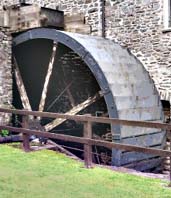
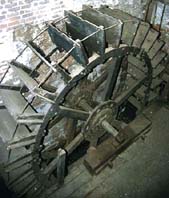
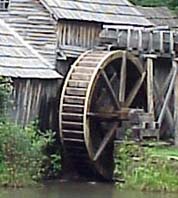
Several designs developed according to the available flow and drop. In an overshot wheel, water is delivered to the top so that its weight in the buckets turns the wheel, making efficient use of a high fall. In an undershot wheel, the lower blades dip into a stream and are pushed by its current, suited to a fast flow with little drop, while breast wheels and middle-shot wheels take water at an intermediate height. For centuries water wheels were a principal source of mechanical power for mills and early industry, before steam and electric power.
The same principle underlies modern hydroelectric power, where flowing water spins a turbine, a more efficient successor to the water wheel, which drives a generator to produce electricity. Dams raise the water level to increase the available fall, and tidal schemes harness the rise and fall of the sea. Because the water is replenished by rainfall and the natural water cycle, hydropower is regarded as a renewable source of energy.
Frequently asked questions
- How does a water wheel work?
- Moving or falling water pushes against blades or buckets around the wheel's rim, turning it. This converts the water's energy into rotary motion that can drive machinery.
- What is the difference between an overshot and an undershot wheel?
- An overshot wheel takes water at the top so its weight turns the wheel, suiting a high fall; an undershot wheel is pushed by a current striking its lower blades, suiting a fast flow with little drop.
- Is hydropower renewable?
- Yes. The water is continually replenished by rainfall and the natural water cycle, so the energy source is not used up.
|
|
Water Wheels  related subjects: Environment: Energy
 |
|
Breast shot
water wheel breast shot water wheel, middle-shot (or breast-shot) water wheel |
|
Breast wheels
breast wheel sizing |
|
GUIDE TO UK MINI-HYDRO
DEVELOPMENTS This Guide is designed to assist anyone in the UK who is
planning to develop a small-scale hydro-electric scheme. It has been prepared by
the British Hydropower Association in order to support and encourage new
developments in this sector, pdf file,
a tip |
|
History of
Water Machines Water wheels, Water turbines, Other water engines, Systematic
research on water engines, Piston pumps, Archimedian screws, Other types of
pumps, The Hydrovolve engine |
|
Hydro
Power Micro Hydropower (from hydro meaning water and micro meaning small
scale) refers to electrical energy that comes from the force of moving water
used to power a household or small village, pdf file |
|
Hydro Power Calculator
A very small script that will calculate the theoretical potential hydropower of
a certain stream.If Discharge Carrying Capacity(cubic meter/sec) of the
stream,available Head(meter) and specific weight of water is given(kg/cubic
meter), the calculator will calculate the potential hydropower(P) of the stream
in m kg/sec |
|
Hydro turbines
All hydro turbines convert the energy from falling water into rotating shaft
power, ....,
Water turbine reaction turbines, Francis turbine, Kaplan turbine,
Propeller, Bulb Tyson turbine, water wheel turbine, impulse turbines, Pelton
impuls turbine, Turgo impulse turbine, Michell-Banki turbine (also known as the
Crossflow or Ossberger turbine) |
|
Pelton
Performance characteristics of a Pelton Turbine Performance characteristics
of a Pelton Turbine, pdf file |
|
Pelton
Turbine Pelton Turbine,
en Français |
|
Pelton
Turbine Experiment Pelton Turbine Experiment, pdf file |
|
Pelton wheel
The Pelton wheel is among the most efficient types of water turbines. It was
invented by Lester Allan Pelton (1829–1908) in the 1870s. The Pelton wheel
extract energy from the impulse (momentum) of moving water, as opposed to its
weight like traditional overshot water wheel |
|
Pelton wheel Pelton wheel, pdf file |
|
Pelton Wheel
Hydraulic Turbine pdf file |
|
Roues hydrauliques
en Français |
|
Rediscovering the Waterwheel |
|
Turbines
Water under pressure contains energy. Turbines convert the energy in water into
rotating mechanical energy. Impulse turbines convert the kinetic energy of a jet
of water to mechanical energy. Reaction turbines convert potential energy in
pressurized water to mechanical energy, pdf file |
|
Undershot Water Wheel Full details on how to construct the undershot water
wheel |
|
Water
Energy The Water Wheel, Types Of Water Wheels, The History Of Water Wheels,
The Watermill, Hydro Electricity, Hydro Turbines, |
|
Water Measurement
Manual Basic Principles of Water Measurement, pdf file |
|
Watermolens in Vlaanderen pdf file |
|
Water powered generators
waterwheel powered generator, water turbine |
|
Waterpowered sawmills |
|
Water Turbines Simply Explained pdf file |
|
Waterwheel
the efficiency of overshot and undershot waterwheels, Renewable Energy |
|
Waterwheel
animation |
|
Water wheel
animation Overshot wheels |
|
Water wheels
Medieval Europe, Types, Undershot wheel, Breastshot wheel, Overshot wheel,
Backshot wheel, Materials for construction |
|
Water wheels: types
overshot waterwheels, undershot waterwheels, breastwheels, Pitchback waterwheel |
|
Water wheels: types
overshot waterwheels, undershot waterwheels, breastwheels |
|
|
|