|
|
| |
The Physics of Tsunamis
A tsunami is a series of ocean waves, sometimes called a wave train, generated by the sudden displacement of a large volume of seawater. The most common cause is an undersea earthquake along a subduction zone, where the abrupt movement of the sea floor lifts or drops the water above it. Underwater landslides, volcanic eruptions and, more rarely, asteroid impacts can also set off tsunamis. The term comes from Japanese words meaning harbour wave, and tsunamis are also referred to as seismic sea waves.
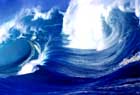
Tsunamis behave very differently from ordinary wind-driven waves. They have extremely long wavelengths, often tens or hundreds of kilometres, and carry energy through the entire depth of the water rather than only near the surface. In the deep open ocean the wave height may be only a metre or less, so it can pass beneath ships almost unnoticed, yet it travels very fast, comparable to the speed of a jet aircraft over the deepest water. The speed depends mainly on water depth, decreasing as the ocean becomes shallower.
As a tsunami approaches the coast and the water shallows, this slowing forces the energy of the long wave into a smaller volume. The wave train piles up, its height grows, and it can surge inland as a fast-moving wall or flood rather than a single curling breaker. Often the sea first withdraws dramatically before the largest waves arrive. Because the open-ocean signal is hard to detect by eye, modern warning systems rely on seismometers and pressure sensors on the sea floor to forecast arrival times for distant coasts.
Frequently asked questions
- Why is a tsunami barely noticeable in the open ocean?
- In deep water a tsunami has a very long wavelength but a small height, so the surface rises only slightly over many kilometres. The wave becomes dangerous only when it slows and grows in shallow coastal water.
- What determines how fast a tsunami travels?
- Tsunami speed depends mainly on water depth. The wave moves fastest over the deep ocean and slows as it enters shallower water near the coast.
- Why does the sea sometimes pull back before a tsunami?
- If the trough of the wave train reaches shore first, the water level drops and the sea retreats unusually far. This withdrawal is a recognised warning that a large wave may follow within minutes.
|
|
Tsunamis  |
|
Alaska tsunami,
Alaska tsunami
animation mov file |
| Aonae tsunami
animation mpg file |
|
Het ontstaan van een tsunami in
Dutch |
|
How tsunamis form How tsunamis form,
All about tsunamis |
|
Rare tsunami photos |
|
Sumatra tsunami animation scientific background on the Indian Ocean
Earthquake and tsunami |
| Surviving a tsunami
contains true stories that illustrate how to survive-and how not to survive-a tsunami. It is meant for people who live, work, or play along
coasts that tsunamis may strike. Such coasts surround most of the Pacific Ocean but also include other areas, such as the shores of the Caribbean,
eastern Canada, and the Mediterranean |
| Tsunamis
the physics of tsunamis |
| Tsunamis
What are Tsunamis,
the phenomenon we call tsunami is a series of large waves of extremely long wavelength and period usually
generated by a violent, impulsive undersea disturbance or activity near the coast or in the ocean |
|
Tsunami |
|
Tsunami animation tsunami Indonesia, animated gif
file |
| Tsunami photographs |
| Tsunami propagation
animation Tsunami propagation
animation |
|
Tsunami
research program Tsunami Forecasting |
| Tsunami:
the great waves the phenomenon we call "tsunami" (soo-NAH-mee) is a series of traveling ocean waves of extremely long
length generated by disturbances associated primarily with earthquakes occurring below or near the ocean floor,
part of Tsunami
library |
|
Tsunami warning system |
|
Tsunami world map |
|
Tsunamis
Sometimes reaching heights of 40 meters (120 ft.) or more, tsunamis are the
most dramatic and destructive of waves. Underwater disturbances, such as
volcanoes, earthquakes and landslides, are the cause of these monster waves,
...killer waves, pdf file |
|
Tsunamis
tsunamis are seismic sea waves. Their name is a Japanese word meaning 'harbour waves'. They are often incorrectly called 'tidal waves'
(rare events linked to tides). A tsunami is a series of travelling ocean waves of extremely long length and period. They are caused by under-sea
events like earthquakes, landslides and volcanic eruptions; or by other natural events such as ocean meteorite impacts, or large landslides into
bays or lakes |
|
Tsunami visualization mov file |
|
Tsunami visualizations
Tsunami visualizations |
| Undersea 2004 Indian Ocean earthquake,
2004 Sumatra earthquake animated giffile |
|
Video
clips of the tsunami |
|
Waveofdestruction.org |
| Waves of
destruction: tsunamis |
|
|
About
|
Site Map |
Email: support[at]karadimov.info
Last updated on:
2026-06-24
|
Copyright © 2011-2021 Educypedia.
https://educypedia.org
|
|
| |
|