|
|
|
|
|
|
| |
Mechanisms and Their Animations
A mechanism is an assembly of connected parts arranged to transmit and transform motion in a controlled way. Mechanical engineering relies on a relatively small set of fundamental mechanisms that, combined, produce the enormous variety of motion seen in machines. Animations are particularly suited to this subject because a mechanism is defined by how its parts move relative to one another, something that a still drawing can only suggest but a moving model makes immediately clear.
Linkages are bars joined at pivots so that moving one part forces the others to follow a definite path; the four-bar linkage and the slider-crank are classic examples, the latter converting rotation into straight-line reciprocating motion. Cams and followers translate the rotation of a shaped profile into a precisely timed up-and-down or in-and-out movement, used to operate valves and to sequence operations in machinery. Each mechanism has a characteristic relationship between its input and output motion.
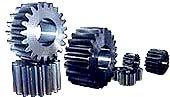
Gears transmit rotation between shafts while changing speed and torque according to the ratio of their tooth counts, and specialised forms such as worm gears provide large reductions in a compact space. The traditional simple machines — the lever, wheel and axle, pulley, inclined plane, wedge and screw — multiply force or change its direction and underlie these more elaborate devices. Studying how these elements move and combine builds the foundation for analysing and designing complete mechanical systems.
Frequently asked questions
- What is a mechanism?
- It is an assembly of connected parts arranged to transmit and transform motion in a controlled and predictable way.
- What does a slider-crank mechanism do?
- It converts rotary motion into straight-line reciprocating motion, or the reverse, as in the link between a crankshaft and a piston.
- How do gears change speed and torque?
- Meshing gears with different numbers of teeth trade speed for torque according to their ratio, so a smaller gear driving a larger one reduces speed and increases torque.
|
|
Mechanisms: animations and java applets  related topic: Physics - motion
 |
|
Blubber system |
|
Cam and follower
Animation of the cam and follower |
|
Cam and follower
system cam shaft animation, could be used to open and close the inlet
and exhaust valves in an engine |
|
Cam and knife
edge follower shows an animation of a rotating cam and knife edge
follower. As the cam rotates the the follower is pushed up |
|
Crank
The crank is used to convert rotary motion to reciprocating or oscillating
motion |
|
Crank and Slider
Mechanism The crank which is the rotating disc, the slider which slides
inside the tube and the connecting rod which joins the parts together |
|
Four-link
mechanisms mechanisms are used to convert motion |
|
Gears
swf file |
|
Gears
Gears are used to change speed in rotational movement |
|
Gears
Evolvent gears |
|
Gears Crown
face gears |
|
Gears
Worm
face gear with cylindrical pinion |
|
Geneva drive Geneva drive or Maltese cross is a mechanism that translates a
continuous rotation into an intermittent rotary motion, Geneva mechanism |
|
Kegeltandwiel avi file, in Dutch |
|
Klok |
|
Krukas in Dutch |
|
Kruk-drijfstang
mechanisme in Dutch |
|
Lever How a Lever-Action Rifle Works |
|
Lever lever: mechanical advantage |
|
Levers
Levers |
|
Levers
Levers |
|
Maltezer kruis |
|
Mechanisms types of motion, levers, cams, rotary cam, cam follower,
linear cams |
|
Mechanisms mechanisms are used to convert motion, types of motion,
rotary motion, linear motion, reciprocating motion, oscillating motion |
|
Mechanisms and
movement mechanisms are used to convert between one type of motion and
another, ..., Crank, Bevel Gear, Cam, Cardan Gear, Chain, Crank, Crank
Slider, Gears, Geneva Stop, Lever, Linkage, Piston, Pulley, Rack and Pinion,
Ratchet, Reciprocator, Quick Return, Wheel, Worm Gear |
|
Mellotron |
|
Nokkenas in Dutch |
|
Pulley shows a small driver pulley pulling round a larger driven pulley.
The rpm (revolutions per minute) of the larger driven pulley wheel will be
less than the smaller driver pulley wheel. The same principle regarding
speed of rotation regarding gears applies to pulley systems as well |
|
Pulley
system pulley system |
|
Pulley
system pulley system |
|
Pulley
system pulley system |
|
Ravigneaux gear set |
|
Riemoverbrenging in Dutch |
|
Tandwielen
rechte vertanding |
| Winding gear how a steam engine was used to power the lift that transported
miners and equipment between the surface and the bottom of the mine shaft |
|
Wormgear
avi file |
|
Worm gear drive |
|
Worm gear drive |
|
Worm gear drive
Worm gear drive |
|
Worm gear drive
Worm gear drive |
|
Worm gear drive
Unlike ordinary gears, the motion is not reversible, a worm can drive a gear
to reduce speed but a gear cannot drive a worm to increase it |
|
|
Home
|
Site Map
|
Email: support[at]karadimov.info
Last updated on:
2026-06-24
|
Copyright © 2011-2021 Educypedia.
https://educypedia.org
|
| |
|
|
| |
|