Educypediathe educational encyclopedia
Science
Automotive
Biology
Biology-anatomy
Biology-animals
Biology-botany
Chemistry
Climate
Geography
Geography-geology
Mathematics
Mechanics
Physics
Physics-Energy
Space
 
Experiments
Chemistry experiments
Energy experiments
Physics Experiments
 
Utilities - Tools
Automotive-animations
Biology-animations
Calculators-online
Chemistry animations
Climate-weather
Energy production
Geography- Geology
Human anatomy
Math-animations
Mechanics-animations
Miscell. - animations
Physics-animations
Science databank
Space-animations
 
Local sitemap
Sitemap


Mechanics and Engineering

Mechanics is the branch of physics concerned with the motion of bodies and the forces that cause or resist that motion. Engineering applies these principles to design machines, structures and systems. Interactive animations are widely used in teaching because many mechanical phenomena — oscillating linkages, rotating shafts, flowing fluids — are easier to grasp when their changing states are shown over time rather than described in static diagrams.

Classical mechanics divides broadly into statics, which studies bodies in equilibrium, and dynamics, which studies bodies in motion. Kinematics describes motion in terms of position, velocity and acceleration without reference to its causes, while kinetics relates motion to the forces and torques acting on a body. Closely related topics include vibration, the periodic motion of elastic systems such as springs and beams, and the analysis of machine elements like cams, cam followers and valve gear that convert one form of motion into another.

Engineering animations often extend into fluid dynamics, the study of liquids and gases in motion, and aerodynamics, which examines air flow around bodies and is investigated experimentally in wind tunnels. Thermodynamics, the study of heat and energy transfer, underlies the operation of engines such as the idealised Carnot engine. Instruments like the manometer measure pressure, while concepts such as strain describe how materials deform under load. Together these subjects form the foundation of mechanical engineering.

Frequently asked questions

What is the difference between kinematics and kinetics?
Kinematics describes how an object moves — its position, velocity and acceleration — without asking why. Kinetics studies the forces and torques that produce that motion.
What is a cam follower?
A cam follower is a machine part that rides against a rotating cam and translates the cam's profile into a controlled reciprocating or oscillating motion, as used in engine valve gear.
Why use animations to study mechanics?
Many mechanical systems change continuously over time, so an animation can show how parts move, interact and transfer energy in ways that a fixed diagram cannot convey.

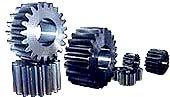


Mechanical engineering: java applets and animations:
Fluid Mechanics Machines Pneumatics
General overview Mechanisms Pumps
  Motion Thermodynamics

Mechanical engineering: motion animations and java applets  related topic: Physics - motion
1D collision - Conservation of Momentum Newton's law of motion, Conservation of Momentum, one dimensional collision problem
2D Collision
Automatic Transmission
Bouncing balls Bouncing balls
Bouncing balls amount of kinetic energy, collision energy, coefficient of restitution
Clock
Clock
Curling
Damped harmonic motion damped harmonic motion applet. This equation describes a damped harmonic oscillator with mass m, damping constant c, and spring constant k
Damped harmonic motion
Damped simple harmonic motion
Dynamic bridge resonance video
Forced Simple Harmonic Motion forced damped simple harmonic oscillator
Free-body Force Diagram applying Newton's second law to a mechanical system
Free Rolling and Circular Motion
Motion: types of motion, rotary motion, linear motion, reciprocating motion, oscillating motion
Motion of a Ping-Pong friction force, acceleration of the ball, torque to the ball
Motion of a Ping-Pong
Mouvement du système à vis sans fin Mouvement du système à vis sans fin avec ressort, en Français
Mouvement du système à vis sans fin Mouvement du système à vis sans fin avec contrepoids, en Français
Mouvement hélicoïdal en Français
One-D motion (displacement, velocity, acceleration) This java applet illustrates relations between displacement, velocity and acceleration for one dimensional motion
Oscillateur mécanique en régime sinusoïdal forcé, Suspension d'un véhicule, ..., en Français
Pendule balistique en Français
Pendulum Pendulum motion
Piano and Player Piano illustrates the components and action of a modern upright piano, describes the player mechanism of a player piano
Piston pellet dynamics application of springs
Poulies en Français
Projectile motion Projectile motion
Projectile Motion and Air Resistance
Projectile Motion with Air Drag Projectile Motion with Air Drag
Racing ball Racing ball
Relative Motion This java applet let you view objects from different frame of reference
Seats
Simple Harmonic Motion (SHM) The uniform circular motion is intimately related to a simple harmonic motion
Simple Harmonic Motion Simple Harmonic Motion applet
Spring Force and Simple Harmonic Motion Hooke's law, Spring Force and Simple Harmonic Motion
Spring Force and Simple Harmonic Motion
Swing door operator
Trebuchet
Watch The escapement of the watch allows energy to be released one tick

Home | Site Map | Email: support[at]karadimov.info

Last updated on: 2026-06-24 | Copyright © 2011-2021 Educypedia.

https://educypedia.org


Powered by ITCom Solutions