|
|
|
|
|
|
| |
Desert Biomes
A desert is a biome defined by very low precipitation, where the amount of water lost through evaporation greatly exceeds the amount that falls as rain. This scarcity of water, rather than heat alone, is the defining feature of a desert, which is why some deserts are hot while others are cold. Deserts cover a large fraction of the Earth's land surface and are often grouped together as drylands. The Sahara in northern Africa is the largest hot desert, and dramatic landscapes such as the Grand Canyon lie within arid regions.
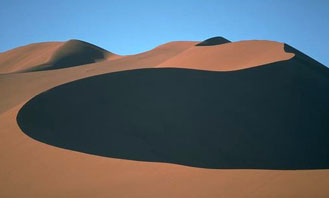
Deserts fall into several types. Subtropical deserts form near the tropics where descending dry air suppresses rainfall. Cool coastal deserts arise along certain shorelines where cold ocean currents limit precipitation. Cold winter deserts experience freezing seasons, and the polar regions are sometimes classed as cold deserts because they receive very little precipitation. Wind and infrequent water shape desert surfaces into features such as sand dunes, rocky plains and dry channels, a field studied as desert geomorphology.
Life in the desert is adapted to conserve water and tolerate extremes. Plants such as cacti and other succulents store water in thick tissues and reduce water loss with small or spine-like leaves, while many desert wildflowers bloom rapidly after rare rains. Desert animals often shelter from the daytime heat, are active at night, and obtain much of their water from food. These adaptations allow surprisingly varied communities to persist despite the harsh climate.
Frequently asked questions
- What defines a desert?
- A desert is defined by very low precipitation and high potential evaporation, so that water is chronically scarce. This can occur in hot regions or in cold ones.
- Are all deserts hot?
- No. Some deserts are hot, but cold winter deserts and the polar regions are also deserts because they receive very little precipitation.
- How do cacti survive in deserts?
- Cacti are succulents that store water in thick stems, have spines instead of broad leaves to reduce water loss, and use shallow, wide-spreading roots to capture rainfall quickly.
|
|
Biomes: deserts: general overview  |
|
Desert biome deserts are places on earth that are characterized by
little vegetation and rain. They are made up of sand or rocks and gravel.
Deserts cover about one-fifth of all the land in the world |
| Deserts:
geology and resources deserts are natural laboratories in which to
study the interactions of wind and sometimes water on the arid surfaces of
planets. They contain valuable mineral deposits that were formed in the arid
environment or that were exposed by erosion. Because deserts are dry, they
are ideal places for human artifacts and fossils to be preserved |
|
Deserts
of our world Deserts of our world |
|
Deserts
of our world the Sahara, Mojave, Sonoran, Chihuahua, Kalahari, Australia, Taklimakan... |
|
Deserts of the world Deserts of the world |
|
Desert photography |
| Desert
directory the desert regions of the American Southwest, deserts, animals , desert life, desert wildflowers, cactus, national parks, desert parks,
desertusa, native american, indians, animal and wildlife, plants, maps,
people |
|
Desert plants, animals,
geology and more |
|
Principal deserts of
the world deserts are arid regions, generally receiving less than ten
inches of precipitation a year, or regions where the potential evaporation
rate is twice as great as the precipitation, subtropical deserts, cool
coastal deserts, cold winter deserts, polar regions |
|
Types of deserts
hot deserts, cold deserts |
|
World's largest
deserts |
|
Biomes: desert topics |
|
Camel of Egypte |
|
Central Washington native plants
photographs of both cordilleran and endemic species |
| Desert
animals printouts deserts cover about one-third of the Earth's land
area. The desert is a harsh environment with very little rainfall and
extreme temperatures. Desert plant life is not abundant; neither is animal
life |
| Desert life in the American Southwest
learn about the desert environment and the unique characteristics that
define the beautiful arid and semi-arid landscapes of the American Southwest |
|
Desertification about 3,6 billion of the
world's 5.2 billion hectares of useful dryland for agriculture has suffered
erosion and soil degradation |
|
Deserts: geology and resources |
|
Desert
plants the undisputed king of the San Felipe desert is the Cardón
cactus. Reaching heights of 60 to 75 feet and weights of 20 to 40 tons,
cardón is the world's largest cactus |
|
Elephant cactus |
| Gobi desert
since ancient times the word 'Gobi' meaning 'desert' in all Ural-Altaic
languages was referred to in literature as shamo |
|
Sand dunes |
|
Signs of
early vegetation appear on the Sahara |
|
Sonoran desert
naturalist the Sonoran desert of Southern Arizona and Northwestern
Mexico is widely known for its beauty and many spectacular life forms. The
abundant cacti and other succulents simply defy the harsh climate with
exuberant biodiversity |
|
Types of deserts deserts are classified by their geographical location
and dominant weather pattern as trade wind, midlatitude, rain shadow,
coastal, monsoon, or polar deserts. Former desert areas presently in nonarid
environments are paleodeserts, and extraterrestrial deserts exist on other
planets |
|
Types of sand dunes |
|
|
 |
|
|
Home
|
Site Map
|
Email: support[at]karadimov.info
Last updated on:
2026-06-24
|
Copyright © 2011-2021 Educypedia.
https://educypedia.org
|
| |
|
|
| |
|