| |
Grassland Biomes
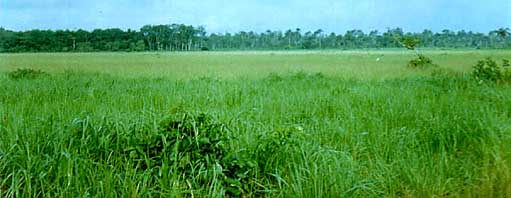
Grasslands are biomes dominated by grasses and other low-growing plants, with few or no trees. They develop in regions where rainfall is too low and irregular to support dense forest but high enough to prevent the land from becoming desert. Periodic fires, grazing by large animals and seasonal drought all help keep grasses dominant by suppressing the growth of trees and shrubs. Grasslands occur on most continents and are known by many regional names.
Ecologists often distinguish two broad kinds. Temperate grasslands, such as the steppe of Eurasia and the prairies of North America, occur in mid-latitudes with cold winters and warm summers. Tropical grasslands, such as the savanna, occur in warmer regions and typically have a pronounced wet and dry season, sometimes dotted with scattered trees. Both types are shaped by their climate and by the cycle of growth and dormancy that follows seasonal rainfall.
Grasslands support distinctive communities of organisms adapted to open country. Grazing mammals feed on the abundant grasses, and these in turn support predators, forming food webs built around the grassland's plant life. Many grassland plants grow from the base of their leaves, allowing them to recover quickly after being grazed or burned. These ecosystems also include relationships with burrowing animals, insects and birds, and they border other biomes such as desert, chaparral and forest, with which they exchange species and conditions.
Frequently asked questions
- What is the difference between steppe and savanna?
- Steppe is a temperate grassland of mid-latitudes with cold winters, while savanna is a tropical grassland, often with scattered trees and a distinct wet and dry season.
- Why don't trees take over grasslands?
- Low and irregular rainfall, periodic fires, drought and grazing by large animals all limit tree growth, allowing fast-recovering grasses to dominate instead.
- How do grasses survive grazing?
- Many grasses grow from the base of their leaves rather than the tip, so they can regrow quickly after being eaten or burned, unlike many broad-leaved plants.
|
|
Grasslands of the World
 visit also Environment
 |
|
African Savanna African Savanna |
|
Grassland |
|
Grassland
animals grasslands lack the trees and heavy bush to hide many creatures. Because of the open
landscape and the widely spaced trees, grasslands are home to large herds of
grazing mammals such as the zebra and bison. Annual rainfall in the
grasslands is between 10 to 30 inches, there is a seasonal drought every
year |
|
Grassland biome
grasslands are characterized as lands dominated by
grasses rather than large shrubs or trees. Savanna is grassland with
scattered individual trees. Temperate grasslands are characterized as having
grasses as the dominant vegetation. Trees and large shrubs are absent.
Steppes are dry areas of grassland with hot summers and cold winters |
|
Grassland biome
The climate for grasslands is basically dry. Precipitation usually does not
exceed 100 cm per year, with a minimum near 20 cm per year. Also, grasslands
tend to be in temperate to subtropical areas, often with cold winters and
hot summers, ... |
|
Grassland of the
world |
| Grasslands
grasslands are characterized as lands dominated by grasses rather than large
shrubs or trees. In the Miocene and Pliocene Epochs, which spanned a period
of about 25 million years, mountains rose in western North America and
created a continental climate favorable to grasslands. Ancient forests
declined and grasslands became widespread |
|
Grasslands |
| Grassland
animal printouts a grassland is a grassy, windy, partly-dry biome, a sea of grass. Almost one-fourth of the Earth's land area is grassland. In
many areas, grasslands separate forests from deserts
|
|
Grasslands Biome
What Is a Grassland Like? Grasslands of the World, Grasslands of the USA,
Grasslands Animals |
|
Grasslands of the World Grasslands of the World,
map |
|
Grasslands of the World
Rotating globe showing global grassland coverage. Data obtained from
Terra/MODIS landcover isolating grasslands, woody savannas, savannas, and
wetlands (all seen in green) |
|
Grasslands of the
world
map, pdf file |
|
Grasslands of the
world |
| National
grasslands |
|
Neotropical
grasslands: habitat, plants and animals |
| Pantanal
is not a real swamp though; it's a floodplain
|
| Pantanal
of Brazil, Bolivia and Paraguay
|
|
Prairie enthusiasts dedicated to the inventory, promotion, restoration,
and protection of natural prairies in Wisconsin, prairie, wildflower,
tallgrass, grass, tallgrass prairie, environment, nature, ecology, habitat,
plant, ecosystem, plant community, prairie restoration |
|
The
grassland biome Grasslands are characterized as lands dominated by
grasses rather than large shrubs or trees |
|
 |
|
|
Home
|
Site Map
|
Email: support[at]karadimov.info
Last updated on:
2026-06-24
|
Copyright © 2011-2021 Educypedia.
https://educypedia.org
|
| |
|
|