| |
Oceans and Seas
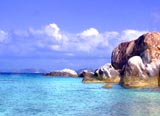
The oceans are the vast bodies of salt water that cover most of the Earth's surface and together form a single connected world ocean, conventionally divided into the Pacific, Atlantic, Indian, Southern and Arctic oceans. A sea is generally a smaller area of salt water, often partly enclosed by land or forming part of an ocean. Lakes, by contrast, are inland bodies of water, usually fresh. Together these waters dominate the planet's surface and play a central role in its climate and life.
Seawater is salty because rivers and other processes have carried dissolved minerals into the oceans over immense spans of time. The oceans are layered and constantly moving, driven by winds, tides, temperature and differences in salt content, which produce currents that circulate water and heat around the globe. Physical oceanography studies these movements and properties, while marine ecology examines the organisms that inhabit the sea. On the deep ocean floor, hydrothermal vents, including dark mineral-rich plumes called black smokers, support unusual communities that draw energy from chemicals rather than sunlight, a process of interest to geochemistry.
Oceans and seas teem with life, from microscopic plankton to the largest animals on Earth, organised into ecosystems that depend on light, nutrients and temperature. They also regulate climate by absorbing heat and carbon dioxide, generate much of the planet's oxygen through marine plants and algae, and sustain fisheries and trade. Many vulnerable marine areas are now protected as underwater sanctuaries to conserve their biodiversity.
Frequently asked questions
- What is the difference between an ocean and a sea?
- Oceans are the largest bodies of salt water and form the connected world ocean, while seas are smaller, often partly enclosed by land or forming part of an ocean.
- Why is the sea salty?
- Rivers and weathering carry dissolved minerals, including salts, into the oceans over long periods. As water evaporates the salts remain, so they accumulate in seawater.
- What is physical oceanography?
- It is the branch of ocean science that studies the physical properties and movements of seawater, such as currents, tides, temperature, salinity and waves.
|
|
Oceans,
lakes and seas
 visit also Environment
 |
| Canada:
great lakes |
|
Deep
ocean floor Exploring the deep ocean floor: Hot springs and strange
creatures |
| De
Noordzee in Dutch |
|
Exploring Earth
from Space- Oceans |
|
Hotspots under the Earth the vast majority of earthquakes and volcanic
eruptions occur near plate boundaries, but there are some exceptions |
|
Life in the deep
This site highlights some of the latest discoveries about seafloor volcanoes
and vents, and how they create environments for extraordinary lifeforms |
| Marine
ecosystems shorelines, temperate oceans, tropical oceans |
| Oceans
& oceanography
the major goals of oceanography are to understand the geologic and geochemical processes
involved in the evolution and alteration of the ocean and its basin, to evaluate the interaction of the ocean and the atmosphere so that greater
knowledge of climatic variations can be attained, and to describe how the biological productivity in the sea is controlled |
| Ocean color viewed from space the "color" of the ocean is determined by the interactions of incident light with substances or particles present in the
water. The most significant constituents are free-floating photosynthetic organisms (phytoplankton) and inorganic particulates |
| Ocean
Explorer Site ocean explorer, ocean exploration, expeditions, discovery,
ocean science, oceanography |
|
Oceanographic utilities Oceanographic utilities |
|
Oceanography |
| Oceanography: physical oceanography physical oceanography |
| Oceanography: physical oceanography
an overview of the processes which determine the state of the atmosphere and the ocean and their dynamics, planetary environment and the governing cycles
and processes which control its behaviour, the processes and phenomena which directly affect the nature and behaviour of the "fluid" Earth, namely, the
composition of the atmosphere and of seawater, the balance of forces which controls winds, ocean currents and waves in both media, and their role in
climate, the natural atmospheric and oceanic processes |
|
Ocean world oceanography, ocean world, physical oceanography, fisheries, weather satellites, science, coral reef, iceage, iceberg, forams,
foramferia, currents el nino, waves marine |
|
Physical oceanography |
|
Savage Seas |
| The sea a tip for kids (also the sky) |
| The sea
a source of information about the four oceans, hurricanes, currents and waves, and sea life, sea facts, oceans maps, tides, sea creatures |
|
Tropical oceans & coral reefs a reef is a coral community consisting of several thousand organisms living together. Although it looks like a
dormant underwater bush, the reef is very much alive. Reefs grow very slowly over time. In fact, an inch of coral reef takes nearly 100 years to grow |
| Water
world what would happen if the ice sheets melted? |
|
What
Indicators Are Used To Describe Coasts and Oceans? coastal wetlands,
coral reefs, seagrasses, and shellfish beds |
|
|
 |
|
|
Home
|
Site Map
|
Email: support[at]karadimov.info
Last updated on:
2026-06-24
|
Copyright © 2011-2021 Educypedia.
https://educypedia.org
|
| |
|
|